

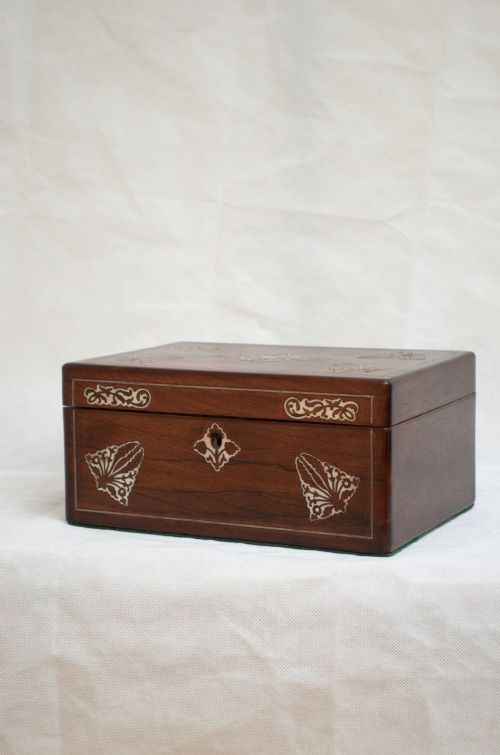


Dark Rosewood Keepsake Box
These dark rosewood keepsake box examples offer practical storage finished in rich, dense timber.
Dark Rosewood Keepsake Box
A dark rosewood keepsake box provides secure storage for small valuables, letters, and personal items. These pieces frequently appear from the Regency, Victorian, and Georgian eras, often taking the form of fitted jewellery boxes, vanity cases, and tea caddies.
Buyers looking for a dark rosewood keepsake box will encounter various traditional formats on this page, including sarcophagus shapes, campaign styles, and compartmented caskets. Many examples incorporate lift-out trays, compartmentalised interiors, and original fabric linings designed to protect delicate contents.
The objects stem predominantly from 19th-century English workshops, though Chinese Republic period pieces also emerge in hardwood with contrasting inlay. These containers combine utility with decorative cabinet-making, serving as desktop accessories or dressing table storage.
How they were made
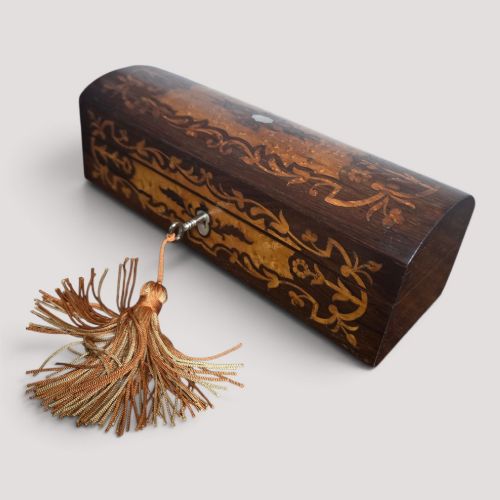
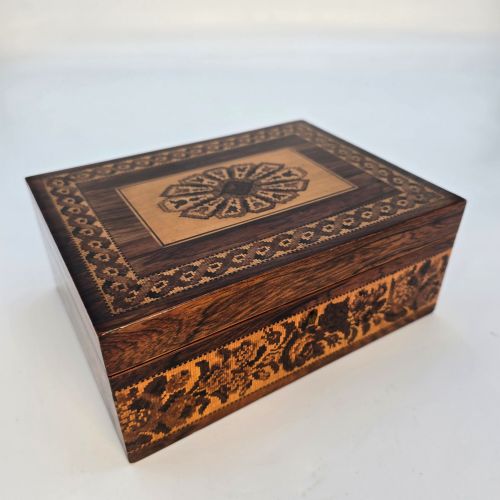
Cabinet-makers constructed these containers using solid or veneered rosewood over secondary timbers, exploiting the dense grain and deep colour of the wood. Surfaces frequently receive elaborate embellishment through contrasting boxwood stringing, geometric parquetry, and detailed Tunbridge Ware marquetry.
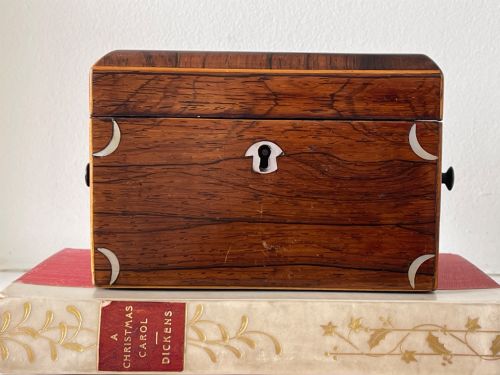
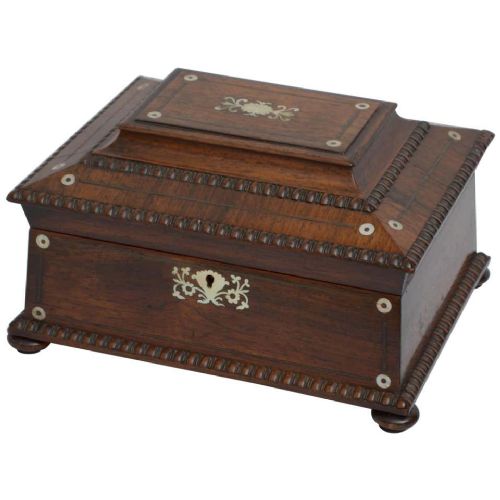
Many examples integrate polished brass banding, escutcheons, and inlaid mother-of-pearl motifs set flush into the lid and front panels. Interiors utilise fitted wooden partitions, velvet or silk linings, and occasionally secret drawers operated by concealed latches.
Dark Rosewood Keepsake Box Retail Price Guide 2026
Typical asking prices for dark rosewood keepsake box among the pieces listed under this phrase on Sellingantiques today, from the lower quarter to the upper quarter. They describe what is for sale here now, not the wider market.
Listings on this page span the Georgian, Regency, and Victorian periods, alongside early twentieth-century Chinese hardwood pieces.
What varies in quality
The standard of execution depends heavily on the precision of the timber preparation and the intricacy of the decorative inlays. Superior examples display tightly fitted joints, perfectly aligned brass stringing, and elaborate marquetry work that remains entirely intact.
Internal organisation also dictates the grade of the piece, with top-tier containers featuring complete lift-out trays, original silk or velvet linings, and working locks with matching keys. The depth of grain figure in the rosewood itself separates standard production boxes from exceptional cabinet work.
Edmund Nye
The Dark Rosewood Keepsake Box Glossary
- Tunbridge Ware
- A form of mosaic woodwork produced in Kent using thousands of tiny coloured wood blocks to create pictorial or geometric designs. This technique appears frequently on nineteenth-century box lids.
- Sarcophagus
- A box shape featuring a domed or sloping lid resting on a rectangular base, popular during the Regency and William IV periods. These containers often rest on bun feet or carved wooden paw supports.
- Parquetry
- Geometric mosaic woodwork formed by fitting small veneer tiles together to create repeating patterns. It differs from marquetry by sticking strictly to geometric arrangements rather than figurative scenes.
- Campaign Box
- A portable container designed for travel, featuring recessed brass handles and reinforced corners to withstand frequent transit. These pieces date primarily to the early nineteenth century.
- Escutcheon
- A protective plate surrounding a keyhole, usually fashioned from brass or mother-of-pearl to prevent the surrounding wood from sustaining wear.
Dark Rosewood Keepsake Box: Frequently Asked Questions
What were dark rosewood keepsake boxes used for?
These containers served to safeguard jewellery, correspondence, tea leaves, and small personal valuables. Wealthy households utilised them on dressing tables, writing desks, and drawing-room side tables.
Inside, compartmentalised trays and velvet linings kept delicate items separated and protected from dust and damage. Many boxes functioned as portable storage for travel or daily household administration.
How do I date a rosewood box?
Dating relies on examining the construction methods, hardware styles, and decorative motifs present on the piece. Regency examples often feature sarcophagus silhouettes and brass lion-paw feet, while Victorian versions frequently incorporate mother-of-pearl inlay or Tunbridge Ware.
Internal fittings, screw types, and lock mechanisms also provide chronological clues. Simpler dovetailing and hand-cut elements generally point towards earlier nineteenth-century manufacture.
How do I care for antique rosewood?
Keep wooden surfaces away from direct sunlight and extreme humidity fluctuations to prevent timber splitting or veneer lifting. Regular dusting with a soft, dry cloth maintains the finish without chemical buildup.
Avoid placing damp items directly onto the internal fabric or wood surfaces. Conditioning oils should be used sparingly and only if the timber appears dry.
What is the difference between marquetry and parquetry?
Marquetry involves cutting various tinted veneers to form pictorial scenes, floral sprays, or elaborate scrollwork. Artisans assemble these pieces like a puzzle before gluing them to the box lid.
Parquetry relies strictly on geometric patterns, such as cubes, chequers, or stripes, constructed from small wood blocks. Both techniques showcase the natural colour variations of exotic timbers.