




Dark Oak Aneroid Barometer
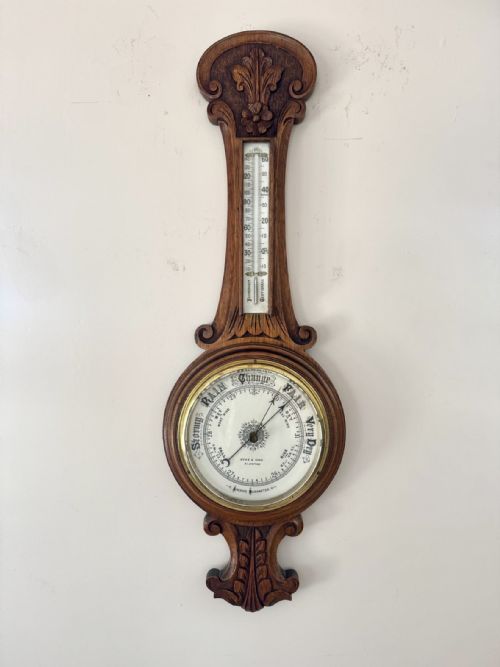
These dark oak aneroid barometers and barographs combine practical weather tracking with heavy carved woodwork, originating mostly from the Victorian and Edwardian eras.
Dark Oak Aneroid Barometer
A dark oak aneroid barometer measures atmospheric pressure using a sealed metal capsule rather than liquid mercury, housed within a rich wooden wall case. When you search for a dark oak aneroid barometer, you encounter pieces spanning from the mid-nineteenth century through the Edwardian period and into the nineteen-twenties.
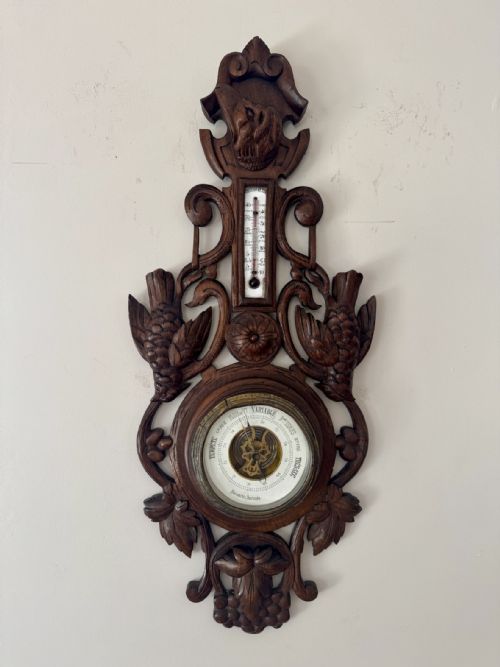
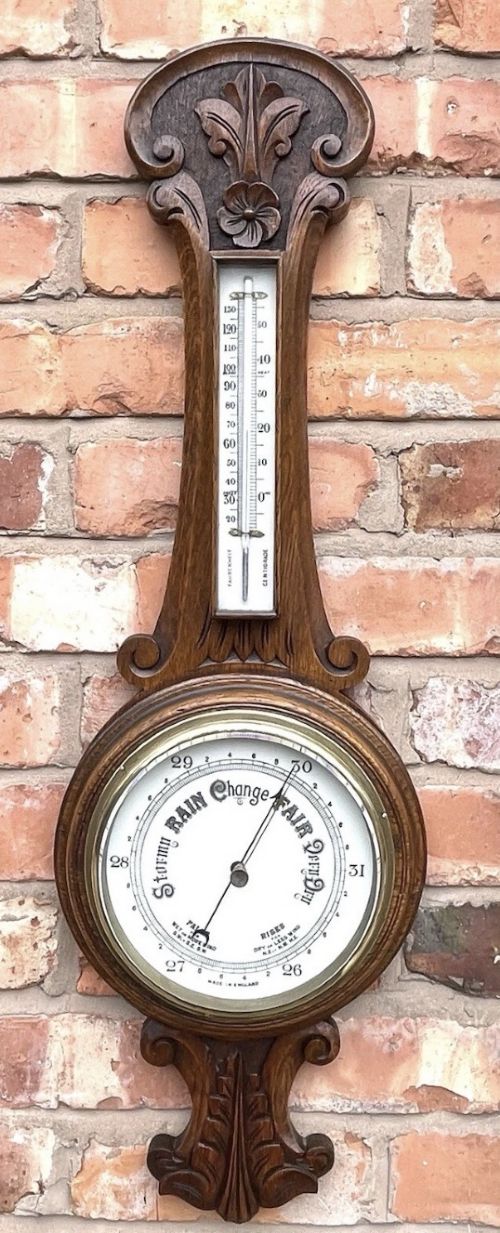
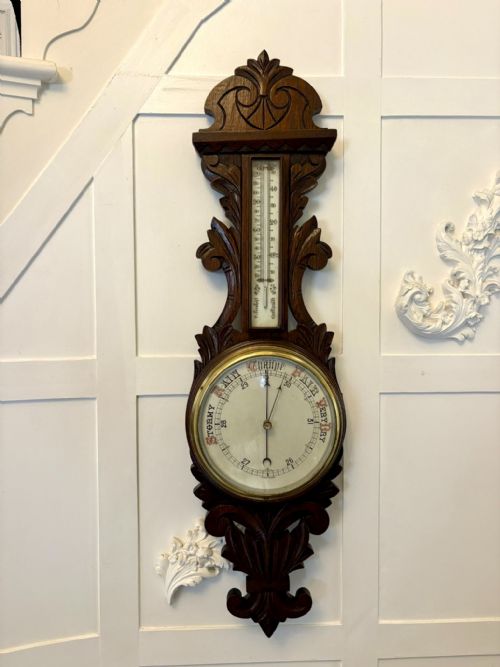
The selections here range from simple circular wall instruments to elaborate banjo barometers incorporating thermometers and carved motifs of birds. Alongside standard wall hung examples, related forms appear such as oak cased barographs, combination clock barometers, and even hatstands incorporating barometer dials.
Makers and retailers like Negretti & Zambra, James Pitkin, and Hyde & Sons Sleaford stamped their names on dials and plates during the Victorian and Edwardian decades. Regional variations include Black Forest interpretations featuring deeply carved Lindenwood elements alongside the staple oak cases.
Materials and construction
The primary housing relies on solid oak and carved wood, frequently shaped into banjo profiles or circular frames, occasionally complemented by walnut or lindenwood details. Bevelled glass protects the delicate dials, while brass bezels frame the instruments and secure the internal aneroid mechanisms.
Carving defines the Victorian and Edwardian aesthetic, with artisans working the timber to depict naturalistic subjects like birds or foliage. Ceramic and porcelain dials appear alongside metal faces, offering contrasting white backgrounds for legible black numerals and meteorological scales.
Listings feature oak, walnut, and lindenwood cases paired with brass, glass, ceramic, and porcelain components across Victorian and Edwardian periods.
What separates examples
The depth and crispness of the wood carving dictate much of the visual merit, distinguishing mass-produced commercial cases from bespoke artisan work. Sharp definition in carved foliage and animal subjects shows the hand of a skilled woodcarver.
The presence of supplementary instruments, such as integrated thermometers, barograph chart drawers, or matching clock faces, elevates the utility and complexity of the piece. Signed dials from notable scientific instrument makers carry greater historical interest than unsigned retailer stock.
Hyde & Sons Sleaford·Negretti & Zambra·Aitchison·James Pitkin London
The Dark Oak Aneroid Barometer Glossary
- Aneroid barometer
- An instrument measuring atmospheric pressure without liquids, using a flexible metal vacuum capsule that expands or contracts with weather changes.
- Banjo barometer
- A tall, symmetrically shaped wall barometer resembling a stringed musical instrument, usually housing a thermometer and humidity dial below the main dial.
- Barograph
- A self-recording meteorological instrument that plots barometric pressure variations over a week onto a rotating drum holding a paper chart.
- Bezel
- The metal ring, commonly made of brass, that holds the protective glass face securely over the barometer dial.
- Black Forest style
- A nineteenth century decorative tradition known for naturalistic, deeply carved wooden animal and plant motifs.
Dark Oak Aneroid Barometer: Frequently Asked Questions
How do I read an aneroid barometer?
Read the main pointer against the pressure scale marked in inches of mercury or millibars. Setting the manually adjustable brass index needle over the main pointer allows you to track whether pressure rises or falls over the course of the day.
Falling pressure typically indicates approaching unsettled weather or rain, while rising pressure suggests improving conditions. Subsidiary dials often show weather predictions like storm, rain, change, fair, and very dry.
Where should I hang a wall barometer?
Hang your barometer on an interior wall away from direct sunlight, central heating radiators, and draughty doors. Fluctuating temperatures can affect the internal metal capsule and lead to inaccurate readings.
Ensure the wall fixing is secure, particularly with larger carved oak banjo models that carry substantial weight. Placing the instrument at eye level makes daily checking straightforward.
How do I date a Victorian oak barometer?
Examine the style of the wood carving, the typography on the dial, and any maker signatures present on the face or mechanism. Mid-nineteenth century pieces often feature heavy, deep relief carving, while Edwardian versions tend toward lighter framing.
Papers drawer locks, backboards, and the type of glass used also provide clues to the manufacturing decade. Patent dates printed on the dial face offer a reliable earliest possible year of creation.
Do antique barometers still work?
Many antique aneroid barometers remain operational if their internal mechanisms escaped moisture damage or rough handling. Gentle tapping on the glass often helps settle the linkage if the pointer feels sluggish.
Professional calibration against a known local pressure reading can restore accuracy to working movements. Even if the mechanism no longer responds to weather changes, the carved oak case retains its decorative appeal.