
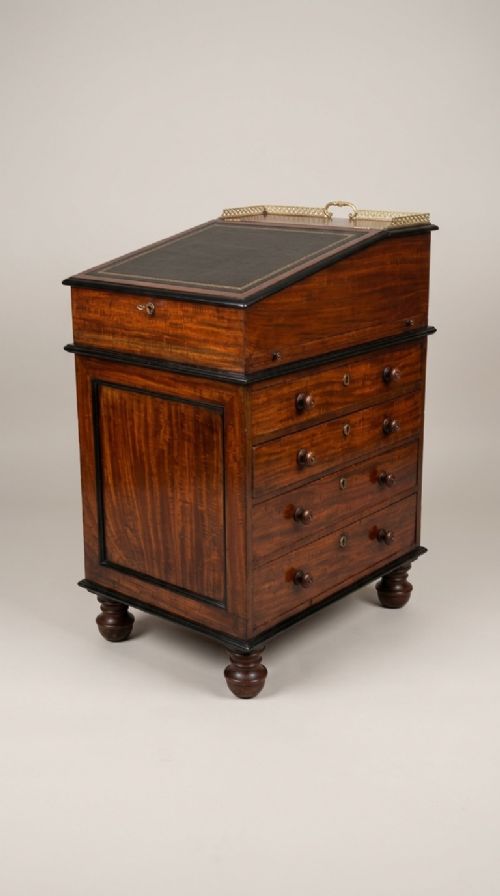

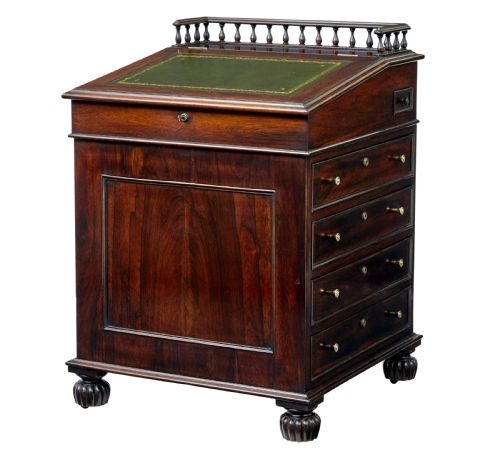


Dark Mahogany Davenport
These dark mahogany davenports are compact writing desks combining fitted stationery compartments with secure drawer storage for the domestic study.
Dark Mahogany Davenport
A dark mahogany davenport is a small writing desk developed during the Georgian, Regency, and Victorian periods for domestic correspondence and record keeping. These pieces typically feature a sloping writing surface above a pedestal of drawers, combining a compact footprint with practical internal storage.
Buyers browsing dark mahogany davenports will most frequently encounter nineteenth-century examples, spanning Early Victorian, William IV, and George IV styles alongside Regency and Edwardian interpretations. Variations include pieces with lyre supports, tambour shutters, or carved Anglo-Indian motifs executed in hardwood and mahogany.
How they were made
Makers constructed these desks from dense tropical hardwoods, selecting figured mahogany for primary exterior surfaces and incorporating secondary timbers for interior drawer linings. Many surfaces received patinated leather writing inserts set into the sloping desktop.
Brass fittings such as casters, gallery rails, and drawer pulls appeared alongside ebonised wood details to accent the dark timber. Cabinetmakers also employed fine turning, carving, and pegged joinery to assemble the structural pedestal and superstructure.
Several examples include original keys for securing the side drawers from the lid.
What varies in quality
Quality in these desks rests upon the choice of timber and the precision of the cabinetwork, particularly where the stationery compartment joins the lower cabinet. Pieces attributed to workshops like Gillows demonstrate superior timber selection and refined proportion compared to standard commercial production.
The sophistication of the internal mechanism, such as side-loading drawers locking via the top lid, distinguishes higher-grade examples. Original brass hardware, intact leather inserts, and well-executed carving elevate the standing of a desk.
Gillows
The Dark Mahogany Davenport Glossary
- Davenport
- A compact pedestal desk featuring a sloping, hinged writing surface and a bank of drawers opening to the side. The form originated in the late eighteenth century and remained popular through the Victorian era.
- Pedestal
- A support structure beneath the desk containing a vertical column of drawers. In davenports, this bank usually sits to one side to allow knee space for the seated writer.
- Ebonised
- Wood treated with a dark finish to imitate ebony. Cabinetmakers applied this technique to mouldings and decorative accents to create contrast against the reddish-brown mahogany.
- Lyre support
- A desk base shaped like the ancient musical instrument with curved wooden scrolls. This form appears frequently on Regency examples.
- Anglo-Indian
- A style designation denoting furniture made in India for British residents, often featuring dense carved decoration in native hardwoods.
Dark Mahogany Davenport: Frequently Asked Questions
What is a davenport desk?
A davenport is a compact nineteenth-century writing desk that combines a sloping desktop with a pedestal of drawers beneath. The design provides a dedicated writing surface while occupying minimal floor space in a room.
Upper sections often lift or slide forward to reveal stationary compartments, pigeonholes, and inkwell holders. This clever arrangement made them popular for boudoirs and parlours where large partner desks proved too cumbersome.
How were davenports used?
These desks served primarily for private correspondence, letter writing, and household accounts. The sloping lid provided a comfortable angle for handwriting while concealing papers stored inside.
Drawers set into the side of the pedestal held writing paper, envelopes, and personal documents. Many models included locking mechanisms secured by the movement of the top lid to keep private papers safe.
How do I date a davenport?
Dating relies on stylistic clues, timber choice, and construction methods spanning the Georgian, Regency, and Victorian eras. Earlier pieces from the Regency or George IV periods often display lighter proportions and neoclassical details like lyre supports. Ninetenth-century Victorian and Edwardian examples tend to feature heavier proportions, darker finishes, and occasional carved embellishments. Comparing hardware and secondary woods helps confirm the manufacturing period.
Where do I place a davenport?
Because the back of a davenport is often finished just as neatly as the front, these desks work well freestanding in the middle of a room rather than pushed flat against a wall. Their compact dimensions suit corners or tight spaces where standard desks will not fit.
Placing the desk near natural window light assists with reading and writing at the sloping surface. Adequate clearance beside the pedestal remains essential to ensure the side drawers pull out smoothly.