
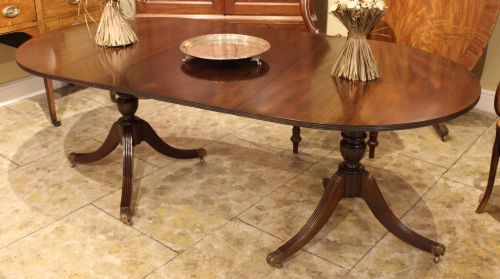


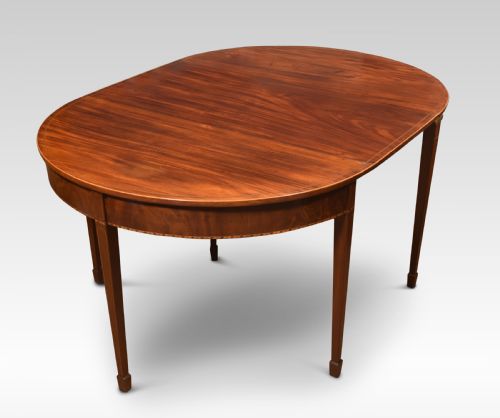


D End Dining Table
When you search for a d end dining table, you are looking at modular antique tables designed to expand with extra leaves for grand gatherings.
D End Dining Table
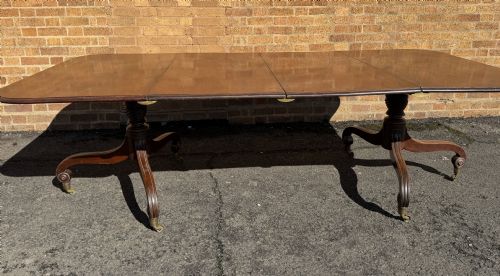
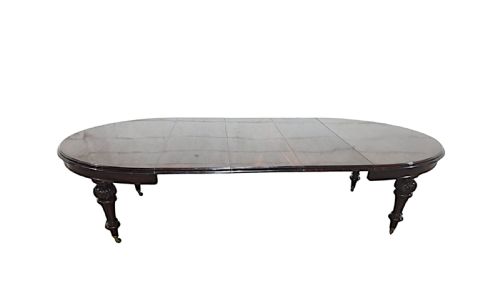
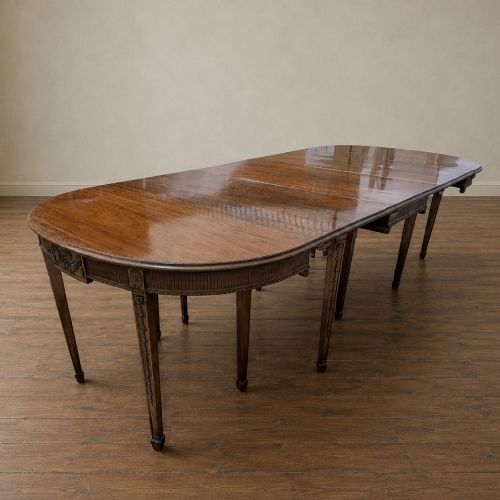
A d end dining table consists of semicircular ends that can stand alone as console tables or push together with a central drop leaf or additional sections to form a long dining surface. When searching for a d end dining table, buyers encounter pieces primarily originating from the Georgian and Victorian periods, often constructed from rich figured mahogany.
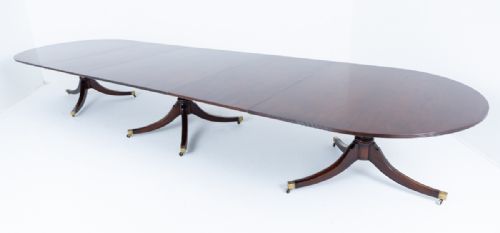
These versatile pieces range from twin pillar pedestal bases to multi leaf extending formats capable of seating twelve or more guests. The design allows rooms to transform from intimate settings to large dining halls by inserting central leaves supported by pull out mechanisms.
How They Were Made
Cabinet makers utilised dense timbers such as mahogany, oak, and walnut, often selecting figured veneers for the top surfaces to catch the light. Pillar bases incorporated brass castors and turned wooden columns to support the substantial weight of extended leaves.
Joinery techniques included rule joints on drop leaves and sturdy peg or dowel construction in the framework, ensuring the modular sections aligned smoothly when joined together.
D End Dining Table Retail Price Guide 2026
Typical asking prices for d end dining table among the pieces listed under this phrase on Sellingantiques today, from the lower quarter to the upper quarter. They describe what is for sale here now, not the wider market.
The archive includes numerous extending formats utilising pillar bases, wind out mechanisms, and removable leaves.
What Varies in Quality
The distinction between ordinary and exceptional examples lies in the selection of timber grain, the precision of the joining mechanisms, and the integrity of the original pedestals. Tables featuring matching grain across multiple added leaves and fine patination on solid mahogany demonstrate superior workshop origin.
Proportion and stability during extension also define the better pieces, where heavy brass fittings and smooth screw or wind out actions indicate careful construction by skilled makers.
William and Gibton·Robert Adam·Gillows·Waring and Gillow
The D End Dining Table Glossary
- D-End
- A table end shaped like a capital letter D, featuring a curved outer edge and a straight side that meets another table section.
- Twin Pillar
- A support structure utilising two distinct pedestals, each typically featuring three splayed legs terminating in brass castors.
- Leaf
- A removable wooden board inserted into the centre of an extending table to increase its overall length.
- Console Table
- A side table designed to stand flat against a wall, often forming the curved ends of a modular dining table when separated.
- Wind Out
- A mechanical extension system operated by a crank handle that separates the table halves evenly to accommodate extra leaves.
D End Dining Table: Frequently Asked Questions
How do you extend a d end dining table?
Many examples utilise a wind out mechanism operated with a metal handle, separating the two halves to reveal internal runners where extra wooden leaves drop into place.
Other versions rely on separate pedestal tables that lock together with brass clips, allowing leaves to be inserted manually into the central gap.
Can d end tables be used as consoles?
The curved ends of these tables function independently as side or console pieces when placed flat against a dining room or hallway wall.
Separating the modular sections provides versatile furniture options for everyday use while keeping extra dining capacity ready.
What wood were d end tables made from?
Mahogany remains the predominant timber found in these dining tables, frequently displaying rich figure and deep reddish brown patination developed over centuries.
Examples also appear in walnut, oak, and rosewood, depending on the specific period and regional workshop traditions.
How many people do these tables seat?
Standard twin pillar formats accommodate eight to ten diners comfortably, while larger three pillar versions extend to seat sixteen or eighteen guests with multiple leaves inserted.
The modular nature allows hosts to adjust the length according to the number of leaves deployed for any specific occasion.