

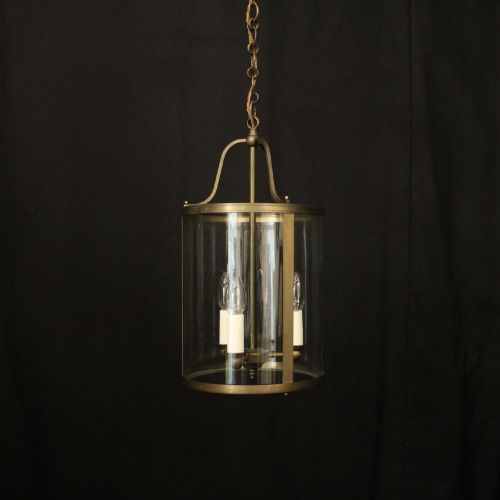
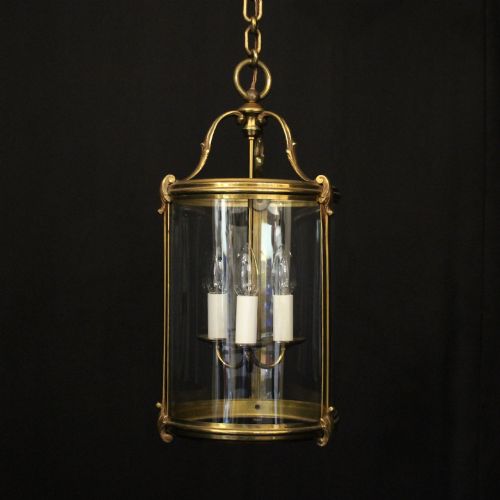
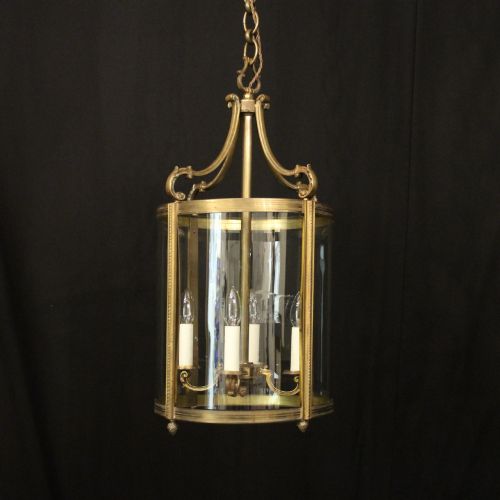
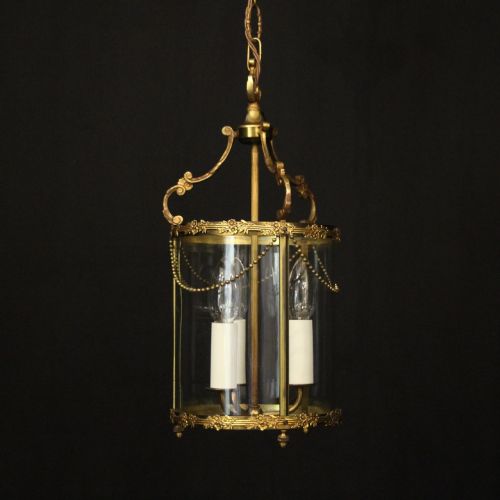
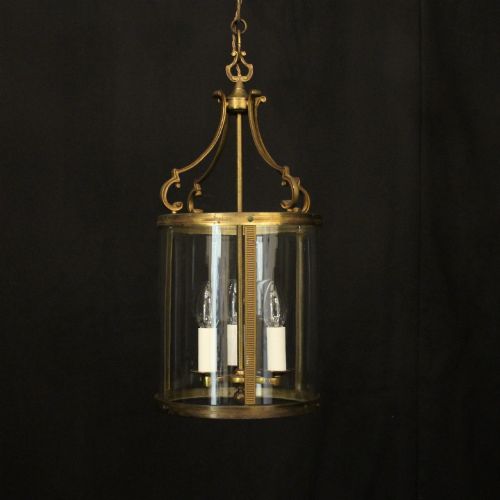
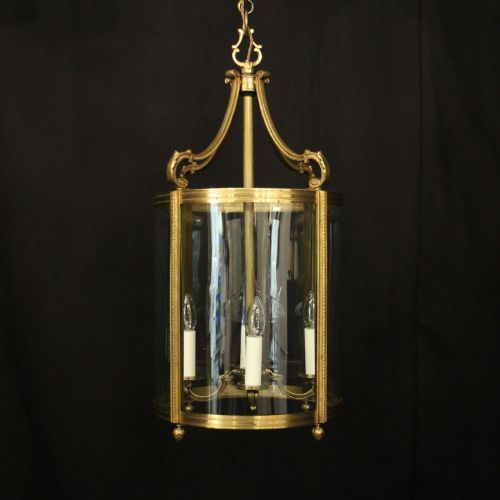


Cylindrical Hall Lantern
A cylindrical hall lantern brings immediate focus to an entrance, casting clear light through glass panels held by metal frames.
Cylindrical Hall Lantern
A cylindrical hall lantern is designed specifically for corridors, vestibules, and entranceways where vertical space matters. These fixtures combine glass with metal framing to distribute light evenly across a restricted area.
You will most commonly encounter pieces originating from the nineteenth century, the Edwardian period, and the 1920s or 1930s. French designs strongly influence the selection, frequently drawing on classical, Empire, and Louis XVI styles.
The form appears in various sizes, ranging from compact round shapes measuring eight inches to large hanging models with triple or quadruple light fittings. English examples also feature amongst the predominantly French selection.
Materials and construction
Makers constructed these lanterns using brass, bronze, and gilt bronze, often applying a gilded finish to enhance the reflective quality of the metal. Glass panels, including convex varieties, wrap around the internal light clusters and fit securely into the metal framework.
Foundry work and metal casting defined the production of the frames, while specialised glass blowers and cutters formed the curved panes. Assembly relied on mechanical joints and fixings to support the weight of the hanging structure and its internal electrical or candle fittings.
Cylindrical Hall Lantern Retail Price Guide 2026
Typical asking prices for cylindrical hall lantern among the pieces listed under this phrase on Sellingantiques today, from the lower quarter to the upper quarter. They describe what is for sale here now, not the wider market.
The recorded styles draw heavily from French design traditions, including Neoclassical, Louis XVI, Louis XV, Empire, and Grand Regency.
Evaluating the standard of execution
Quality reveals itself in the weight and substance of the bronze or brass casting, as well as the crispness of any applied chased detail. Finer pieces demonstrate precision in the curvature of the glass and the tight fit of the panels within the metal channels.
The finish also separates different tiers of production, with careful fire gilding or polished patination outlasting simpler surface treatments. Structural integrity in the suspension loop and the rigidity of the cylindrical frame indicate superior craftsmanship.
The Cylindrical Hall Lantern Glossary
- Convex glass
- Curved glass panels that project outward from the frame. This shape disperses light more widely than flat glass panes.
- Gilt bronze
- Bronze metal treated with a thin layer of gold or gold-coloured alloy. It provides a durable and decorative surface finish.
- Hall lantern
- A ceiling-hung lighting fixture intended for entrance spaces and corridors. These fixtures usually feature enclosed sides to protect the light source.
- Empire style
- A neoclassical design movement originating in France during the early nineteenth century. It draws heavily on ancient Roman and Greek motifs.
Cylindrical Hall Lantern: Frequently Asked Questions
How are these lanterns hung?
They suspend from ceilings using chains or rigid metal rods attached to a loop at the top of the frame. This allows the fixture to hang at the correct height for an entryway.
Electrical wiring typically runs down through the suspension mechanism to power the internal lamp holders safely.
Can I use modern bulbs?
Most antique lanterns are adapted to accept standard modern lamp fittings while retaining their historical appearance. Electricians can easily fit appropriate internal wiring.
Low-heat LED bulbs work particularly well inside enclosed glass lanterns to protect historic components from excessive warmth.
How do I clean the glass?
Carefully remove dust with a soft, dry cloth before applying a gentle glass cleaner to the panels. Avoid spraying liquid directly onto the metal frame to protect the gilt or bronze finish.
For thorough cleaning, lift out removable glass panels if the construction allows, or clean them in place with steady, controlled movements.
What periods do these date from?
The available selection spans from the nineteenth century through the Edwardian era up to the 1930s. French workshops produced a large proportion of the surviving examples.
Stylistic cues such as Empire details or simple Edwardian lines help narrow down the manufacturing era of each piece.