



Cut Glass Candle Holders
Cut glass candle holders bring weight, colour and sharp refraction to a room, catching the light in a way ordinary glass simply cannot manage.
Cut Glass Candle Holders
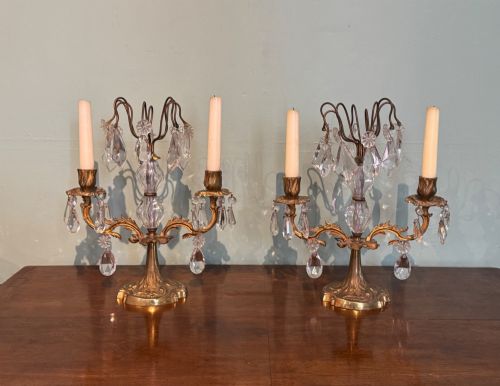
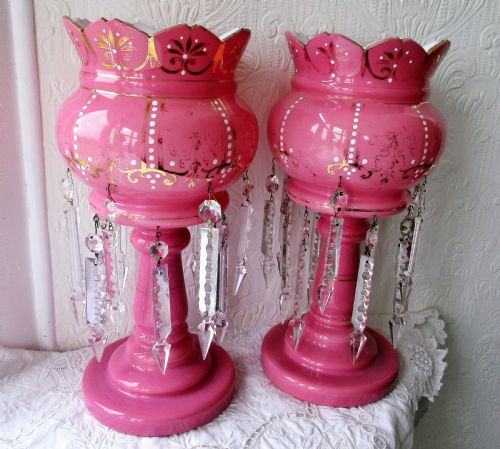
When searching for cut glass candle holders, buyers encounter a variety of forms including candlesticks, table lustres and multi-branched candelabra dating from the eighteenth century to the early twentieth century.
The selection on offer spans English, French and Bohemian origins, taking in styles from Regency clarity to Victorian exuberance and later twentieth-century production.
Pairs dominate the material evidence, often featuring hanging glass drops or prisms designed to amplify the flicker of candlelight.
How they were made
The makers combined heavy lead crystal or glass with cast metals such as brass, gilt bronze, ormolu and silver plate to build stable, decorative bases and mounts.
Workers shaped the glass by blowing and moulding before using wheels to cut deep facets, flutes and geometric patterns into the surface.
Many examples incorporate enamel decoration, overlay techniques or flash glass layers, while others suspend crystal drops from metal or glass bezels using wire.
Some Victorian dining tables once gleamed with patent Cricklite lamps, designed to let diners inspect their food through a rosy glow.
What varies in quality
The crispness of the wheel-cut facets dictates the visual sharpness, where deeper and cleaner cutting produces superior light refraction.
The weight and clarity of the base material, alongside the solidity of the brass or bronze mounts, separate standard production from finer workshop pieces.
Completeness matters, particularly regarding the survival of matching crystal drop pendants and the originality of matching storm shades or nozzle components.
Clarke's Cricklite
The Cut Glass Candle Holders Glossary
- Lustre
- A decorative tabletop piece fitted with glass pendant drops that catch and reflect the flame. These often double as candle holders.
- Candelabra
- A branched candlestick holding multiple lights on separate arms. They frequently incorporate central columns decorated with cut glass.
- Flash glass
- Glass formed of two or more distinct layers of different colours, usually a thin layer over a clear or contrasting body. This technique allows cutters to grind through the top layer to reveal the colour beneath.
- Ormolu
- Gilded bronze mounts used extensively on French and English pieces from the eighteenth and nineteenth centuries. The finish provides a warm, golden contrast to clear or coloured glass.
Cut Glass Candle Holders: Frequently Asked Questions
What is a lustre?
A lustre is an ornamental candlestick or vase hung with cut glass pendants designed to catch the light. They were popular in the nineteenth century for decorating mantelpieces and drawing-room tables.
Most examples hold candles in a central nozzle while the surrounding prisms create a glittering effect when lit.
How do I date a piece?
Dating relies on stylistic clues, mounting techniques and the colour palette of the glass. Regency pieces often show clean neoclassical lines, whereas Victorian items lean towards rich ruby, green or pink hues with heavier ornamentation.
Patina on the brass components and the method of cutting the glass also offer reliable chronological indicators.
Are these pieces fragile?
While lead crystal and glass possess considerable weight and thickness, hanging pendants and delicate branches require careful handling. Moving them demands attention to the suspended drops, which can easily detach or chip.
Placement should be stable and away from heavy household traffic to prevent accidental knocks.
How should I clean them?
Cleaning requires warm soapy water and a soft cloth, keeping metal mounts dry to protect gilt or brass finishes. Glass drops can be removed individually for thorough washing and drying.
Harsh chemical cleaners and abrasive cloths must be avoided to prevent scratching the surface.