



Curved Hallway Console
A curved hallway console brings fluid line and compact depth to a narrow threshold, offering surface space without crowding the passage.
Curved Hallway Console
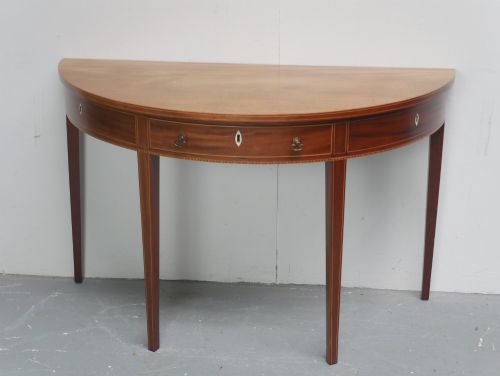
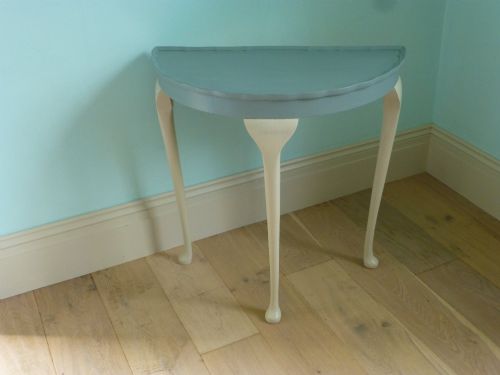
A curved hallway console comprises side tables, demi-lune forms, and small sideboards designed to fit narrow spaces with softened front edges.
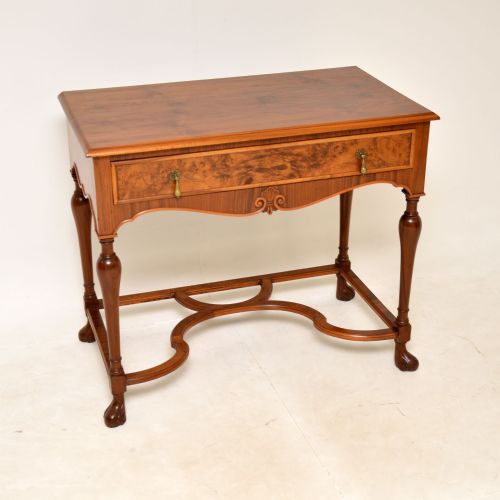
The selections span Georgian, Regency, and Art Deco periods, alongside Victorian and Biedermeier examples, showing how cabinetmakers adapted the curved silhouette across different eras.
Makers such as Hille and Maple and Co are represented, bringing twentieth-century modernism and nineteenth-century craftsmanship to these hall-friendly proportions.
How they were made
Timbers like mahogany, walnut, burr walnut, and maserbirch provide the primary structural foundation, often enhanced by satinwood inlay or painted wood finishes.
Brass details appear on feet, adding metallic contrast to the timber frames of late eighteenth-century and nineteenth-century pieces.
Cabinetmakers constructed bow fronts and demi-lune shapes using curved veneers and solid wood framing to achieve the distinctive rounded profile.
Listings feature timbers including mahogany, walnut, burr walnut, and painted wood across periods from Georgian to Art Deco.
What varies in quality
The choice of timber figure separates standard production from finer work, particularly where burr walnut or figured mahogany is selected for the top surface.
The precision of the curved joinery and the integration of satinwood inlay dictate the sophistication of the construction.
Hille·Maple and Co
The Curved Hallway Console Glossary
- Demi-lune
- A half-moon shape used for console tables designed to sit flush against a wall. This profile saves floor space in narrow hallways.
- Bow front
- A convex curved front that projects outward from the frame. It softens the linear appearance of a side table.
- Burr walnut
- Wood taken from a tree growth that produces intricate, swirling grain patterns. It is typically utilised for decorative veneer surfaces.
- Satinwood inlay
- Contrasting light-coloured wood inserted into the primary timber surface to create decorative borders. This technique highlights the geometric lines of the console.
Curved Hallway Console: Frequently Asked Questions
Where does a curved hallway console fit best?
These tables suit narrow entrance halls and landings where standard rectangular furniture blocks movement.
The shallow depth of a demi-lune or bow front shape keeps walkways clear while holding keys and post.
How do I identify a Georgian console?
Georgian pieces rely on solid mahogany construction and restrained proportions rather than heavy applied decoration.
Look for understated mouldings and straightforward timber work typical of eighteenth-century cabinetmaking.
What is the difference between Art Deco and Regency consoles?
Art Deco versions often feature dramatic burr walnut veneers and streamlined silhouettes from the early twentieth century.
Regency examples lean on classical restraint, featuring mahogany timbers and occasional brass mounts.
Can these tables be used in dining rooms?
Many of these pieces function equally well as sideboards or serving tables in compact dining spaces.
The curved profile allows dishes and glassware to rest within reach without dominating the room.