





Curved Front Sideboard Table
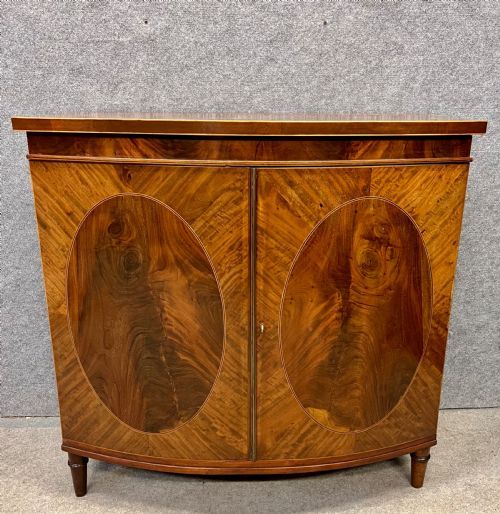
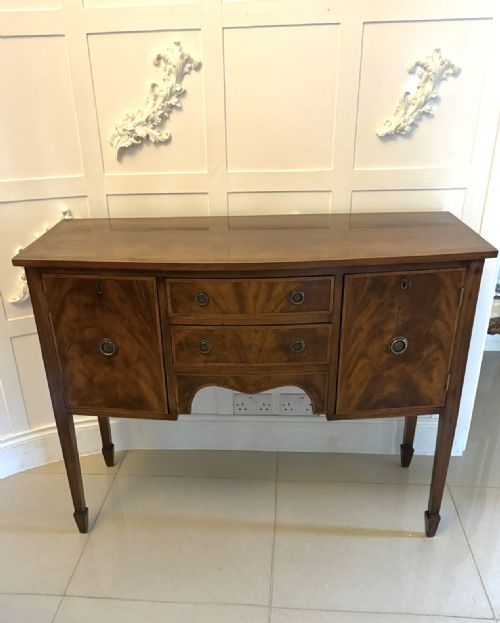
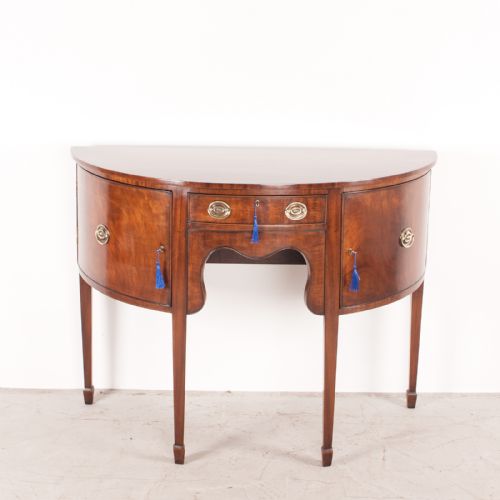
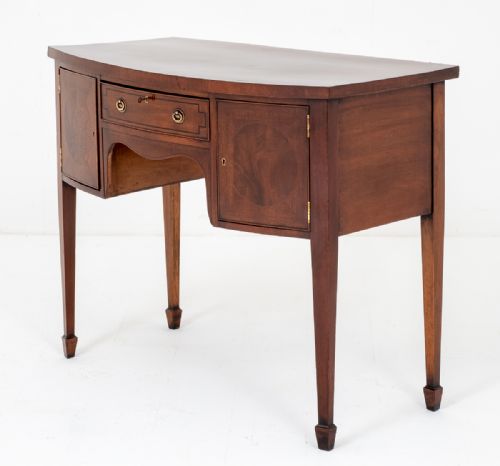
These curved front sideboard table examples bring refined dining room storage to life through elegant timber framing and graceful geometric lines.
Curved Front Sideboard Table
When you search for a curved front sideboard table, you are looking at substantial dining furniture designed to hold serving ware while following a sweeping, convex or semicircular footprint. These pieces shape the corner of a room or anchor a dining wall far better than a standard square frame.
How they were made
Cabinetmakers constructed these forms using solid mahogany and flame mahogany veneer laid over sturdy secondary woods. The curved facades required precise timber selection to follow the sweeping lines without splitting.
Many examples incorporate delicate satinwood and boxwood inlay to trace borders and drawers. Brass fittings and foot details complete the construction on specific pieces.
Some tambour doors hide secrets so well guests might search the entire room for the drinks.
What varies in quality
The standard of a curved front sideboard table rests on the depth of the timber grain and the precision of the curved drawer fronts. Finer examples display matched flame mahogany veneers that flow seamlessly across multiple drawers rather than mismatched cuts.
Detailing in the boxwood and satinwood inlay also separates standard pieces from exceptional ones. Sharp, crisp joinery along the curved rails indicates a higher level of workshop skill during construction.
The Curved Front Sideboard Table Glossary
- Bowfront
- A furniture front that curves outward in a convex arc. This shape softens the corners of a room and creates deeper central storage space.
- Demi-lune
- A half-moon shape used for tables and cabinets with a flat back and a curved front. It fits snugly against a wall while offering a striking profile.
- Serpentine
- A front shape featuring a central convex curve flanked by two concave curves, or vice versa. This complex line requires advanced woodworking skill.
- Flame mahogany veneer
- A thin slice of mahogany timber cut from the fork of the tree where branches meet. It produces a striking, flickering flame pattern across large surfaces.
- Tambour front
- A flexible sliding door made of narrow vertical strips of wood glued to canvas. It allows access to curved cabinet interiors without swinging doors.
Curved Front Sideboard Table: Frequently Asked Questions
Where should I place a curved front sideboard table?
These pieces suit dining rooms, large hallways, or living spaces where a softer profile is preferred over sharp corners. Their curved design allows them to sit comfortably against flat walls while breaking up the monotony of straight lines in a room.
Ensure you measure the depth at the centre point of the curve, as this is often wider than the ends where the piece meets the wall.
How do I care for mahogany veneer surfaces?
Dust regularly with a soft, dry cloth and avoid placing the furniture in direct sunlight to prevent the timber and inlay from fading. Natural wax applied occasionally helps nourish the wood and maintain a soft sheen.
Keep these tables away from direct heat sources and radiators to protect the veneer from drying and lifting over time.
Can I use a demi-lune cabinet as a serving table?
Demi-lune cabinets and serving tables provide a useful surface for holding dishes and glassware during meals. Their half-moon shape offers adequate top space while taking up less floor depth than a rectangular sideboard.
Check the interior height and shelf configuration if you plan to store taller bottles or specific serving platters behind the doors.