
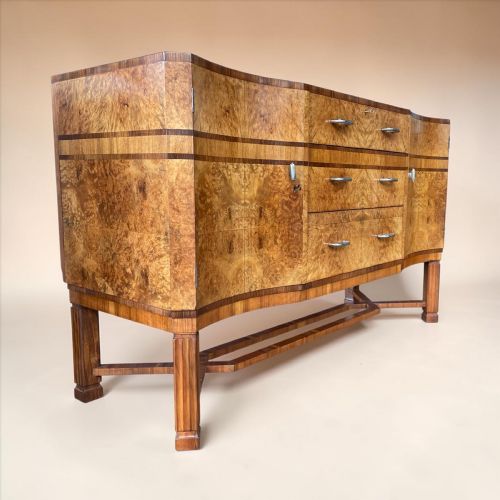
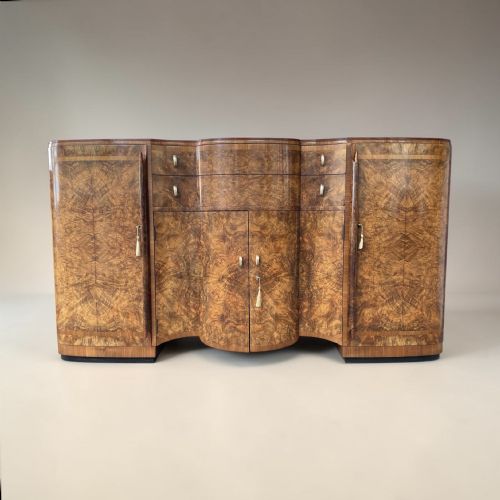
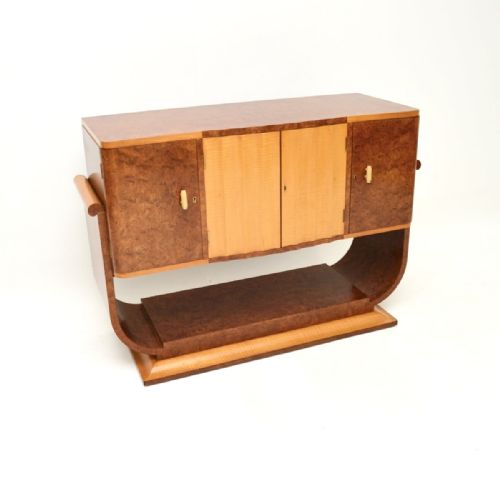
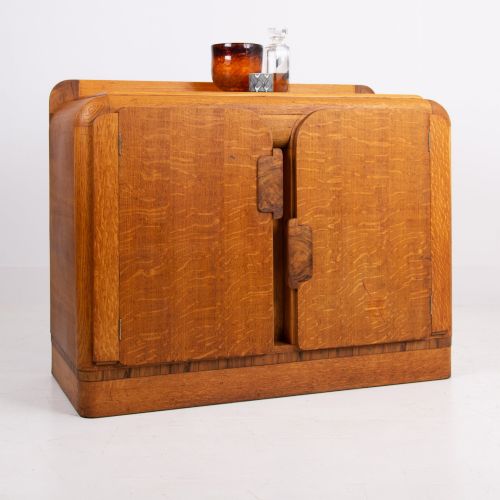
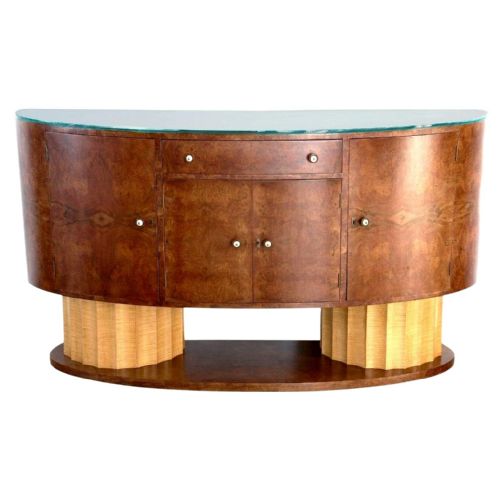
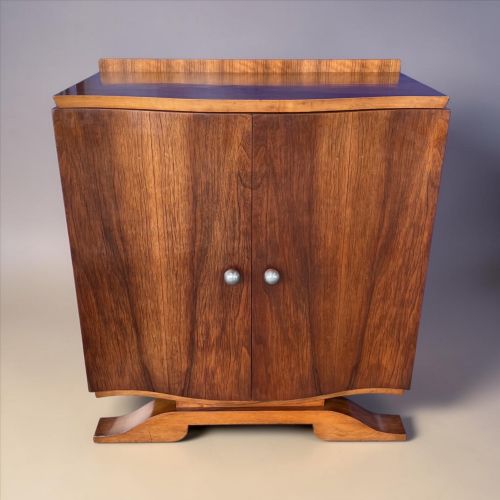


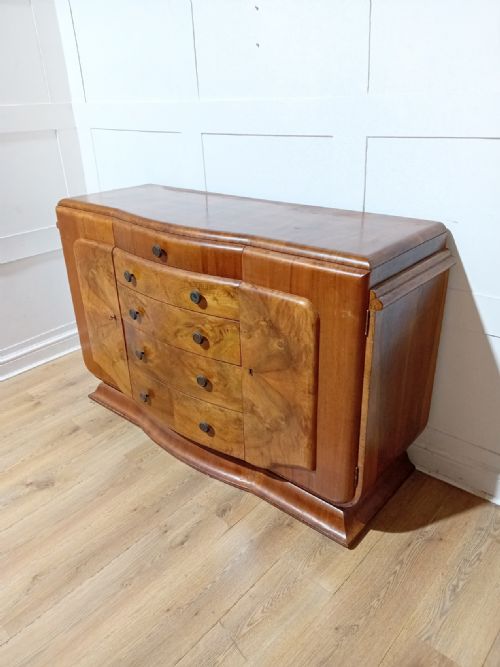


Curved Art Deco Sideboard
These curved art deco sideboard examples combine bold geometry with sweeping lines, offering generous storage and distinct period character.

Curved Art Deco Sideboard
A curved art deco sideboard defines the interior through sweeping radius fronts and architectural presence. These pieces emerge predominantly from the 1920 and 1930 periods, functioning as principal dining room storage or cocktail serving units.
The versions most commonly met on this page span sideboards, cabinets, and combination cocktail cabinets. Their forms rely on symmetrical arcs and rounded ends that soften the rigidity usually associated with earlier case furniture.
How they were made
Cabinet makers utilised timber frameworks overlaid with walnut and burr walnut veneer to achieve striking grain patterns across the curved surfaces. Sycamore and birch often appear as contrasting internal or secondary timbers, adding brightness to interior compartments.
Metal and brass details punctuate the designs, serving as structural trim or functional hardware. Veneers were carefully matched and laid outward from a central axis to accentuate the sweeping radius of each front.
Listings span the 1920 and 1930 periods, incorporating walnut, burr walnut, sycamore, birch, timber, metal, and brass materials.
What varies in quality
The division between standard production and exceptional work rests on timber selection and veneer matching. Pieces utilising highly figured burr walnut across continuous curved doors demand superior joinery skill compared to flat-paneled alternatives.
Maker attribution and internal configuration elevate certain pieces above anonymous workshop output. Fitted cocktail interiors with mirrored backs and specialised storage compartments reflect a higher tier of design ambition.
Maurice Adams·Gomme·Hille·Harry and Lou Epstein·Hamptons of Pall Mall London·The Bowman Brothers·Otto Schulz for Boet
The Curved Art Deco Sideboard Glossary
- Burr walnut
- A prized wood veneer harvested from the growth excrescences of walnut trees, noted for swirling, irregular grain patterns. It forms the primary decorative surface on many high-end pieces.
- Veneer
- Thin slices of decorative wood applied over a stable timber core to create complex visual patterns without warping. This technique allows makers to wrap continuous grain around tight curves.
- Sycamore
- A light-coloured hardwood frequently used for interior linings and contrasting stringing lines. Its pale tone provides a sharp visual boundary against darker walnut exteriors.
- Swedish Grace
- A refined classicising style bridging neoclassical restraint and early modernism, prominent in northern European design of the period. It influences the softer geometric curves seen in select cabinetry.
Curved Art Deco Sideboard: Frequently Asked Questions
How do I style a curved art deco sideboard?
Position the piece against a clean wall where its rounded silhouette can command the room without obstruction. Keep surface objects minimal to let the natural grain patterns of the walnut or burr walnut remain the focal point.
Pair the furniture with lighting that highlights the metallic brass accents and curved geometry. Allow adequate clearance around the ends so the sweeping radius reads clearly from multiple angles.
Were these used for drinks storage?
Many examples double as cocktail cabinets or serving tables designed specifically for entertaining. Interior compartments frequently include specialised shelving and mirrored sections tailored for glassware and bottles.
This dual functionality makes them practical additions to modern dining and living spaces. The combination of closed cabinet doors and dedicated serving surfaces accommodates contemporary hosting needs effortlessly.
How do I distinguish 1920s pieces from 1930s work?
Items originating in the 1920s often lean toward transitional geometric abstraction influenced by early modernist shifts. Pieces from the 1930s frequently emphasise the dramatic, sweeping curves and waterfall edges characteristic of later streamline design.
Examining the construction methods and hardware choices helps clarify the timeline. The inclusion of lighter contrasting woods like sycamore becomes particularly pronounced in the later decade.
What maintenance do walnut veneers require?
Protect the surfaces from direct sunlight to prevent the walnut and burr walnut veneers from fading unevenly over time. Dust regularly with a soft, dry cloth and avoid harsh chemical polishes that can degrade the original finish.
Maintain stable indoor humidity levels to prevent the timber core and applied veneers from shifting. Treating the wood with appropriate maintenance oils preserves the depth of the grain.