




Country Bridge Painting
A country bridge painting captures pastoral stillness and spans of masonry or timber, offering timeless rural calm for any wall.

Country Bridge Painting
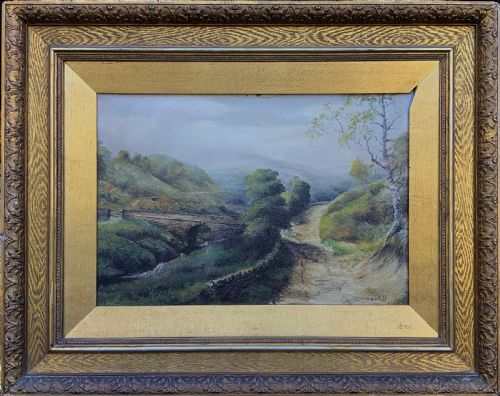
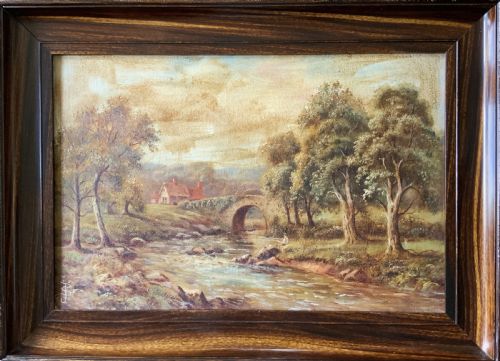
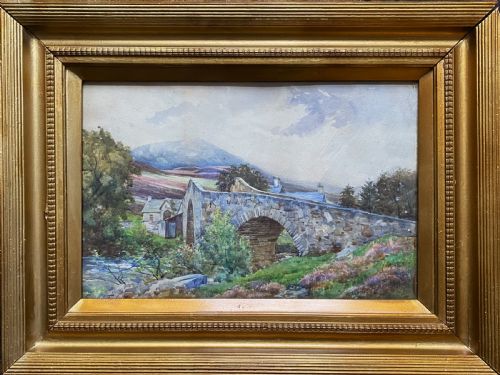
A country bridge painting records rural crossings, rivers, and pastoral settings across Britain. When you search for country bridge painting, you encounter works ranging from Victorian watercolours to early twentieth-century oils.
The selections on this page span the Victorian era, the Edwardian period, and the 1930s. These pieces frequently depict specific local landmarks such as Ludlow Castle, Dinham Bridge, and Yorkshire rivers.
Most examples take the form of framed watercolours or oil paintings on canvas. Certain works portray figures crossing rivers, drovers with cattle, or quiet pastoral scenes framed by trees and stone arches.
Materials and Techniques
Artists working on these rural scenes utilised oil paint on canvas and delicate watercolours on paper. Canvases are often stretched and housed within traditional gilt wood frames.
Mediums range from fluid watercolour washes capturing atmospheric light to layered oil paints building rich textures on canvas. Some pieces extend to painted stained glass panels framed in wood and glass.
Inscriptions appear directly on stretchers or paper margins, recording titles, locations, and dates in the artist's own hand. Signatures frequently anchor the corner of the composition.
Judging Quality
Quality rests in the precision of brushwork and the handling of atmospheric light over water and stone. Master hands capture the texture of weathered masonry and the movement of a stream with economy and confidence.
Condition varies according to the preservation of the paper or canvas and the stability of the original frame. Works retaining clear artist signatures, period inscriptions, and clean surfaces command greater attention from collectors.
Sydney Yates Johnson·William Traies·Fred Stead·Fred Lawson·Sir David Murray
The Country Bridge Painting Glossary
- Watercolour
- A paint consisting of pigment suspended in a water-based solution, typically applied to paper. This medium allows for transparent washes and fine illustrative detail.
- Oil on Canvas
- A traditional painting method utilising pigments bound in a drying oil, applied to a woven fabric stretched across a wooden frame. It offers deep colour saturation and visible brush texture.
- Stretcher
- A wooden framework that tensions a canvas painting. Inscribed notes regarding the location and artist often appear directly on this wooden support.
- Gilt Wood
- Wood treated with a thin layer of gold leaf or metallic gilt finish. It forms the decorative border of traditional picture frames.
Country Bridge Painting: Frequently Asked Questions
What periods do these paintings represent?
The available selection spans the nineteenth and twentieth centuries, encompassing Victorian, Edwardian, and 1930s works.
Specific dates within titles point to mid-nineteenth-century creations alongside early twentieth-century British watercolours and oils.
How were these artworks framed?
Many examples are mounted behind glass within traditional wooden frames or gilt wood surrounds.
Canvases are stretched over wooden frames, while works on paper utilise protective framing and mats.
Are the locations in the paintings identified?
Several works feature inscribed titles on stretchers or margins identifying specific sites.
Named locations include Ludlow Castle, Dinham Bridge, Dartmoor, and Yorkshire landscapes.
What mediums are used in these pieces?
Painters employed watercolour on paper, oil paint on canvas, and painted stained glass.
Wood and glass complete the physical construction of the framed artworks and panels.