
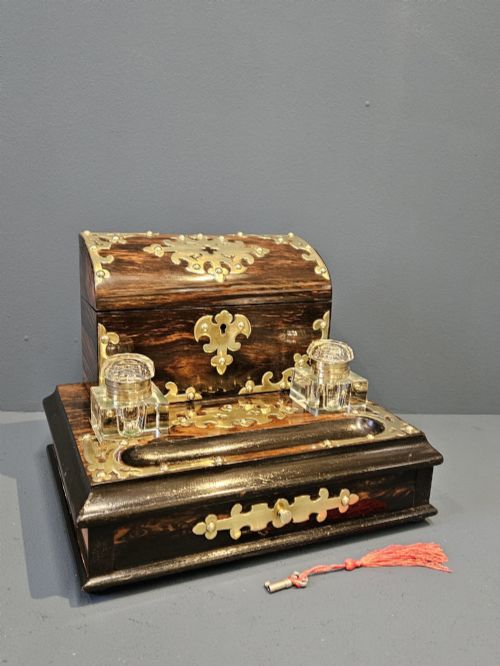


Coromandel Stationery Box
A coromandel stationery box brings striking grain and rich dark tones to a desk, offering an enduring place for correspondence.
What They Are
A coromandel stationery box is a desk accessory designed to hold writing paper, envelopes, and ink, taking forms such as cabinets, caskets, and slant-front boxes. Most examples seen here date from the nineteenth century, spanning the Regency period through to late Victorian times.
The objects frequently combine stationery storage with inkstands, writing boxes, and keepsake boxes. Makers of the period produced drop-front cabinets, dome-top boxes, and brass-bound caskets to suit the elaborate writing habits of the era.
How They Were Made
These pieces utilise dense coromandel wood as the primary foundation, often highlighted with contrasting satinwood or enriched with bone inlay. Artisans shaped the heavy timber into solid desk furniture designed to withstand regular use.
Decoration relied heavily on metalwork and stone, featuring gilt brass strapwork, brass binding, and inlaid mother of pearl or abalone. Some elaborate versions incorporate pietra dura panels or mounted glass and silver plate details.
Retail Price Guide 2026
Typical UK retail prices for coromandel stationery box, calculated from the Sellingantiques database of over a million retail prices indexed since 2003. This retail price guide relies exclusively on Sellingantiques data; no external sources or auction records are used, so the figures do not describe the wider market.
Some nineteenth-century letter caskets feature hidden secret drawers triggered by subtle wood spring latches.
What Varies in Quality
Quality rests in the selection of the coromandel timber, where deeply figured grain and rich colour contrast elevate an object. The precision of the joinery and the integration of internal fittings dictate the overall standard of the piece.
The ambition of the ornamentation separates standard containers from superior works. Finely chased brass hardware, complex pietra dura plaques, and signed maker plaques indicate a higher level of workshop output.
Houghton and Gunn·C.G. Hope Hastings·Parkings and Gotto
The Coromandel Stationery Box Glossary
- Coromandel
- A dense, heavily figured exotic timber with dark brown and black striping, prized for nineteenth-century luxury boxes.
- Pietra dura
- An inlaid technique using polished, cut coloured stones to create pictorial or geometric designs on the box lid.
- Strapwork
- Ornamental metal bands applied to the exterior surfaces of a box for structural reinforcement and visual contrast.
- Stationery box
- A desk container specifically partitioned to hold folded writing paper, envelopes, and related correspondence items.
- Gilt brass
- Brass metal treated with a thin layer of gold to give a bright, rich metallic finish that resists tarnishing.
Frequently Asked Questions
What is a coromandel stationery box?
It is a desk container made from dense exotic timber designed to hold writing paper and correspondence.
These pieces range from simple lidded boxes to elaborate drop-front cabinets fitted with ink wells.
How do I date a coromandel box?
Dating relies on stylistic clues such as Gothic Revival brasswork, Regency proportions, or Victorian brass binding.
Maker signatures and registration marks also help establish the exact period of manufacture.
Where were these boxes used?
They sat upon writing desks in the studies and drawing rooms of nineteenth-century homes.
Owners used them to keep personal stationery and writing implements organised and secure.
How do I care for coromandel wood?
Keep the wood away from direct sunlight and steady heat sources to prevent the dense timber from splitting.
Applying a light wax occasionally helps maintain the polished finish and rich grain.