
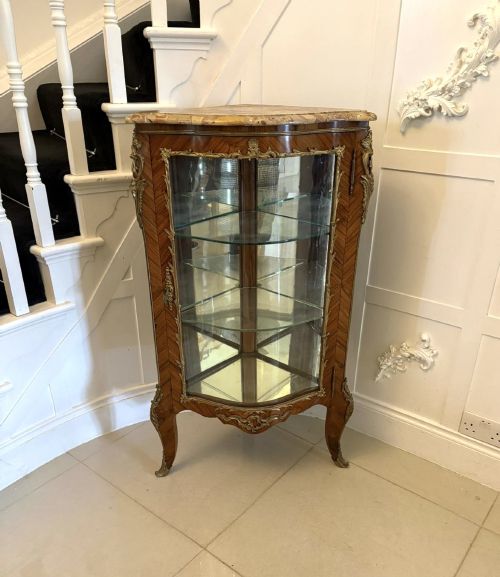
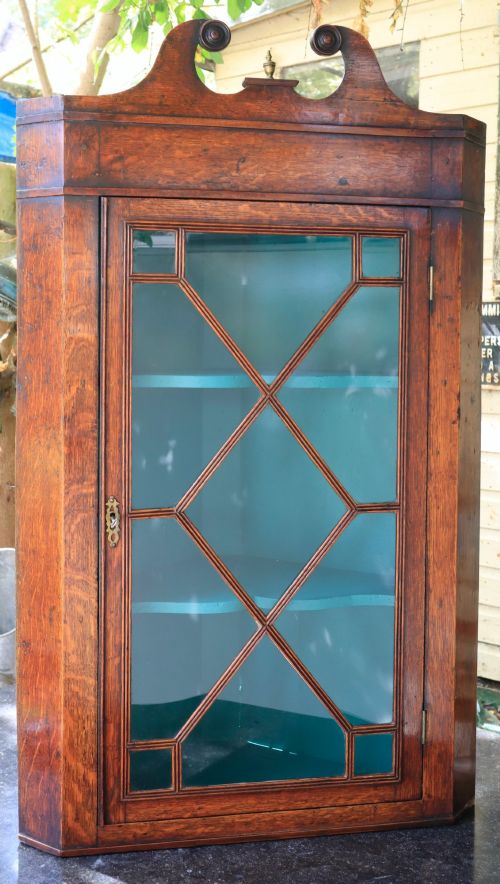


Corner Glass Display Case
A corner glass display case turns an empty room angle into a focal point for precious objects, offering glazed panels to keep treasures safe.
Corner Glass Display Case
A corner glass display case makes clever use of awkward angles, fitting snugly into room corners while drawing the eye upward. These pieces appear across Georgian, Victorian, Edwardian and early twentieth century periods, taking forms from wall-hanging cupboards to tall standing cabinets and shop counters.
You will encounter freestanding mahogany models with bow-front doors alongside oak hanging cupboards and serpentine fronted vitrines. Some versions feature single glazed doors, while others offer double heights or triple aspect glass fronts designed to catch the light from multiple angles.
The objects serve primarily to showcase ceramics, glassware or small collections without cluttering floor space. Their origins span English country houses, Scottish homes, French workshops and retail spaces.
Materials and construction methods
Cabinet makers relied heavily on timber frames of mahogany, oak and kingwood, frequently incorporating satinwood inlay, marquetry or brass mounts. These woods provided the structural rigidity needed to support heavy glass panes and internal shelving.
Glazing techniques involved fitting glass panels into rebated wooden doors, occasionally using bowed or serpentine glass to soften the angular silhouette. Details such as ormolu mounts, marble tops, locking keys and internal drawers appear on more elaborate examples from the nineteenth century onward.
Several cabinets retain their original working keys, proving that eighteenth century household security occasionally survived generations of lost keyrings.
Distinctions in craftsmanship
Quality reveals itself in the selection of timber veneers and the precision of the joinery, particularly around curved glass doors and inlaid panels. Finer examples display meticulous attention to grain alignment on burr walnut or satinwood surfaces and robust internal shelving designed to bear weight without sagging.
The distinction between standard domestic cupboards and exceptional showroom pieces lies in the hardware and secondary ornament. Original brass mounts, working locks with keys, marble tops and subtle serpentine shaping elevate certain cabinets far beyond basic utilitarian storage.
Edwards And Roberts·John Stow Ltd·Sage And Co
The Corner Glass Display Case Glossary
- Bow front
- A convex, outwardly curved front section that gives a cabinet a softer profile and increases interior visibility. This shape requires advanced woodworking skill to fit curved glass panes.
- Serpentine
- A gently undulating shape featuring a convex centre flanked by concave curves. It adds visual movement and sophistication to the front frame.
- Vitrine
- A glass-fronted cabinet specifically designed for displaying fine objects and porcelain. The term often denotes pieces with extensive glass panels on multiple sides.
- Marquetry
- Decorative patterns formed by inserting thin veneers of different coloured woods into a solid background. It transforms plain timber surfaces into pictorial or geometric designs.
- Ormolu
- Gilded bronze ornamentation applied to furniture as mounts and feet. It was favoured by French makers and later revivalists to add richness.
Corner Glass Display Case: Frequently Asked Questions
Can these cabinets hold heavy items?
The interior timber shelves are generally suited for glassware, ceramics and books. Overloading them with dense metal objects can strain the wooden supports and internal battens.
Distribute weight evenly across the shelves and check the condition of the support ledges before loading.
How do I tell an 18th century piece from a 20th century revival?
Eighteenth century examples typically show hand-cut joinery, pegged joints, and older glass panes with slight imperfections or bubbles. Timber patination develops a deep, warm glow over centuries of polishing.
Revival pieces from the twentieth century often utilise machine-sawn elements and more uniform glass production techniques, even when mimicking earlier Georgian styles.
Where should I place a corner display case?
Position them in living rooms, dining spaces or hallways where dead corner space can be utilised effectively. Placing them near a natural light source enhances the visibility of items displayed behind the glass.
Avoid positioning antique wood and fabric linings in direct, prolonged sunlight to prevent fading and timber drying.