
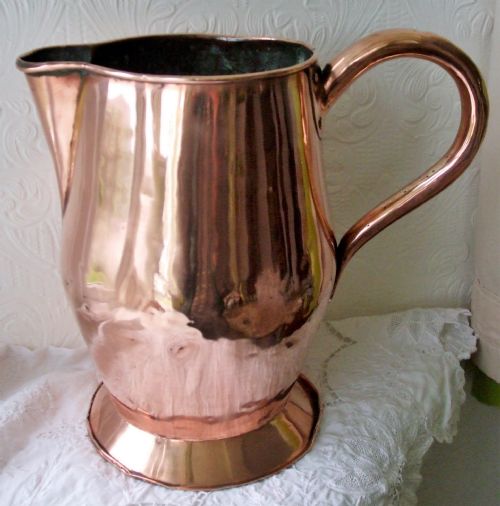
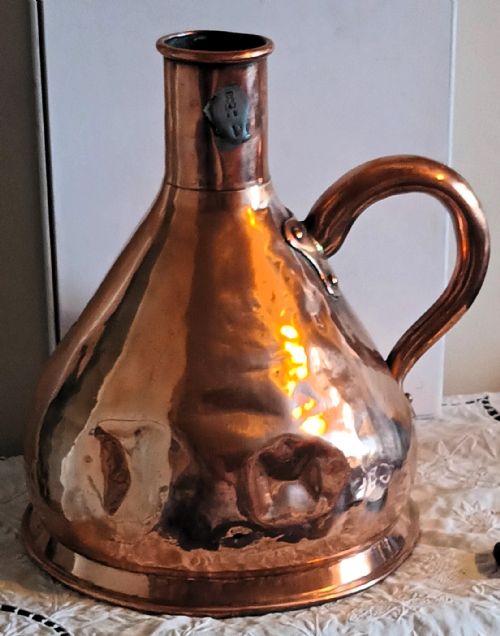


Copper Ale Pitcher
A copper ale pitcher is a robust drinking or measuring vessel shaped from metal to serve hearty brews in taverns and halls.
Copper Ale Pitcher
A copper ale pitcher on this page is a functional serving or measuring vessel stemming primarily from the Georgian and Victorian eras. These containers take forms such as tall flagons, haystack measures, tavern jugs, and large harvest vessels holding capacities ranging from three pints up to four gallons.
Many examples reflect institutional or commercial use, including Liverpool patterns and club jugs marked for taverns or societies. Buyers encounter both single statement pieces and graduated sets designed for precise liquid measurement.
The prevalent style identity spans Georgian and Victorian provincial designs, showing plain hammered or seamed bodies built for everyday utility rather than fragile display.
How they were made
These vessels rely fundamentally on heavy sheet copper, shaped and joined with lead or brass components to form rigid, liquid-tight bodies. Makers fashioned structural seams carefully to withstand the daily strain of holding heavy volumes of liquid.
Surface treatments and operational marks often include tin linings to prevent metallic taste in the ale, alongside stamped capacity figures or crown VR inspection stamps.
Listings span the Georgian and Victorian periods, utilising copper, brass, lead, and tin to form specialised tavern measures and flagons.
What varies in quality
Quality rests on the integrity of construction, seen in clean joints and the weight of the metal sheet used to form the body. Heavier gauge metal and crisp capacity stamps separate utilitarian vessels from finer workshop productions.
Provenance and specific maker identification elevate certain pieces, particularly those bearing named makers or established London addresses compared to unmarked provincial items.
J Bower·Loftus of Oxford Street London·S Hancock
The Copper Ale Pitcher Glossary
- Haystack measure
- A distinctive British liquid measure featuring a curved, bulbous body tapering toward the top, resembling a traditional stack of hay. These vessels often form graduated sets.
- Flagons
- Large drinking vessels or pitchers typically fitted with lids and sturdy handles, used for serving ale in substantial quantities. They appear frequently in tavern and club contexts.
- VR mark
- A royal cypher stamp indicating Victoria Regina, denoting official government verification of capacity for commercial measures. Such marks confirm the legal standard of the vessel.
- Graduated set
- A group of multiple vessels scaling down in size, designed to nest or sit in order. Each piece represents a specific fraction or multiple of liquid volume.
Copper Ale Pitcher: Frequently Asked Questions
What is a copper ale pitcher used for?
These vessels served to measure, carry, and pour ale in domestic, club, and tavern settings during the Georgian and Victorian periods.
Larger versions functioned as bulk storage or measuring standards, while smaller ones poured directly at the table.
How do I date a copper jug?
Dating relies on stylistic markers, construction methods, and official stamps such as crown VR cyphers indicating Victorian manufacture.
Georgian examples tend to show earlier hand-beaten characteristics, whereas mid-nineteenth-century pieces often incorporate standardised haystack or Liverpool forms.
Are these pitchers safe for holding drinks?
Many historical vessels feature internal tin linings intended to separate the copper from consumable liquids like ale.
Buyers intending modern consumption should check the condition of the interior lining before use.
What capacities do these measures come in?
The surviving evidence shows a wide scale ranging from modest three-pint jugs up to substantial four-gallon measures.
Graduated sets provide multiple sizes within a single matching collection.