




Colonial Writing Slope
These colonial writing slope pieces are portable mahogany, teak, and ebony desks designed for travel, offering built-in storage for ink and correspondence.
Colonial Writing Slope
A colonial writing slope is a portable desk designed for use during travel, featuring a hinged lid that opens to reveal a slanted writing surface and internal compartments for ink and paper. When you search for colonial writing slope, you encounter portable boxes and desks originating from nineteenth-century contexts.
The selections available here lean heavily into Anglo-Indian and Victorian colonial aesthetics, utilising dense exotic timbers and sturdy brass mounts. These pieces range from simple campaign boxes to intricately carved stationery boxes and Davenport desks.
Most examples date from the nineteenth century, including specific items from the eighteen-eighties and nineteen hundreds. Their portable nature made them essential for administrators and travellers navigating distant territories.
How they were made
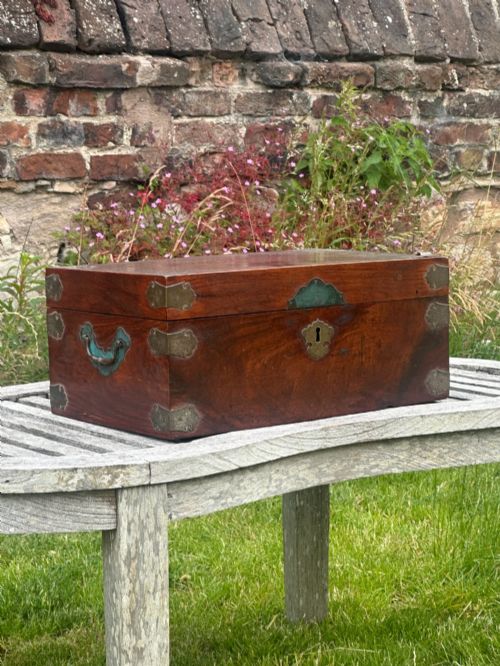
Cabinetmakers constructed these writing slopes using dense tropical hardwoods such as teak, padouk, camphor wood, and ebony to withstand humid climates and frequent transit. These timbers were selected for their durability and rich natural grain.
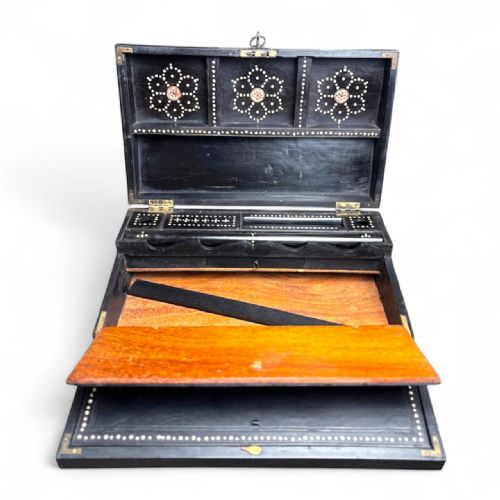
Metal reinforcement was essential for travel, so workshops fitted corners, straps, and carrying handles in brass. Interior details often incorporated bone or ivory inlay, alongside carved decorative motifs on specific Anglo-Indian and Ceylonese pieces.
What varies in quality
Quality rests upon the selection of timber and the precision of the joinery, particularly where brass banding and corner mounts meet the wood. Solid ebony or padouk construction represents a higher grade than veneered alternatives.
The intricacy of internal fittings, such as secret drawers, pen trays, and fitted stationery compartments, distinguishes standard boxes from finer bespoke commissions. The crispness of carved decoration on Ceylonese and Anglo-Indian examples also marks the standard of craftsmanship.
The Colonial Writing Slope Glossary
- Writing slope
- A portable box with a slanted lid designed to hold writing materials and provide a desk surface. When opened, the sloping board reveals storage compartments underneath.
- Campaign box
- A piece of furniture designed for military use in the field, typically featuring flush brass handles and reinforced corners. These items were built to withstand rigorous transport.
- Padouk
- A heavy tropical hardwood valued for its durability and deep reddish-brown colour. It frequently appears in nineteenth-century Anglo-Indian furniture.
- Camphor wood
- An aromatic timber utilised in colonial box and chest construction due to its insect-repellent properties. It is commonly found in military campaign pieces.
- Vizagapatam
- A coastal region in India known for luxury boxes decorated with intricate bone and ivory inlay. Pieces from this area display distinctive local craftsmanship.
Colonial Writing Slope: Frequently Asked Questions
What is a colonial writing slope?
A colonial writing slope is a portable desk made in distant territories during the nineteenth century for travellers and administrators.
These boxes fold closed to secure writing materials and open to provide a sloping surface for correspondence.
How were these boxes used?
They served as portable offices for officials, military officers, and merchants on the move.
Inside, users stored paper, inkwells, and nibs, using the slanted lid to write letters while away from home.
How do I identify the wood?
Examine the grain density, weight, and colour of the timber exposed on the exterior and interior compartments.
Common materials in these listings include dark ebony, reddish padouk, and fragrant camphor wood.