


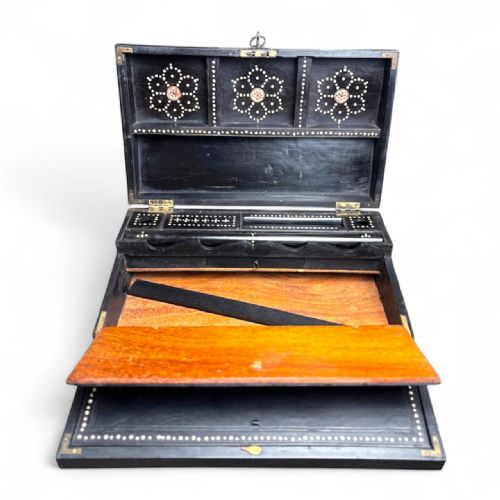


Colonial Writing Desk Box
These colonial writing desk box pieces are portable campaign and correspondence chests built for travel, offering brass mounts, fitted interiors and rich hardwoods.
Colonial Writing Desk Box
A colonial writing desk box serves as a portable writing surface and storage chest designed for travel across distant territories during the nineteenth century. The examples met on this page span the Victorian era, incorporating styles such as Anglo-Indian, Victorian Colonial and Military Campaign.
Most pieces encountered here take the form of writing slopes, writing boxes, stationery boxes or correspondence boxes. They often originate from regions like Ceylon, Sri Lanka, Jamaica and broader Anglo-Indian workshops, reflecting the global reach of nineteenth-century craftsmanship.
The dominant material across these listings is heavy ebony, alongside camphor wood, teak and general hardwoods. Many incorporate brass mounts, bone or ivory inlay and reeded decoration, serving both decorative and functional purposes during transit.
How they were made
Cabinet makers utilised dense hardwoods such as ebony, camphor wood and teak to withstand the rigours of long journeys and tropical climates. These timbers provide natural durability and a heavy structure suited to folding slope mechanisms.
Brass mountings reinforce the corners, edges and key areas of the boxes to protect against heavy handling during military campaigns or colonial voyages. Internal compartments and slope lids utilise precise joinery to house writing implements and stationery securely.
Materials across these listings include ebony, camphor wood, teak, brass, bone and ivory.
What varies in quality
Quality differentiates itself through the choice of primary timber and the intricacy of surface decoration, such as carved wood, bone inlay or reeded moulding. Solid ebony construction and detailed Ceylonese carving represent distinct levels of craftsmanship compared to plainer utility boxes.
The sophistication of the internal fittings, including secret drawers, brass-bound edges and metamorphic roll-top mechanisms, marks out superior examples. Completeness of original bone, ivory or brass inlay also separates standard campaign items from finer collector pieces.
The Colonial Writing Desk Box Glossary
- Writing Slope
- A portable box featuring a hinged slanted lid designed for writing letters on the go. Inside, it typically contains compartments for inkwells, pens and paper.
- Anglo-Indian
- A style describing items made in India during British rule, often combining traditional local carving techniques with European furniture forms like the writing slope.
- Reeded Decoration
- A surface pattern formed of parallel convex mouldings carved directly into the wood. This technique adds texture and refinement to the exterior panels.
- Metamorphic
- A term for furniture that transforms from one function to another, such as a box converting into a complete lap desk with a roll-top mechanism.
Colonial Writing Desk Box: Frequently Asked Questions
What is a colonial writing desk box?
A colonial writing desk box is a portable timber chest used during the nineteenth century for writing letters and storing correspondence while travelling.
These pieces often feature fitted internal compartments for ink and pens, along with secure locking mechanisms for transit.
How were campaign boxes used?
Campaign boxes served as portable desks and storage for officers and officials on the move across the British Empire.
Their robust construction and brass hardware protected contents against moisture and rough handling on long journeys.
Which woods are most common?
Listings frequently feature dense timbers such as ebony, camphor wood and teak, chosen for their resilience.
These hardwoods often appear alongside decorative elements like bone inlay and brass mounts.
How do I date a writing box?
Dating relies on stylistic markers, materials and construction methods associated with the Victorian period and nineteenth century.
Specific regional influences, such as Anglo-Indian carving or Ceylonese ebony work, also help place the piece in its era.