






Colonial Inlaid Box
These colonial inlaid box pieces are dense, travelled objects of hardwood and bone, offering a tactile anchor to distant histories.
Colonial Inlaid Box
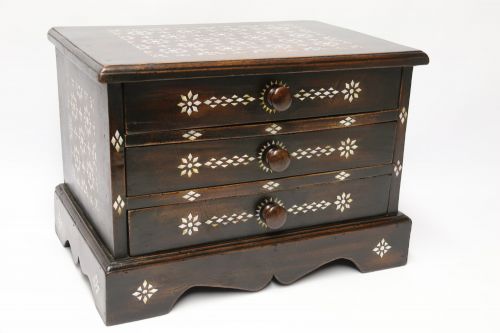
A colonial inlaid box brings together domestic utility and global reach, taking forms from small stationery boxes and writing slopes to large blanket chests and trunks. The pieces seen here span the nineteenth century into the early twentieth, drawing on Victorian, Regency, and Dutch Colonial traditions.
Most frequent among these are writing slopes and collector chests, often originating from Anglo-Indian or Ceylonese workshops. They serve as portable desks or secure containers, built to survive long sea voyages with their contents intact.
How they were made
Workshops relied on dense tropical timbers such as teak, padouk, satinwood, and ebony as the primary structural body. These stable hardwoods resisted warping in humid climates while providing a dark, contrasting ground for decorative work.
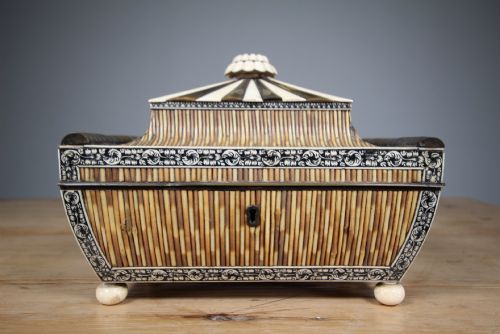
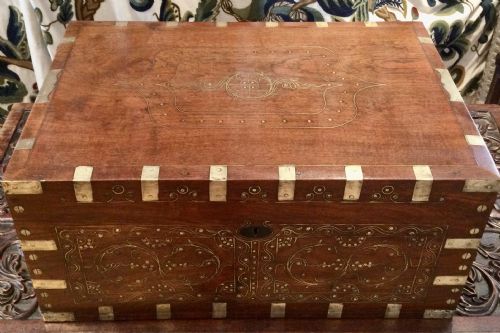
Surface ornamentation combined intricate bone, ivory, antler, or porcupine quill inserts with fine geometric micro-mosaics known as Sadeli work. Brass mounts, corner braces, and flush handles were then fitted to protect the edges during transport.
The inventory records nineteenth-century production spanning Regency, Victorian, and Edwardian periods, utilising teak, ebony, porcupine quill, and bone.
What varies in quality
Quality rests upon the precision of the inlay and the selection of the timber. Finer examples display tight, uninterrupted geometric patterns in Sadeli work and perfectly flush bone or ivory threads that follow the contours of the box without gaps.
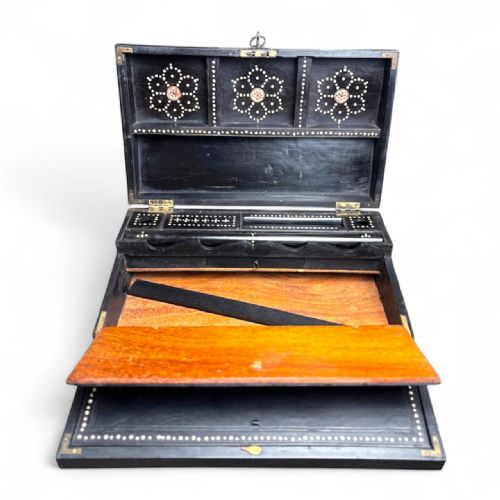
The sophistication of the internal fittings marks the difference between standard production and superior craftsmanship. Better pieces offer secondary lidded compartments, fitted inkwells, and secret drawers concealed within the hardwood structure.
The Colonial Inlaid Box Glossary
- Sadeli mosaic
- A complex micro-mosaic technique using minute slivers of horn, bone, ivory, and metal assembled into geometric bands. These strips are sliced thin and pressed into the wood surface to create shimmering borders.
- Vizagapatam
- A coastal city in India renowned for luxury export boxes decorated in elaborate engraved bone and ivory work. Pieces from this centre often feature intricate floral scrolls and compartmentalised interiors.
- Writing slope
- A portable desk featuring a hinged lid that opens to reveal an inclined leather-lined writing surface. Beneath this slope lie hidden compartments for stationery, nibs, and ink.
- Campaign chest
- A sturdy wooden chest designed in sections for military officers on the move, fitted with recessed brass handles and corner brackets. This construction allowed heavy storage to travel securely.
- Porcupine quill
- Quills harvested from crested porcupines used to sheath the exterior of decorative boxes, typically arranged in radial or chevron patterns. They are frequently contrasted with ebony framing and bone stringing.
Colonial Inlaid Box: Frequently Asked Questions
What is a colonial inlaid box used for?
These boxes served multiple functions while travelling, acting as portable writing desks, sewing containers, and secure receptacles for jewellery or letters. Their internal layouts often included compartments, small drawers, and lidded wells tailored to personal effects.
Today, they function well on side tables or desks to hold modern correspondence, keepsakes, or small collections while adding texture to a room.
How do I care for porcupine quill and bone inlay?
Organic materials like bone, ivory, and porcupine quill react sensitively to extreme shifts in humidity and temperature. Keep these pieces away from direct sunlight and radiators to prevent the dry air from shrinking the timber and loosening the tiny pins.
Dust them gently with a soft, dry cloth rather than using liquid polishes or damp cloths that might seep into the micro-mosaic joints.
How do I tell an Anglo-Indian box from a Dutch colonial piece?
Anglo-Indian boxes frequently employ dense decorative surfaces featuring porcupine quill, Sadeli mosaic, or intricate bone and ivory carving. They reflect the aesthetic exchanges between British patrons and Indian craftsmen during the nineteenth century.
Dutch colonial pieces tend to emphasise heavy tropical hardwoods like teak and ebony, accented with robust brass mounts, studs, and simpler panel construction rather than dense surface micro-mosaics.
Are campaign chests heavy?
Campaign chests are constructed from dense hardwoods like teak and padouk, reinforced with brass corners and strapwork to endure rough transport. Because they were built to be split into separate modular sections for loading onto ships and baggage animals, individual parts remain manageable.
When assembled, they form solid, heavy furniture designed to stand firm on uneven floors.