
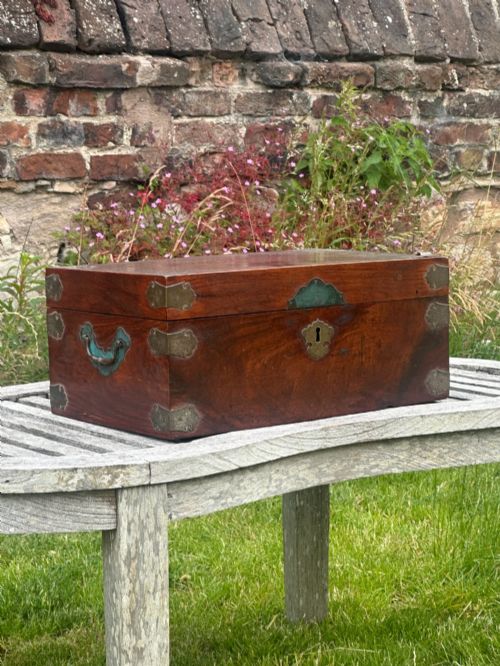


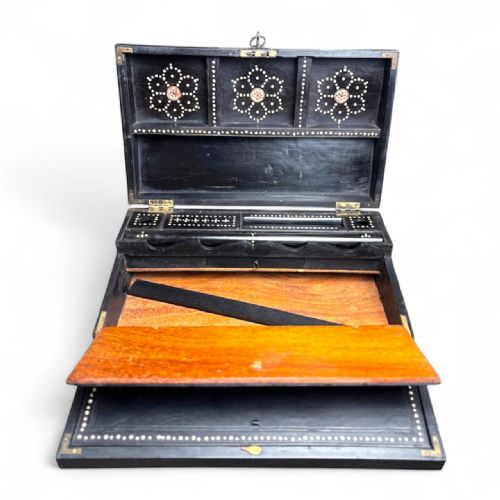


Colonial Indian Writing Slope
A colonial indian writing slope is a sturdy portable desk designed for travel, combining rich imported timbers with meticulous brass bound or inlaid decoration.
Colonial Indian Writing Slope
When you search for a colonial indian writing slope, you encounter portable desks and boxes fashioned during the nineteenth century and the Victorian period. These pieces originate from regions influenced by British trade and administration, most notably India and Ceylon.
The items listed on this page span writing slopes, writing boxes, stationery boxes, and campaign desks. You are most likely to meet nineteenth-century examples executed in dense tropical hardwoods.
Forms range from simple rectangular boxes with brass mountings to carved davenports and roll-top campaign slopes. They reflect the practical needs of travellers and officials who required a secure mobile desk.
How they were made
Cabinetmakers utilised heavy exotic timbers such as ebony, padouk, teak, and camphor wood for the primary carcases. These woods provided the necessary durability for long journeys and protection against humidity.
Decoration relied on contrasting materials inserted into the timber surface. Workshops employed bone, ivory, antler, and brass stringing or corner brackets to articulate the exterior surfaces.
Recorded forms include writing slopes, deed boxes, stationery boxes, campaign desks, and roll-top boxes.
What varies in quality
Quality rests upon the selection of timber and the precision of the decorative inlay. Solid ebony construction and intricate bone or ivory carving command greater attention than plain wood variants.
The integration of brass campaign mounts and the tightness of joint work also separate standard pieces from superior examples. Better items exhibit well-fitted interiors with fitted stationery compartments and writing surfaces.
The Colonial Indian Writing Slope Glossary
- Writing slope
- A portable box with a hinged sloping lid designed for correspondence. When opened, it reveals a writing surface and storage compartments.
- Campaign box
- A piece of furniture built for military officers or travellers on the move. These items typically feature recessed brass handles and reinforced corners.
- Padouk
- A heavy tropical hardwood valued for its strength and rich reddish-brown tone. It appears frequently in nineteenth-century campaign furniture.
- Vizagapatam
- A coastal city known for ornate decorative work using horn, ivory, and bone. Pieces from this region display distinctive inlaid geometric patterns.
Colonial Indian Writing Slope: Frequently Asked Questions
What is a colonial indian writing slope?
A colonial indian writing slope is a portable desk made during the nineteenth century in regions like India and Ceylon. They were built for travellers who needed a secure place to write letters on the move.
These pieces feature hinged lids that open to reveal sloping writing surfaces and compartments for ink, pens, and paper.
How were these boxes used?
Owners used them as portable desks while travelling or stationed abroad. They kept correspondence, writing materials, and important documents organised and secure.
The sturdy construction protected contents from the rigours of transport and changing climates.
What materials are typical?
Common materials include dense tropical timbers like ebony, padouk, teak, and camphor wood. Makers often decorated these woods with brass mounts, ivory, bone, or antler inlay.
Campaign pieces frequently incorporate brass corners and flush handles to withstand rough handling.