



Cocktail Lounge Armchair
These cocktail lounge armchair pieces bring period seating charm to a room, offering low profiles and tailored lines that collectors prize.
Cocktail Lounge Armchair
A cocktail lounge armchair is a low-slung seating form designed for relaxed conversation, drawing heavily on early twentieth-century domestic and social spaces. You encounter examples primarily from the nineteen-thirties and nineteen-twenties, alongside occasional nineteenth-century French pieces and nineteen-forties variants.
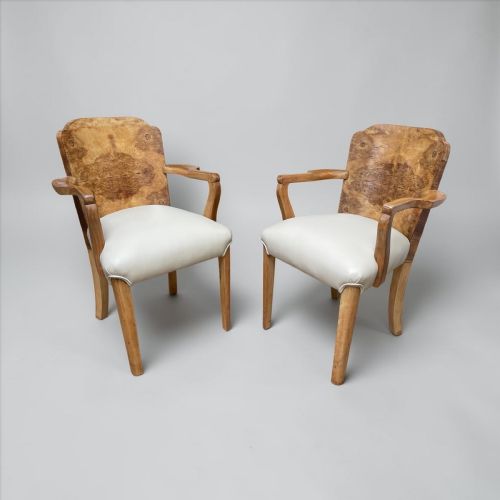
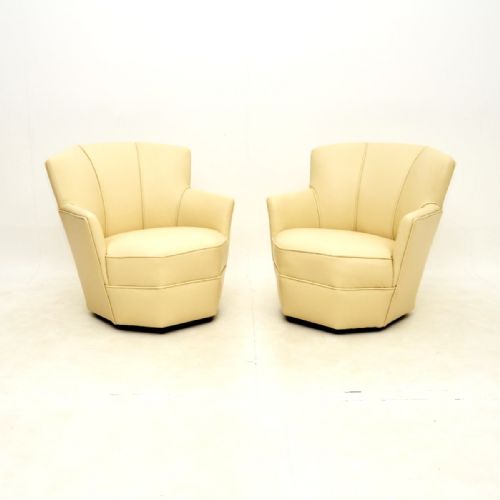
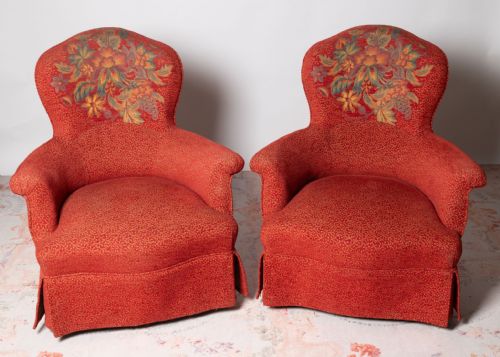
The selections span distinct stylistic traditions, notably Art Deco designs alongside French Napoleon III and vintage low armchair forms. Many appear in pairs, offering matched seating options for interior arrangements.
Makers such as Hille contribute to the available range, representing high-end cabinet making of the period. Buyers find both upholstered formats ready for placement and frames awaiting fresh textile work.
How they were made
Construction relies upon solid timber frameworks, with specific references to oak, walnut, and burr walnut providing robust structural foundations. Brass details often accent the frames, adding metallic contrast to the timber bodies.
Upholstery techniques employ leather and various textile fabrics, including blue ribbed finishes for barrel-back shapes. Frames span antique French models requiring complete reupholstery to finished Art Deco pairs.
Some chairs wait patiently for a new outfit, offering bare nineteenth-century frames just yearning for a glamorous velvet revival.
What varies in quality
Quality rests upon the integrity of the timber framework, where choice woods like burr walnut elevate a piece far above standard construction. The distinction also lies in whether the piece retains its original period leather or requires total textile replacement.
Attribution plays a major role, as authenticated workshop output from makers like Hille commands greater interest than anonymous manufacture. The sophistication of the period styling, from restrained nineteenth-century French lines to bold Art Deco geometry, defines the upper tier of the range.
Hille
The Cocktail Lounge Armchair Glossary
- Art Deco
- A design style spanning the nineteen-twenties and nineteen-thirties characterised by streamlined geometric forms and modern materials. It remains the dominant aesthetic found in these lounge seating listings.
- Burr Walnut
- A highly figured wood veneer prized for its swirling grain patterns. It is utilised on premium timber frames to create visual depth.
- Occasional Chair
- A movable, decorative seat intended for periodic use rather than primary lounging. These pieces match larger room schemes.
- Napoleon III
- A nineteenth-century French revival style known for eclectic ornamentation and comfortable upholstered forms. Pieces from this era predate the twentieth-century Art Deco movement.
Cocktail Lounge Armchair: Frequently Asked Questions
What is a cocktail lounge armchair?
A cocktail lounge armchair is a compact, low-profile seat built for social spaces and relaxed interiors during the early twentieth century. These pieces emphasise comfortable proportions and stylish silhouettes suited for sitting rooms.
Most examples date from the nineteen-thirties, though earlier nineteenth-century French pieces and nineteen-forties designs also appear. They often feature upholstered bodies supported by timber frames.
How do I date a cocktail lounge armchair?
Dating relies upon stylistic markers such as geometric Art Deco lines from the nineteen-thirties versus ornate nineteenth-century French framing. Materials like burr walnut and specific upholstery textures also point to distinct decades.
Maker attribution provides further chronological clarity, particularly when dealing with documented firms like Hille. Examining the underlying construction methods helps separate original period pieces from later interpretations.
Are these chairs sold in pairs?
Many listings feature matched pairs of occasional and lounge chairs rather than standalone pieces. This makes them practical for symmetrical interior layouts and drawing room arrangements.
Pairs frequently share identical timber frames, such as walnut or oak, alongside matching leather or textile upholstery.
What materials were used?
Makers utilised solid timbers including oak, walnut, and burr walnut for the structural frames and decorative veneers. Brass hardware occasionally appears as a contrasting detail on these wooden elements.
Upholstery materials range from smooth leather to textured textiles and blue ribbed fabrics. Some antique frames are sold specifically for upholstery restoration.