





Cobalt Blue Flask
A cobalt blue flask brings deep, saturated colour to a room, offering both decorative presence and practical utility across centuries of craft.
Cobalt Blue Flask
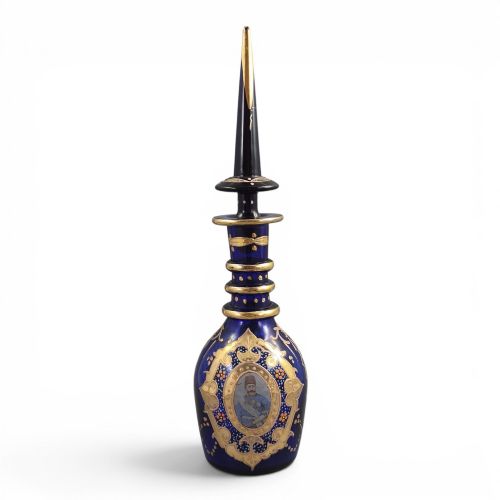
A cobalt blue flask encompasses a diverse array of vessels, including scent bottles, decanters, perfume bottles, and rose water sprinklers designed for personal or household use. These items appear across multiple periods, from the eighteenth century through to the Edwardian era, reflecting shifting tastes in functional ornamentation.
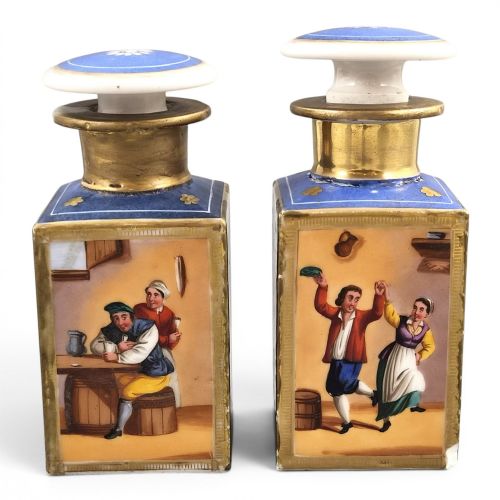
The version most commonly encountered on this page is the nineteenth-century glass or porcelain bottle, often enhanced with enamel, gilding, or silver mounts. Makers ranged from English potteries and Worcester porcelain works to Bohemian glasshouses and French studios, catering to both domestic and international markets.
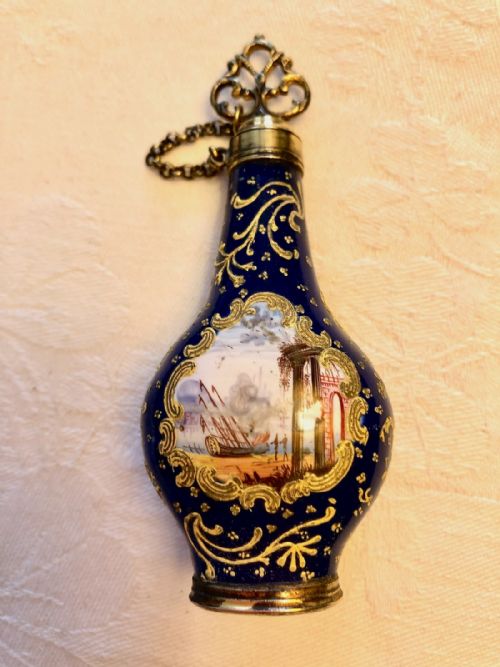
Forms vary from miniature scent flasks intended for the chatelaine to larger decanters and wine bottles meant for display or service. Each period brings distinct stylistic traits, connecting Georgian enamel work and Regency porcelain with later Victorian and Edwardian glass production.
How they were made
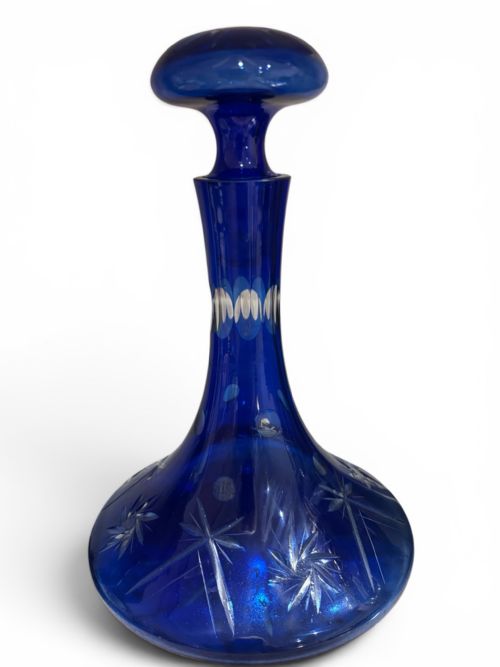
Makers utilised rich cobalt compounds to colour glass and glazes deeply before applying surface decoration such as gold leaf, enamel, or hand-painted scenes. Overlay glass techniques allowed artisans to cut through layers to reveal the contrasting hue beneath.
Mounts and hardware in sterling silver or gilt metal were frequently added by silversmiths to complete scent bottles and decanters. Porcelain pieces relied on hard-paste bodies fired at high temperatures to accept intricate overglaze enamels and gilding securely.
Listings feature items spanning the 17th century through to the Edwardian period, incorporating porcelain, cobalt glass, opaline glass, and sterling silver.
What varies in quality
The standard of a piece rests largely on the depth and purity of the cobalt blue colour alongside the precision of any hand-painted scenes or cut crystal facets. Superior examples show meticulous detail in the brushwork and crispness in the glass cutting or overlay work.
Mounts also distinguish the range, where heavy sterling silver or finely chased gilt metal indicates a higher grade of production than standard base-metal fittings. The integrity of the original enamelling and the preservation of gold leaf finish further separate fine specimens from ordinary factory output.
Jacob Petit·Franchini & Bigaglia·Crown Staffordshire·Flight, Barr & Barr
The Cobalt Blue Flask Glossary
- Cobalt glass
- Glass coloured deep blue by the addition of cobalt oxide during the melting process. This material forms the body of many nineteenth-century decanters and scent bottles.
- Chatelaine scent bottle
- A small flask equipped with a chain or hook designed to hang from a woman's chatelaine belt clip. These miniature bottles were popular accessories during the Victorian period.
- Overlay glass
- A technique involving layers of different coloured glass fused together, where the outer layer is partially cut away to reveal the contrasting hue beneath. It creates striking dimensional patterns on nineteenth-century vessels.
- Rose water sprinkler
- A specialised vessel with a narrow neck designed for dispersing scented water in eastern or western households. Examples in Worcester porcelain demonstrate the crossover between European manufactories and traditional forms.
- Bleu de Roi
- A deep, rich royal blue enamel glaze developed at the Sèvres porcelain factory in France. The term is widely applied to similar intense blue grounds on European porcelain and perfume bottles.
Cobalt Blue Flask: Frequently Asked Questions
How do I date an old flask?
Dating relies on stylistic clues, mounting materials, and manufacturing techniques characteristic of periods like the Georgian era or Victorian times.
Maker marks, where present on porcelain or silver mounts, provide the most precise indication of origin and age.
Were these bottles meant for display?
Many larger decanters and wine bottles served functional roles on dining tables or sideboards while adding vibrant colour to an interior.
Smaller scent bottles and perfume flasks were personal items intended for daily use or carriage on a chatelaine.
How should I clean antique glass?
Gentle washing with warm water and mild soap is generally sufficient for removing dust without harming old surfaces.
Avoid harsh abrasives or soaking pieces with silver mounts or delicate gold leaf and enamel decoration.
What is the difference between porcelain and glass flasks?
Porcelain flasks utilise fired ceramic bodies that are opaque and often feature hand-painted overglaze scenes or gilding.
Glass flasks rely on translucent or cased materials that showcase the deep cobalt hue through refraction and cut facets.