





Coastal Cliff Watercolour Painting
These coastal cliff watercolour painting works capture dramatic shorelines from the nineteenth and early twentieth centuries, bringing authentic maritime atmosphere into your home.
Coastal Cliff Watercolour Painting
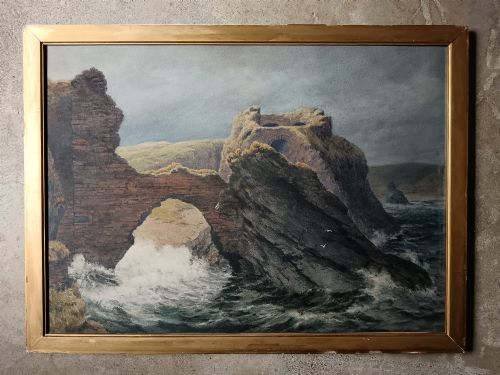
A coastal cliff watercolour painting depicts rugged British and Irish shorelines, featuring dramatic rock faces, turbulent seas, and historic seaside towns. These works span the Victorian era, the Edwardian period, and into the nineteen thirties, capturing the changing light of the coast.
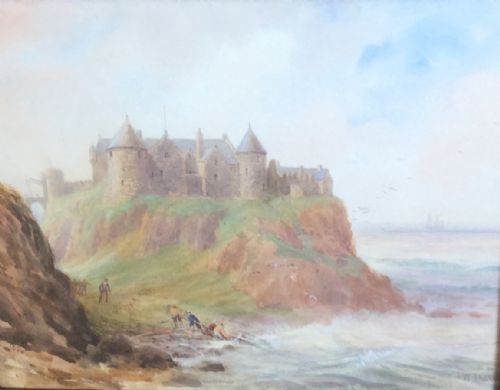
The subjects range from Scottish castles and Yorkshire piers to Devon chalk cliffs and Irish ruins. Most pieces on this page originate from the nineteenth century and the early decades of the twentieth century, created by named British and Irish artists.
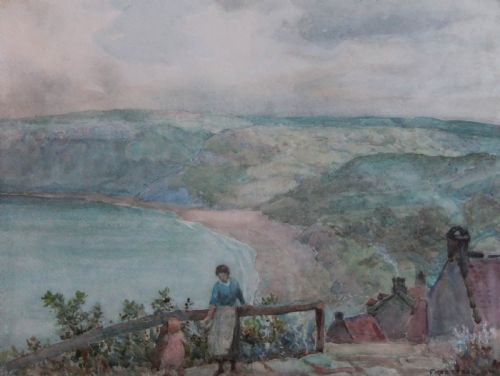
Compositions often include human elements such as fishermen, families on pebble beaches, and working fishing boats alongside the grandeur of the cliffs. Framed behind glass in wood or gilt wood frames, these watercolours offer a direct window into historical coastal views.
Materials and methods
Artists applied watercolour pigment directly onto heavy paper sheets, utilising the white of the unpainted paper to capture the bright glare of sea foam and chalk cliffs. This transparent medium allowed painters to build subtle washes of colour for the sky and sea while retaining luminous clarity.
Finished watercolours were housed behind protective glass and secured within traditional wood frames, frequently finished in gilt to complement the palette of the painting. The combination of water-soluble pigments and robust paper supports has preserved these coastal scenes over many decades.
Several paintings include tiny families and fishermen dotting the pebble beaches, reminding us that Victorian day-trippers loved bracing cliff walks just as much as we do.
Judging quality in coastal watercolours
Quality rests in the artist's handling of light and atmospheric perspective, distinguishing atmospheric topographical records from rigid illustrations. Stronger works convey the movement of the tide and the texture of weathered rock through confident brushwork.
The preservation of the pigment also dictates the desirability of a piece, as exposure to strong light can fade delicate watercolours over time. Original period framing, particularly period gilt wood surrounds under glass, adds significantly to the integrity of the work.
John Moxon·Sir Thomas Newenham Dean·Stephen John Batchelder·Joseph Newington Carter·Rowland Henry Hill·Fred Stead·Joseph William Carey·George Marks·Henry Valter
The Coastal Cliff Watercolour Painting Glossary
- Watercolour
- A painting method where natural pigments are suspended in a water-soluble vehicle and applied to paper. It relies on the luminosity of the paper background to shine through thin washes of colour.
- Topographical Landscape
- An artwork that accurately records a specific geographic location or named view. These pieces serve as historical documents of particular coastal towns and cliffs.
- Gilt Wood
- Timber framing finished with a thin layer of gold leaf or metallic gilt paint. It was commonly used in the nineteenth century to enhance the richness of framed watercolours.
- Pigment
- The finely ground natural or synthetic coloured powder that forms the basis of the paint. In these works, pigments are bound together and applied to paper surfaces.
Coastal Cliff Watercolour Painting: Frequently Asked Questions
How should I hang a coastal cliff watercolour painting?
Keep watercolours away from direct sunlight to prevent the pigments from fading over time. Position them on interior walls where light levels remain stable and moderate.
Ensure the room humidity stays consistent to protect both the historic paper and the wooden frame. Professional picture wire and secure fixings will safely support the weight of the glass and frame.
Are these coastal scenes genuine period works?
The works featured here date from the nineteenth and early twentieth centuries, reflecting the artistic styles and framing techniques of those eras. Signatures, artist biographies, and period materials help confirm their origins.
Examining the backboards, framing methods, and paper ageing provides further context for dating each specific piece. These indicators connect the paintings directly to Victorian and Edwardian traditions.
What subjects appear in these watercolours?
The paintings record specific British and Irish locations, including Yorkshire bays, Scottish castles, and Devon chalk cliffs. Artists frequently included local figures such as fishermen, families on pebble beaches, and working boats.
These details ground the landscapes in everyday nineteenth and early twentieth century coastal life. Each scene offers a specific topographical record combined with atmospheric marine weather.