
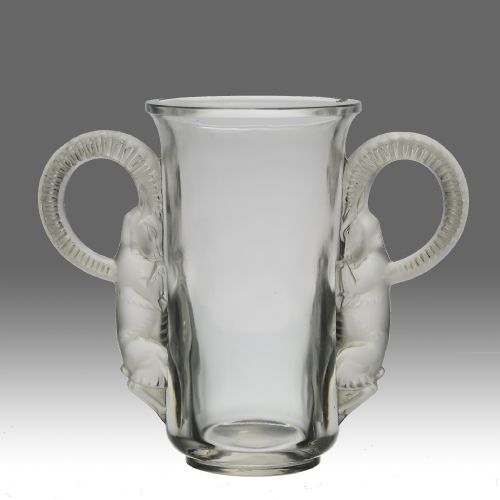


Clear Crystal Urn
These clear crystal urn pieces bring together heavy lead crystal and classic forms, offering both ornamental presence and practical utility.
Clear Crystal Urn
A clear crystal urn search covers decorative vessels, lidded jars, and display vases spanning the Victorian, Edwardian, and Art Deco periods. These objects serve primarily as mantel ornaments, table centerpieces, or lidded storage pieces for the home.
The most common examples encountered in this selection include Victorian cut glass lidded jars, Edwardian vases, and twentieth-century French glass works. Pieces range from large classical revival vessels to modernist moulded forms from the nineteen-twenties.
Makers and origins vary from English workshops to French studios and Bohemian glasshouses, often incorporating metal mounts or engraved surface decoration alongside the clear material.
Materials and production methods
Production relies on heavy lead crystal or clear glass, shaped either by free-blowing into moulds or by heavy mechanical cutting. Artisans then refine the surface using abrasive wheels to create deep facets, flutes, and geometric patterns that catch the light.
Late nineteenth and early twentieth-century pieces frequently utilise acid-etching or frosted finishes alongside polished clear surfaces to create contrast. Some examples incorporate additional elements such as paste gilt decoration or Dutch silver covers.
The heavy walled vessels require controlled cooling in a lehr to prevent internal stress within the thick glass or crystal structure during manufacture.
Listings feature periods spanning from Regency and Victorian eras through to Edwardian and Art Deco twentieth-century production.
Assessing craftsmanship and execution
Quality in these vessels depends on the crispness of the cutting and the purity of the material itself. Superior examples display sharp facet junctions and minimal internal bubbles or impurities within the heavy crystal body.
The weight and balance of the object indicate the density of the lead content and the skill involved in forming thick-walled vessels. Surface polish within the cut grooves also distinguishes masterwork production from standard commercial output.
René Lalique
The Clear Crystal Urn Glossary
- Lead crystal
- Glass containing a significant proportion of lead oxide, which increases the weight, refractive index, and clarity of the material. This composition allows for deeper and sharper facets during the cutting process.
- Sweetmeat jar
- A covered vessel originally designed for holding preserved fruits, sweets, or confections during the eighteenth and nineteenth centuries. These pieces often feature footed bases and decorative matching lids.
- Cut glass
- Glass decorated by abrading the surface on rotating wheels to produce geometric or floral patterns. The technique exposes the refractive qualities of thick-walled vessels.
- Frosted glass
- Glass treated with acid or sandblasting to create a matte, translucent surface texture. This finish provides contrast against polished clear crystal sections.
- Overlay
- A technique where a layer of coloured glass is cased over a clear glass body and partially cut away to reveal the contrasting layer underneath.
Clear Crystal Urn: Frequently Asked Questions
How were crystal urns originally used?
These lidded vessels and urns served primarily as decorative garniture on mantelpieces, sideboards, and occasional tables in formal rooms. Many held sweets, potpourri, or simply displayed the reflective quality of the heavy crystal.
Larger scaled examples functioned as decorative focal points in nineteenth-century interiors, often matched in pairs to balance a mantel arrangement.
How do I distinguish Victorian from Art Deco pieces?
Victorian examples generally feature deep hand-cut geometric facets, panel cutting, and ornate decorative lids with heavy classical proportions. They rely on traditional symmetry and high-relief ornamentation.
Art Deco items from the nineteen-twenties often incorporate frosted surfaces, stylised natural motifs, and bolder moulded forms associated with French studio production.
Are these pieces made of lead crystal?
Many examples from the nineteenth and twentieth centuries utilise heavy lead crystal to achieve high refractive brilliance and depth in the cut patterns. The increased density gives the objects substantial weight for their size.
Some lighter or simpler vessels are formed from standard clear glass rather than full lead crystal, depending on the period and place of manufacture.
How should I clean heavy cut crystal urns?
Wash these vessels by hand in warm water using a mild liquid detergent, avoiding sudden temperature changes that can crack thick glass. Lining the sink with a towel prevents accidental chipping of the heavy rims and bases.
Dry the pieces immediately with a lint-free cloth to maintain the sparkle of the cut facets and prevent water spots from forming on the polished surface.