
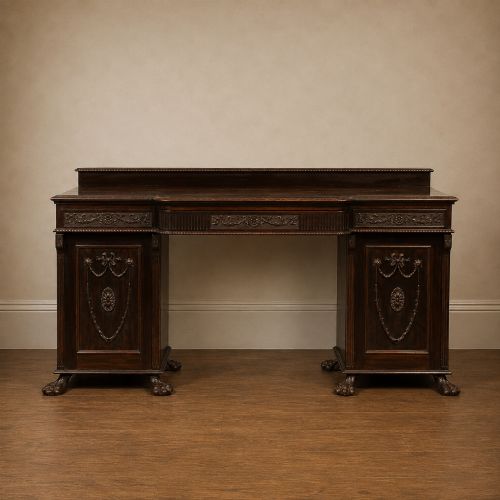
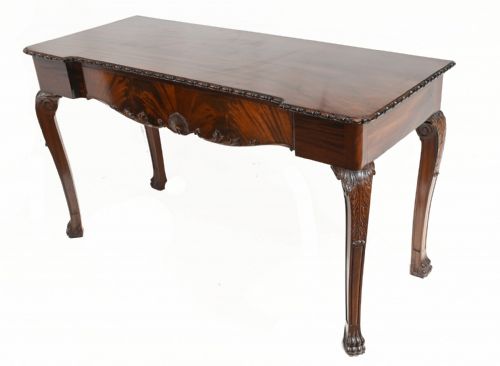
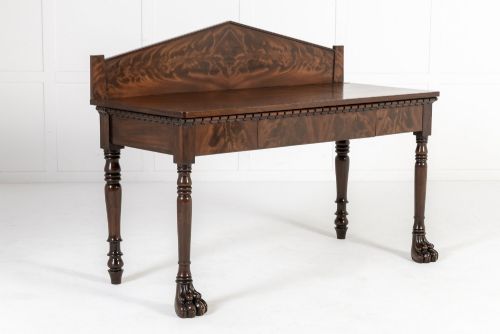


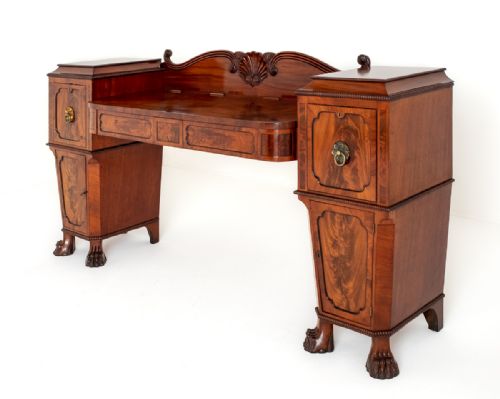


Claw Foot Server Table
A claw foot server table brings strong timber and robust paw supports into a dining room or hallway, offering a surface built for practical use.
Claw Foot Server Table
A claw foot server table encompasses robust dining and hallway furnishings designed primarily for serving food or displaying decorative objects. The forms seen across these listings include sideboards, serving tables, console tables, and side tables.
The versions most commonly met span the nineteenth century, including Georgian and Edwardian revivals alongside pieces from the Regency era. Cabinetmakers constructed these heavy pieces to anchor formal dining spaces with deep proportions and substantial timber frames.
Makers often drew upon classic design motifs, resulting in pieces labelled under styles such as Irish Regency, Adam Revival, Baroque, and Chippendale Revival. This variety ensures that a buyer investigating a claw foot server table will encounter significant detailing in the carving and edge work.
How they were made
Makers relied heavily on solid mahogany and flame mahogany veneer, supplemented by structural oak and occasional timber painted in monochrome or polychrome schemes. Cabinetmakers applied gold leaf to accentuate carved details on specific revival pieces.
Carving formed the primary decorative technique, particularly around the paw feet and aprons where craftsmen shaped the timber into animalistic or scroll forms. Brass hardware and fittings occasionally appeared on drawers and mounts to complement the dark wood tones.
Listings span the nineteenth and twentieth centuries, incorporating Georgian, Regency, and Edwardian revivals executed primarily in mahogany, oak, and flame mahogany veneer.
What varies in quality
Quality rests upon the depth and definition of the timber carving, particularly around the paw feet where the skill of the hand carver determines the sharpness of the claws. Plain turned legs sit at the lower end of the spectrum, while deeply undercut paws attributed to known workshops represent the upper tier.
The selection of veneers dictates visual appeal, with symmetrical flame mahogany panels commanding greater attention than plain or poorly matched timber surfaces. Construction integrity, seen in the thickness of the mahogany top and the weight of the supporting frame, separates standard production from superior cabinet work.
Gillows·Robert Strahan & Co
The Claw Foot Server Table Glossary
- Breakfront
- A piece of furniture whose central section projects forward from the flanking wings. This layout creates depth and visual rhythm across the front of a sideboard or serving table.
- Console table
- A table designed to be fixed against a wall, frequently supported by ornamental brackets or front legs. These tables often served decorative purposes in grand hallways and formal reception rooms.
- Flame mahogany veneer
- A thin slice of mahogany cut from the fork of the tree where branches meet the trunk, revealing a characteristic fiery, undulating grain pattern. Cabinetmakers laid this over a stable secondary wood to create striking patterned surfaces.
- Paw feet
- Carved furniture supports shaped to resemble the foot of a beast, often grasping a ball or resting flat on the floor. They form a defining visual anchor on heavy dining and serving furniture.
Claw Foot Server Table: Frequently Asked Questions
What is a claw foot server table used for?
These tables served primarily as surfaces for holding dishes, platters, and serving utensils during large meals in formal dining rooms. They also functioned as console tables in grand hallways for displaying ornamental objects.
Today, they suit similar roles in domestic interiors, providing generous surface area and sturdy storage or display space against a wall.
How do I identify the period of a claw foot server table?
Dating relies on examining the timber species, construction methods, and stylistic revival cues present in the carving and overall silhouette. Pieces span the Georgian, Regency, and Edwardian eras, often reflecting the design vocabulary of earlier centuries through later revivals.
Comparing the drawer linings, backboards, and secondary timbers helps clarify whether a piece dates to the original period or a later nineteenth-century revival.
Where should I place a claw foot server table?
A claw foot server table requires a solid wall position, either in a dining room behind a dining table or along a spacious hallway or drawing-room wall. Because many feature finished fronts intended as focal points, they need adequate floor space to let the carved paw feet and timber grain show.
Avoid placing heavy timber furniture in direct sunlight or close to active heat sources to protect the mahogany and veneer from drying out.
What wood was used for a claw foot server table?
Mahogany served as the predominant timber, chosen for its rich colour, density, and stability under intricate carving tools. Cabinetmakers frequently employed flame mahogany veneer on drawer fronts and top surfaces to provide dramatic grain patterns.
Secondary woods like oak appeared in drawer construction and internal framing, while occasional pieces incorporated paint and gold leaf for decorative emphasis.