
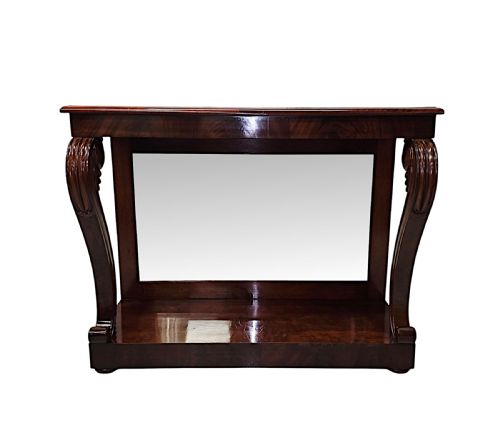
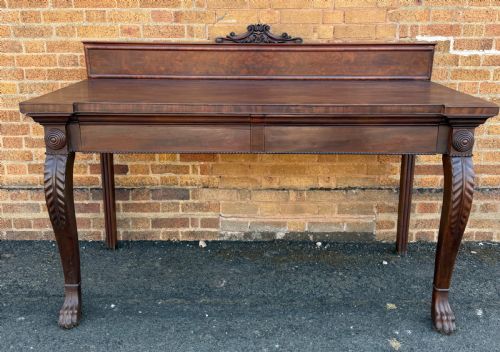


Irish Regency Console
An irish regency console brings monumental Dublin craftsmanship into a room, offering striking architectural presence and rich timber figures.
Irish Regency Console
An irish regency console represents a specific high point in cabinet making, uniting classical proportions with robust regional design. When searching for an irish regency console, buyers encounter grand serving tables, library tables, and wall consoles spanning the early nineteenth century and the Georgian period. Mahogany and pollard oak dominate these forms, often showing bold carved details and substantial scale.
Makers working in Dublin during this era produced pieces that combined British Regency vocabulary with distinct Irish heaviness and vigour. Pieces range from formal serving tables attributed to major workshops down to side tables and tea tables. The inventory shows examples stretching from George III roots through William IV interpretations.
Materials and construction
Makers selected dense hardwoods such as flame mahogany and pollard oak, applying them over solid oak and pine carcases to achieve deep natural grain patterns. Brass mounts and occasionally glass components appear as structural or decorative accents on the finer library and console tables. Timber selection focused on rich figuring, particularly on top surfaces designed to catch the light.
Joinery techniques relied on heavy framing and substantial timber thicknesses to support the imposing scale typical of Dublin workshops. Carving was executed directly into solid mahogany, producing crisp mouldings and robust structural supports without relying on applied composition ornament.
Even a simple tea table from this group was built heavy enough to withstand Dublin hospitality.
Judging quality and execution
The distinction between standard production and top workshop execution lies in the depth of the carving and the choice of primary veneers. Tables carrying attribution to known Dublin firms display superior timber selection, particularly in figured pollard oak and flame mahogany tops. Proportions remain the key indicator, with superior examples maintaining balanced classical lines despite their heavy scale.
Original brass work and untouched surface patination separate preserved specimens from heavily restored alternatives. The crispness of hand-carved details on friezes and legs distinguishes skilled cabinet work from simpler provincial output.
Gillingtons of Dublin·Robert Strahan and Co·Mack Williams and Gibton·Williams and Gibton of Dublin
The Irish Regency Console Glossary
- Console table
- A table designed to stand against a wall, frequently secured to it with brackets for stability. These tables form the core of the irish regency console selection.
- Serving table
- A large side table used in dining rooms for the presentation of food and plate. Many examples in the evidence share forms with console tables.
- Pollard oak
- Timber taken from the upper branches of pollarded trees, yielding a tightly clustered, speckled grain pattern. It appears on library tables from major Dublin makers.
- Flame mahogany
- Mahogany veneer cut to reveal a distinctive flamed or fire-like grain figure. Cabinet makers reserved this timber for prominent top surfaces.
- Serving or console table
- A hybrid term used in trade descriptions for large side furniture that could function in either a dining or reception room context.
Irish Regency Console: Frequently Asked Questions
What is an irish regency console?
An irish regency console is a heavy nineteenth-century side or serving table produced in Dublin, known for bold carved ornament and rich mahogany or pollard oak.
These pieces served formal reception and dining rooms, reflecting classical architectural influences interpreted by local cabinet makers.
How do I style an irish regency console?
Place the table against a prominent wall in a hallway, drawing room, or dining space where its architectural scale can anchor the room.
Keep surrounding objects balanced and minimal to let the strong timber grain and carved details remain the visual focus.
How do I date an irish regency console?
Examine the timber species, secondary woods like oak framing, and stylistic markers that bridge late Georgian and William IV design.
Attributions to recorded Dublin firms or specific carved motifs often narrow the date of manufacture to the early nineteenth century.
Were these tables used for dining?
Many examples catalogued as serving tables functioned in dining spaces to hold silver, glass, and dishes during meals.
Console variants functioned primarily as decorative furniture against reception room walls, though forms often overlapped.