
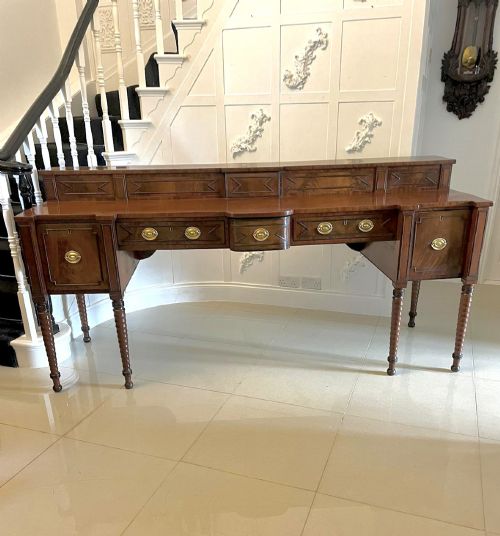
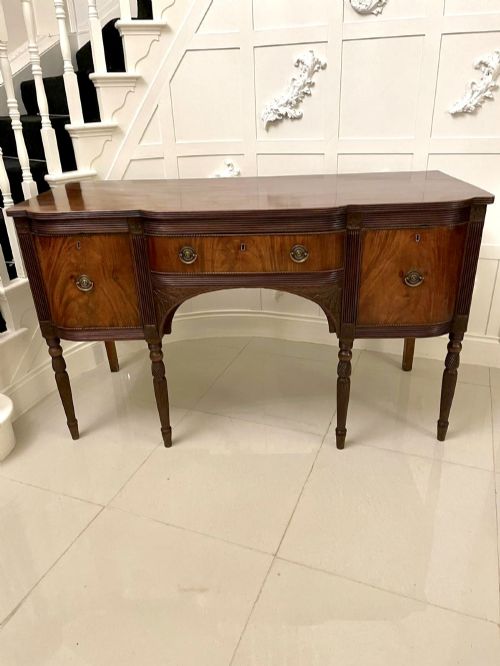


Reeded Mahogany Sideboard
When you want a reeded mahogany sideboard, you are after a functional anchor for a dining room that brings distinct grain and carved vertical moulding.
Reeded Mahogany Sideboard
A reeded mahogany sideboard offers a long surface for serving and deep storage beneath, taking forms such as breakfronts, bow fronts, and serpentine shapes. The selection leans heavily towards the Regency and Georgian periods, alongside later Victorian, Edwardian, and Sheraton Revival interpretations.
Makers and workshops of the era produced serving tables, chiffoniers, and side cabinets in addition to standard sideboards. These items serve as practical dining room furniture while displaying the rich figuring of timber worked by cabinetmakers centuries ago.
How they were made
Cabinetmakers constructed these pieces primarily from solid mahogany and flame mahogany veneer, often accentuating the design with ebony, boxwood, and other wood inlays. Structural details were finished with brass fittings, while some associated lighting pieces incorporated fabric and ceramic.
The characteristic reeding - series of parallel, rounded convex mouldings - was carved directly into the solid mahogany legs or frame members. Workshops employed precise joinery to marry flame veneer surfaces with structural framing, ensuring stability across wide serving tops and cabinet doors.
Some sideboards harbour hidden cellaret drawers designed to keep your claret cool on hot Georgian afternoons.
What varies in quality
The distinction between standard items and superior examples rests on the selection of timber and the crispness of the carving. Flame mahogany veneer displays striking figuring across the drawer fronts, while finer pieces show exceptionally sharp execution in their reeded mouldings and inlay work.
Attribution to notable workshops like Gillows or makers such as Robert Strahan & Co elevates an item through documented standards of construction and proportion. The integration of original brass hardware and well-figured secondary timbers further separates exceptional pieces from simpler vernacular work.
Gillows·Robert Strahan & Co
The Reeded Mahogany Sideboard Glossary
- Reeding
- Parallel rows of convex mouldings carved into wood, frequently seen running down the legs or framing of Regency furniture.
- Breakfront
- A cabinet or sideboard whose central section projects forward from the flanking outer sections.
- Serpentine
- A front contour that curves outward in the middle and inward towards the ends in a continuous wave shape.
- Flame mahogany
- A veneer cut from timber where the grain creates a dramatic, flamelike pattern across the surface.
- Chiffonier
- A small sideboard or low cabinet equipped with doors, popular during the Regency and Victorian eras.
Reeded Mahogany Sideboard: Frequently Asked Questions
How do I spot a Regency sideboard?
Regency sideboards typically feature architectural lines influenced by classical antiquity, often utilising brass gallery rails, lion mask ring handles, and finely turned reeded legs. They discard heavy baroque carving in favor of clean mahogany surfaces punctuated by subtle ebony or boxwood stringing.
You will frequently encounter bow-front or straight-front carcasses that prioritize the natural figure of the timber over excessive ornamentation. Proportions tend to be robust yet elegant, designed specifically for the formal dining rooms of the early nineteenth century.
How do I care for mahogany?
Mahogany furniture requires stable indoor humidity and protection from direct sunlight to prevent the timber and its delicate veneer from drying out or fading. Regular dusting with a soft, dry cloth maintains the surface without the buildup of heavy silicone polishes.
Feeding the wood occasionally with traditional beeswax preserves the depth of the flame veneer and protects the finish. Avoid placing hot dishes or wet glasses directly onto the surface to safeguard the historic polish.
How do I tell Georgian from Victorian?
Georgian pieces, spanning the eighteenth century into the Regency period, generally emphasise restraint, classical proportions, and understated inlay work. Their construction utilises solid timbers and thoughtful placement of flame mahogany veneer to create balanced, functional serving furniture.
Victorian items, produced later in the nineteenth century, often incorporate heavier dimensions, bolder carvings, and more eclectic revival styles. They tend to feature more expansive cabinet interiors and integrated superstructure galleries suited to changing dining customs.