
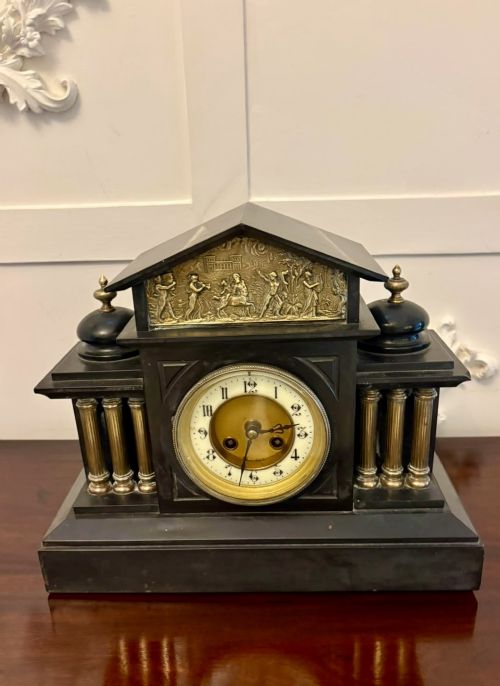


Classical Revival Clock
A classical revival clock brings severe architectural columns, gilt brass and black marble into the room with unapologetic Victorian weight.
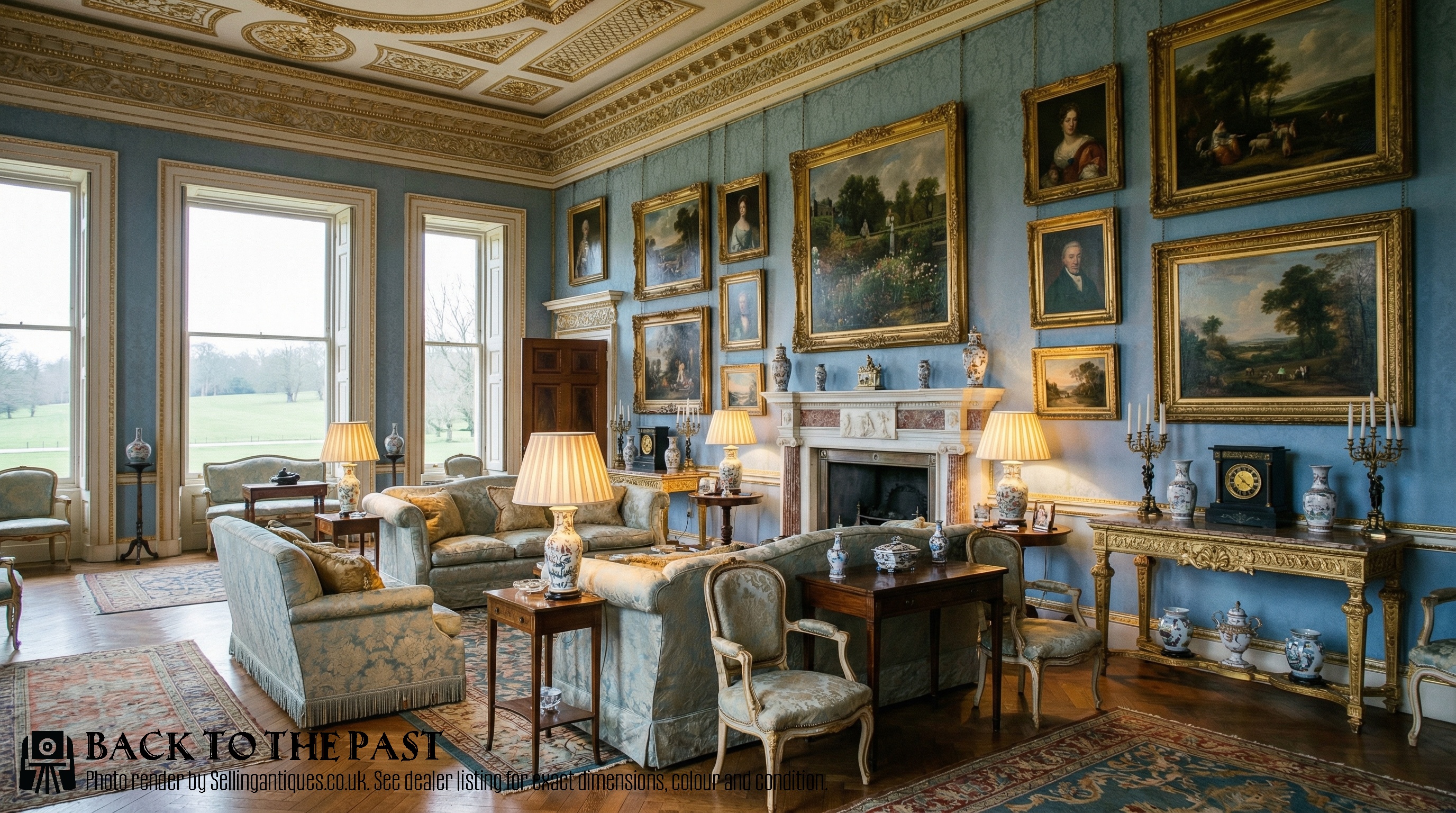
Classical Revival Clock
A classical revival clock is typically a substantial mantel clock drawing on ancient architectural motifs, architectural forms and classical proportions. The examples seen here belong mainly to the Victorian period, spanning the decades from eighteen sixty to eighteen ninety, alongside nineteenth-century French work.
Buyers encounter heavy black marble and slate cases paired with bright brass or ormolu mounts, frequently built as architectural facades with columns and pediments. Mantel clocks and bracket clocks dominate the forms, sometimes accompanied by matching side pieces in a clock set.
Origin plays a direct role in the design language, with French workshops producing gilt metal, bronze and crystal regulator clocks by makers such as Samuel Marti and P.H. Mourey alongside domestic Victorian pieces.
How they were made
The construction relies on heavy stone bodies of black marble and slate, cut and polished to resemble monumental architecture. These stone carcasses are then dressed with cast ormolu, gilt brass and bronze mounts, often housing eight-day mechanical movements behind glass and enamel dials.
French makers utilised precision cast brass and gilt metal for decorative details, while cases combined contrasting dark stone with bright metallic gilding. Enamel dials provide the crisp white face against which black Roman numerals and delicate hands track the hours.
Classical Revival Clock Retail Price Guide 2026
Typical asking prices for classical revival clock among the pieces listed under this phrase on Sellingantiques today, from the lower quarter to the upper quarter. They describe what is for sale here now, not the wider market.
Listings feature black marble, slate, ormolu and brass across Victorian and nineteenth-century periods.
What varies in quality
Quality reveals itself in the architectural ambition of the case, separating simple stone boxes from elaborate facades featuring engaged columns, bronze figures and intricate ormolu mounts. The precision of the stonework and the sharpness of the cast metal details dictate the standing of a piece.
Signed movements by known makers elevate a clock above standard workshop production, demonstrating superior mechanical execution alongside the decorative ambition of the bronze, marble or gilt brass exterior.
Philippes Paris·Samuel Marti·Barraud & Lunds·P.H Mourey
The Classical Revival Clock Glossary
- Ormolu
- Gilded bronze, where finely ground gold is amalgamated with mercury and applied to a bronze base through heat. This technique creates a rich, durable golden finish characteristic of French nineteenth-century clock cases.
- Crystal Regulator
- A clock housed in a glazed brass or gilt frame that allows light to pass through the sides and back. These French pieces showcase the pendulum and movement from multiple angles.
- Bracket Clock
- A portable clock originally designed to sit on a wall bracket or table. Victorian examples often feature ebonised wood or stone cases with heavy mechanical movements.
- Slate
- A fine-grained metamorphic rock used extensively for Victorian clock cases. It takes a smooth, dark polish that mimics black marble at a lower weight and cost.
- Eight-Day Movement
- A mechanical clock movement requiring winding once a week. This denotes a standard of domestic utility found across the better quality Victorian and French pieces.
Classical Revival Clock: Frequently Asked Questions
What is a classical revival clock?
A classical revival clock is a nineteenth-century timepiece inspired by ancient Greek, Roman or Renaissance architecture. These clocks use heavy materials like black marble, slate, bronze and gilt brass to create miniature temples and facades on the mantelpiece.
They emerged strongly during the Victorian era and the French Belle Epoque, combining mechanical clockwork with sculptural ornamentation.
How do I wind an eight day movement?
An eight-day movement requires a key inserted into the dial holes to tension the mainsprings every week. Care must be taken not to overwind the springs, stopping as soon as resistance increases.
These mechanical movements keep time through an escapement and pendulum, which may need occasional beat adjustment if the clock sits on an uneven mantel.
Are crystal regulators different from standard clocks?
Crystal regulators feature glass panels on all four sides held within a brass or gilt frame. This design exposes the entire movement and pendulum to view.
Originating largely from late nineteenth-century French workshops, they emphasise transparency and delicate mechanical display over heavy stone architecture.
How do I tell French and Victorian clocks apart?
French clocks frequently utilise ormolu, bronze, and glass crystal regulator designs stamped with maker names like Samuel Marti or P.H. Mourey. Victorian pieces often lean into heavier black marble, slate, and architectural bracket clock formats.
Both traditions intersect during the nineteenth century, as British buyers readily imported French movements and decorative metalwork for domestic mantelpieces.