
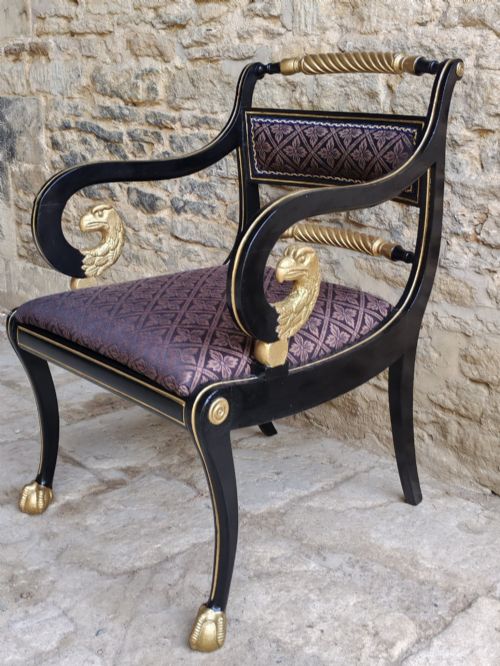
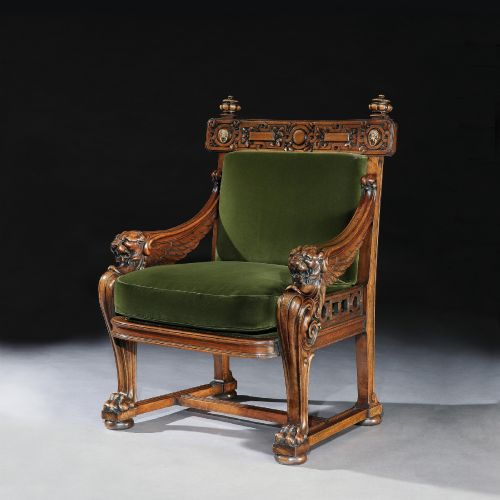
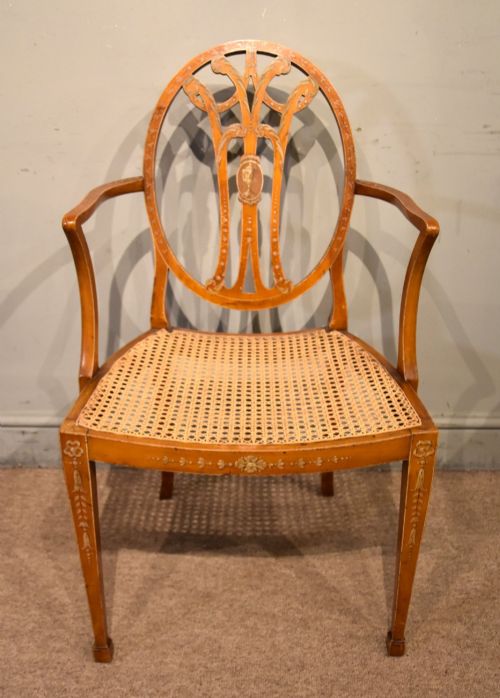
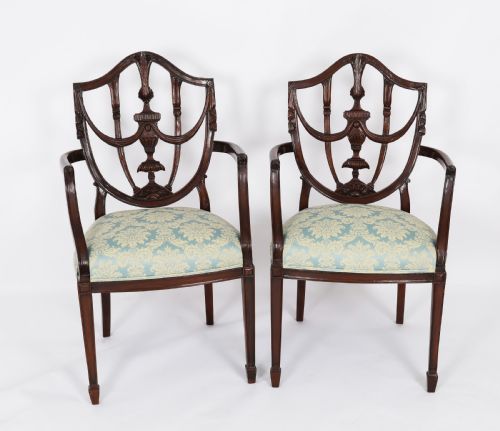
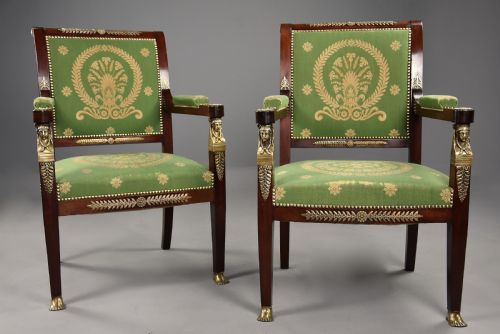


Classical Revival Armchair
These classical revival armchair examples bring sculptural dignity and historic form to any room.
Classical Revival Armchair
A classical revival armchair is a seating form drawing directly upon the architectural vocabulary of antiquity, translating ancient motifs into domestic furniture.
You will most frequently meet pieces from the Edwardian period and the nineteenth century, alongside examples styled after Regency and French Empire designs.
These chairs combine robust timber structures like mahogany and oak with ornate decorative elements including parcel gilt finishes and inlaid wood.
How they were made
Cabinetmakers utilised dense timbers such as mahogany and oak to construct sturdy frames capable of supporting intricate carving and classical proportions.
Surface decoration relied upon careful inlay work, satinwood painting, and parcel gilt highlights to accentuate the architectural lines of the frame.
Upholstery completed the seating, frequently employing rich velvet or durable fabric to contrast against the polished wood and brass details.
Materials across these listings include mahogany, oak, beech, brass, and velvet.
What varies in quality
The sophistication of the carved ornament and the precision of the inlay largely determine the standing of an individual chair within its period.
Proportion and execution distinguish ambitious interpretations after designers like Thomas Hope from more modest workshop productions of the later nineteenth century.
The Classical Revival Armchair Glossary
- Monopodia
- A carved furniture support taking the form of a single lion's leg and paw, derived from ancient Roman and Greek stone tables. This motif adds fierce classical authority to nineteenth century seating.
- Fauteuil
- A French term for an open armchair with upholstered back and armrests, possessing exposed wooden framing. These chairs frequently showcase the influence of French Empire style.
- Parcel Gilt
- A decorative technique where specific carved details or mouldings are partially covered in gold leaf while the surrounding wood remains visible. It highlights classical relief work.
- Satinwood
- A pale, lustrous timber native to India and Ceylon, prized for its fine grain and reflective quality. Cabinetmakers utilised it extensively for painted and inlaid Edwardian furniture.
Classical Revival Armchair: Frequently Asked Questions
What is a classical revival armchair?
A classical revival armchair is a seating piece designed during the nineteenth or early twentieth century using decorative motifs borrowed directly from ancient Greece and Rome.
These designs often incorporate sculptural elements like lion monopodia or architectural frames intended to project historic grandeur.
How do I date these armchairs?
Dating relies on examining the timber, the construction techniques, and the specific stylistic revival movement evident in the carving and upholstery.
Evidence from this category spans from the Regency era through Victorian interpretations and Edwardian adaptations.
Where were these chairs placed?
Historically, such prominent seating occupied libraries, formal reception rooms, and parlours where guests would observe their striking silhouettes.
Their architectural forms were intended to signal the owner's classical learning and refined taste.
Are these chairs comfortable?
While built with sturdy wooden frames and upholstered seats, their primary purpose historically included a strong decorative and formal function.
Modern comfort depends on the specific depth of the seat and the padding style employed within the fabric or velvet upholstery.