


Savonarola Style Chair
A savonarola style chair brings rhythmic X-frame geometry and historical presence to an interior, drawing on centuries of revivalist design.
Savonarola Style Chair
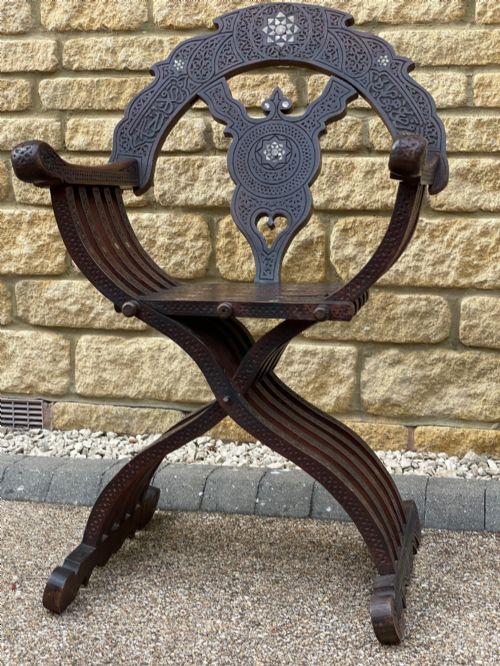
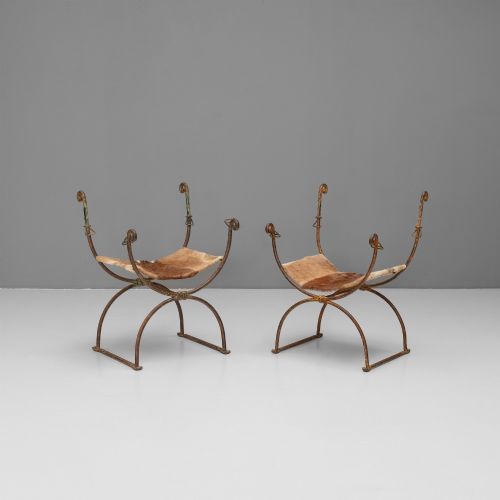
A savonarola style chair is a folding or X-framed seat taking its lineage from Renaissance forms, frequently identified in the evidence through armchairs, side chairs, and stools. These pieces arrive in various revivals, including Renaissance, Moorish, Gothic, and Spanish interpretations.
Most examples found in the listings date from the nineteenth century into the early twentieth century, spanning decades such as eighteen-eighty, nineteen-hundred, and nineteen-thirty. The primary forms rely on intersecting slats that create a curule or scissor support structure.
Makers and regions diverge widely, with items originating from Syrian, Indian Hoshiarpur, Austro-Hungarian, and Andalucian workshops. Buyers meet both sturdy walnut armchairs and lighter folding variations intended for occasional placement.
What varies in quality
Quality rests on the precision of the joinery where the intersecting slats meet, determining whether the X-frame operates smoothly or sits rigidly without wobble. Superior pieces display crisp carving and tight structural alignment rather than loose joints.
The density and execution of surface decoration dictate the tier of the piece, from plain timber frames to densely detailed surfaces featuring complex mother-of-pearl or bone inlay. The integrity of the original materials, such as intact nacre-shell segments and period leather, elevates the standing of the work.
The inventory spans nineteenth-century revivals from Spain, Syria, India, and Austro-Hungary.
White Allom and Co
The Savonarola Style Chair Glossary
- X-frame
- A structural base formed by curved slats crossing in a scissors configuration. This design provides the foundational support for folding and curule chairs.
- Curule
- An ancient magistrate chair shape featuring opposing curved legs. It translates directly into the X-frame geometry seen in nineteenth-century revivals.
- Nacre-shell
- Mother-of-pearl inlay material harvested from mollusc shells. Artisans set small geometric pieces into wood surfaces across Middle Eastern and Indian workshops.
- Renaissance Revival
- A nineteenth-century design movement mimicking sixteenth-century forms. It accounts for many of the carved walnut and ebonised armchairs in this category.
- Hoshiarpur
- A town in India known for intricate wood carving and inlay work. Pieces from this region utilise brass and bone inset into hardwood frames.
Savonarola Style Chair: Frequently Asked Questions
Are these chairs comfortable for daily sitting?
Most of these seats are firm upright furniture designed for halls, studies, or accent placement rather than lounging. Many feature wooden slats, leather pads, or tight textile seats that encourage an erect posture.
Adding a small cushion can soften the timber backrest, but the rigid X-frame geometry remains fixed and supportive rather than yielding.
Do savonarola chairs actually fold up?
Many examples retain the original scissor-action engineering that allows the frame to collapse flat for transport or storage. This folding capability stems from the pivoting joint where the intersecting slats cross at the centre.
Fixed versions also exist where the X-frame is permanently secured with dowels or glue, prioritizing stability over portability.
How do I identify a Syrian or Middle Eastern example?
Syrian and Middle Eastern pieces typically feature dense geometric mother-of-pearl or bone inlay across walnut or fruitwood surfaces. The woodwork often displays intricate star patterns and Moorish or Ottoman architectural motifs.
In contrast, European revival pieces rely more heavily on deep relief carving, ebonising, and heraldic crests without shell inlay.
Where should I place an X-frame chair in a room?
These chairs work well as occasional seating in hallways, libraries, or corners where their architectural silhouette can be viewed from the side. Because the intricate inlay or carved frame is the main attraction, they benefit from open placement rather than being pushed deep under a desk.
Pairing a single armchair with a plain wall or simple table lets the complex geometry stand out.