




Classical Ormolu Candelabra
Classical ormolu candelabra bring the warm glow of nineteenth-century French and English salons into a modern room through gilded bronze and marble.
Classical Ormolu Candelabra
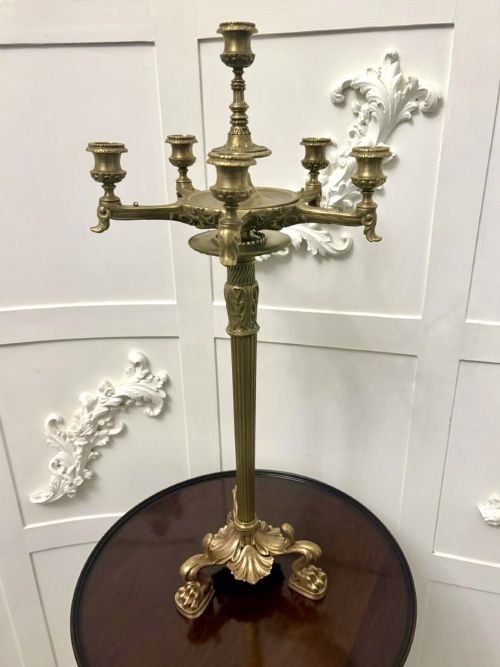
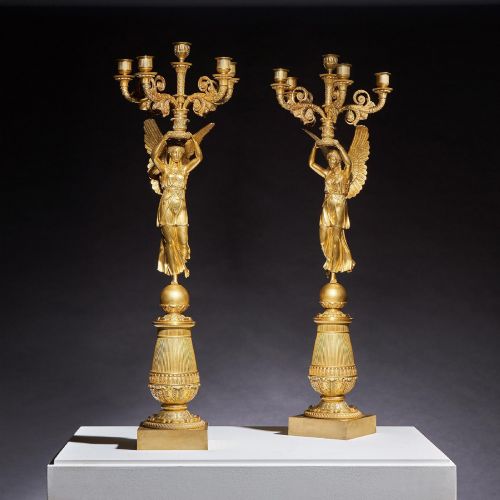
When you search for classical ormolu candelabra, you are looking at nineteenth-century lighting fixtures designed to hold multiple candles upon elaborate tiered branches. These pieces span French Empire, Louis XVI Revival, and Regency styles, reflecting classical motifs and mythological figures cast in bronze.
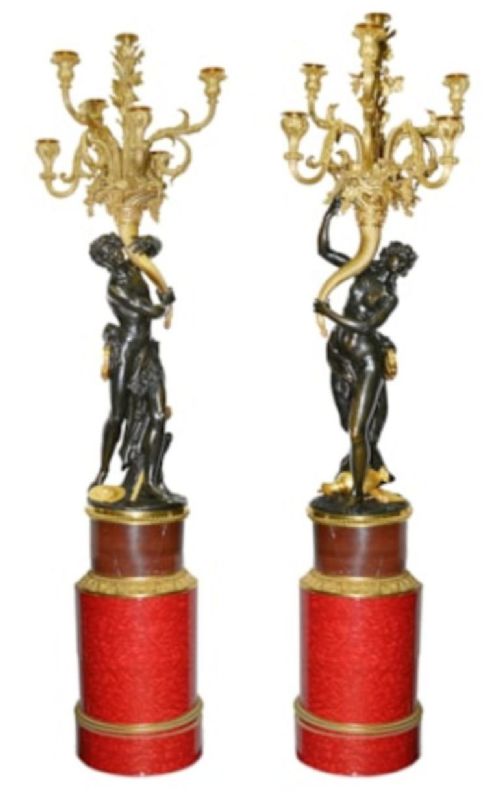
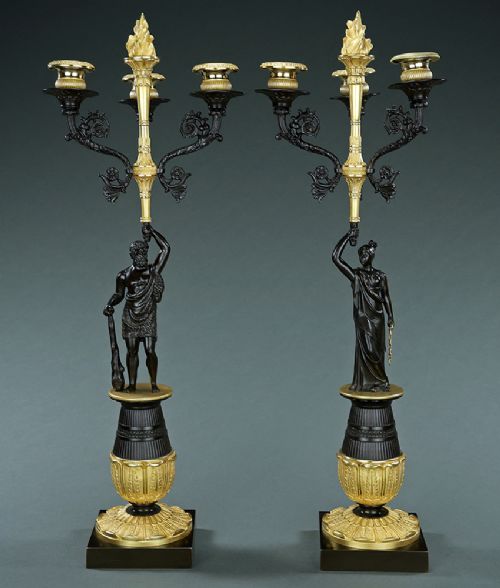
The most common version you will meet on this page is a matched pair originating from French workshops, often featuring patinated bronze figures contrasted against bright gilt metal. Alongside standard candelabra, the listings include related garniture clock sets and wall sconces sharing the same decorative vocabulary.
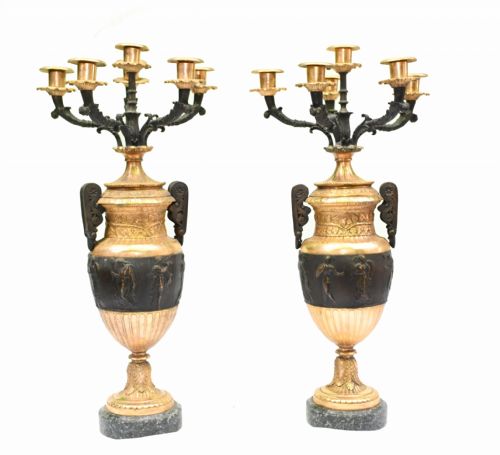
Originating largely from the nineteenth century, these objects range from restrained neoclassical designs to heavily ornamented Victorian interpretations. They frequently incorporate white marble, porphyry, or slate bases that anchor the soaring gilded branches above.
Materials and Technique
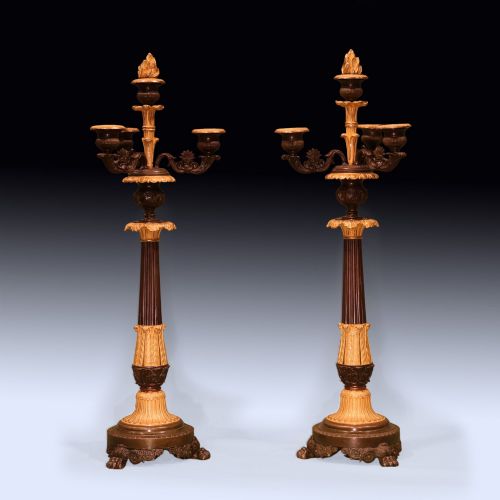
The making of these pieces relied heavily on mercury gilding or fire-gilding techniques applied to cast bronze, creating the distinctive rich surface known as ormolu. Artisans combined this luminous gilt finish with dark patinated bronze to create striking tonal contrasts across the figures and foliage.
Marble and slate were turned and polished to form heavy architectural bases that supported the complex metal structures. Individual branches and candle nozzles were cast separately and joined with threaded pins, allowing for intricate multi-arm configurations.
Several pairs feature cherubs perched precariously among the candle branches, seemingly caught in the act of playing music or tumbling through the gilt foliage.
Craftsmanship and Proportion
The harmony of the overall silhouette separates superior pieces from ordinary ones, particularly in how the arms sweep outward from the central stem. Selection of base materials also matters, with dense marbles and porphyry indicating higher ambition than simpler turned stones.
Pierre Philippe Thomire·Rabiat·Thiebaut Freres·H Luppens Paris·Deniere Paris·Thomas Hope
The Classical Ormolu Candelabra Glossary
- Ormolu
- A method of applying finely ground high-carat gold amalgam to a bronze object, which is then heated to drive off the mercury and leave a durable golden coating. This technique produced the brilliant, warm metallic lustre characteristic of luxury decorative arts from the period.
- Patinated bronze
- Bronze that has been chemically treated to achieve a dark brown, black, or greenish surface colour. In these pieces, the dark bronze provides a visual anchor against the bright reflections of the surrounding ormolu.
- Garniture
- A matching set of decorative objects, typically comprising a mantel clock flanked by a pair of candelabra or urns. These ensembles were designed to sit symmetrically upon a fireplace mantel or console table.
- Regency
- An English design period spanning the early nineteenth century defined by a strong adherence to classical Greek and Roman motifs. Pieces from this era often employ bold contrasts of dark bronze and gilt metal.
- Porphyry
- An extremely hard igneous rock containing large crystals, prized for its deep reddish-purple hue. It was frequently utilised for the luxury bases of nineteenth-century candelabra and decorative objects.
Classical Ormolu Candelabra: Frequently Asked Questions
What rooms suit classical ormolu candelabra?
These pieces fit naturally onto mantelpieces, large sideboards, or console tables where their height and gilded surfaces can catch the ambient light. They work well in traditional interiors or as striking focal points in more contemporary spaces.
Because they were built to hold candles or occasionally convert to lamps, they provide a flexible source of accent lighting. Their architectural proportions demand sturdy furniture capable of supporting their substantial bronze and marble weight.
How do you clean ormolu?
Cleaning requires only a very soft, dry microfiber cloth to gently remove dust from the intricate recesses of the cast bronze. Moisture and abrasive modern polishes must be avoided entirely, as they strip the historic fire-gilt surface.
Preserving the original patina depends upon leaving the delicate chemical layers undisturbed over decades of care. Professional conservation is advisable only if heavy grime obscures the detail of the chasing.
How do I tell Empire from Regency?
French Empire pieces lean heavily into Napoleonic symbolism, classical military trophies, and mythological figures cast with immense sculptural ambition. They often feature dense arrangements of laurel wreaths, eagles, and classical deities.
Regency examples from England draw upon similar archaeological sources but tend toward a slightly more restrained linearity. They frequently incorporate native woods or specific local interpretations of classical antiquity alongside the bronze.
Were these made as lamps?
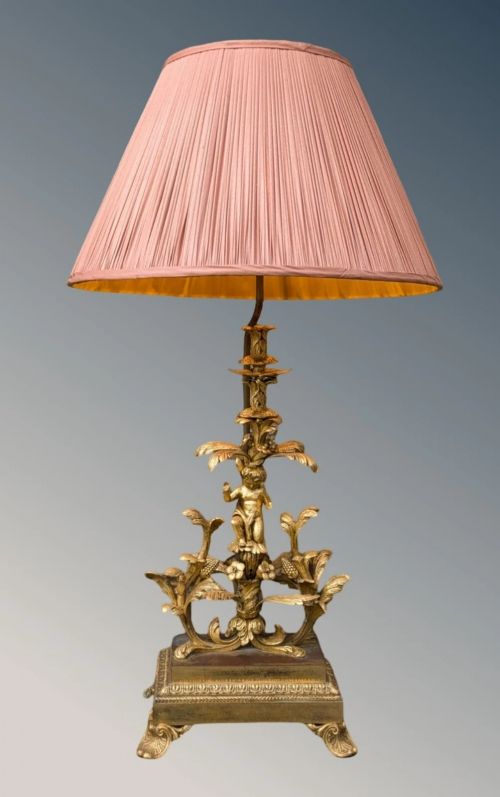
Nineteenth-century workshops produced these objects exclusively to hold wax candles for ambient illumination during dinner parties and evening receptions. Many surviving examples have since been wired for electricity to serve as table lamps.
When conversion occurs, skilled electricians run cords through the central channel without altering the historic metalwork. This allows original candelabra to function safely in modern lighting schemes while retaining their antique character.