
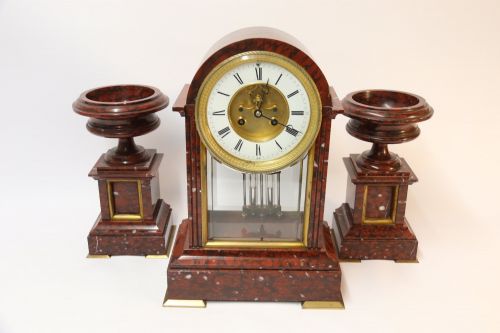


Classical Marble Clock Set
A classical marble clock set brings monumental weight and neoclassical proportion to a mantelpiece, pairing heavy stone with gleaming metal mounts.
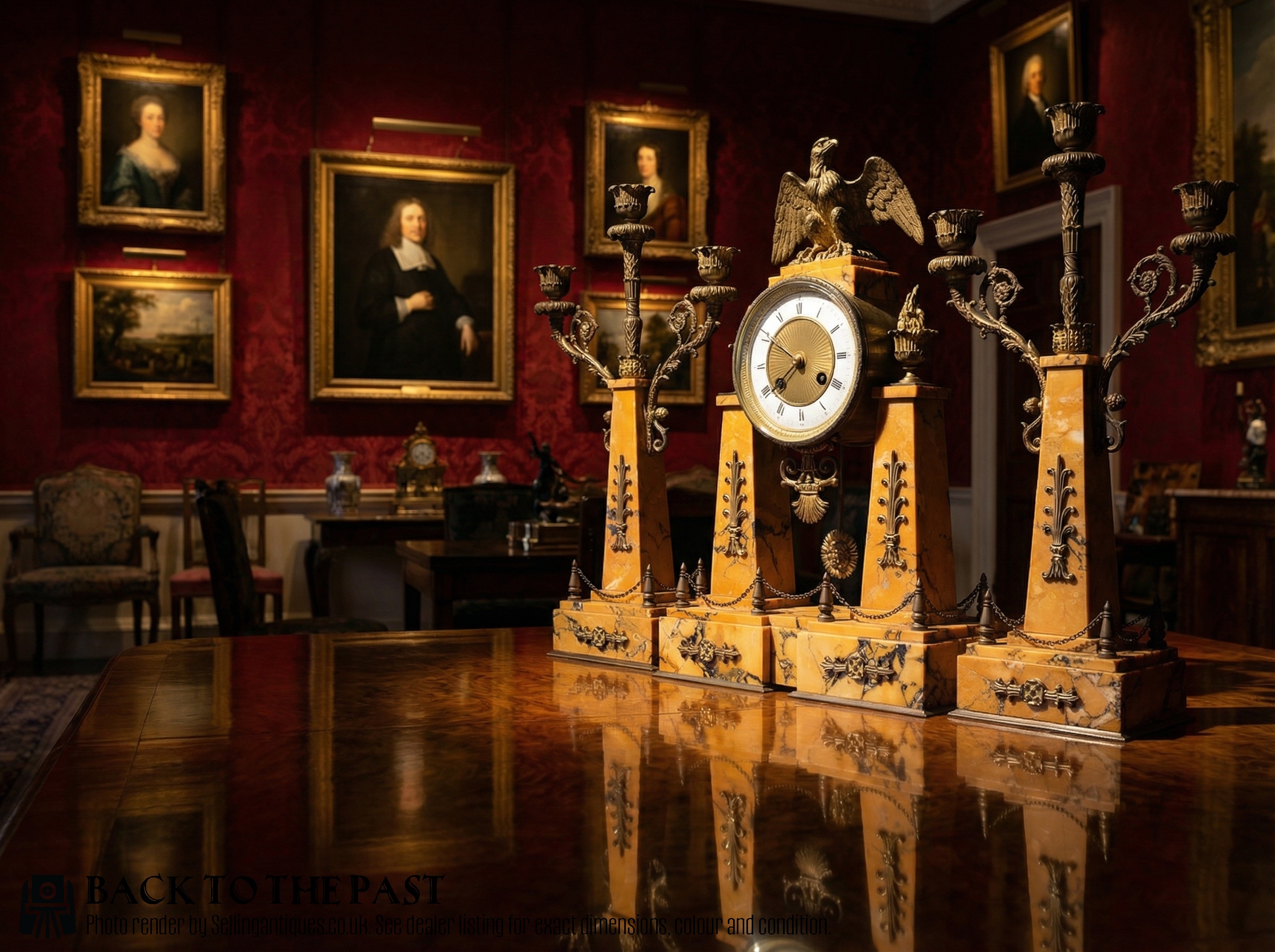
Classical Marble Clock Set
A classical marble clock set comprises a central mantel timepiece accompanied by matching sidepieces such as candelabra or urns, forming a unified display. When searching for a classical marble clock set, buyers encounter substantial nineteenth-century formations originating primarily from French workshops and Victorian revival makers.
The core objects take the form of mantel clocks, portico clocks, and extensive garnitures featuring architectural marble bodies. These pieces frequently draw upon French Empire and Louis XVI styles, incorporating structural symmetry, classical columns, and patinated bronze figures.
The standard configuration on this page spans the period from eighteen sixty to nineteen hundred, encompassing Victorian interpretations and continental designs. Green onyx, pink marble, sienna marble, and black slate provide the solid foundations for these tripartite decorative arrangements.
Assessing Quality
Quality resides in the crispness of the bronze chasing and the depth of the gilding applied to the mounts, distinguishing standard production from finer output. Finer sets display sharply cast ornamentation, substantial bronze weight, and harmonious proportions between the central clock and its matching garniture pieces.
The selection of the marble itself indicates grade, with rich sienna tones, uniform green onyx, and finely grained black slate marking superior examples. Furthermore, the integration of named makers or complex eight-day striking movements elevates the standing of an individual set.
Several sets celebrate literature with bronze figures reading books, proving that even a clock needs a quiet story on the mantel.
Samuel Marti·H Luppens Paris
The Classical Marble Clock Set Glossary
- Clock garniture
- A set consisting of a central clock flanked by two matching decorative objects such as urns or candelabra. These matched sets were designed to create a balanced arrangement on a mantelpiece or sideboard.
- Ormolu
- Finely ground high-carat gold applied to a bronze base using a mercury amalgamation technique, or later electroplating methods. This creates a bright, durable golden surface on the metal mounts.
- Portico clock
- A mantel clock built in the architectural form of a classical temple with supporting columns. The pendulum often hangs visibly within the open central space between the pillars.
- Sienna marble
- A yellow-brown decorative natural stone quarried in Italy, featuring dark purple or grey veins. It was frequently utilised in nineteenth-century French and Victorian decorative pieces.
- Eight day movement
- A mechanical clock movement that requires winding approximately once a week. This weight or spring-driven mechanism was standard in better quality Victorian and continental clocks.
Classical Marble Clock Set: Frequently Asked Questions
What is included in a clock garniture?
A clock garniture consists of a central mantel clock accompanied by two matching side ornaments, typically candelabra, vases, or urns. These pieces share identical materials, styles, and decorative motifs to create a unified display.
Designed to be placed together on a mantelpiece or console table, the sidepieces echo the architectural details and metal mounts of the main clock.
How do I wind an antique clock?
Antique clocks with eight-day movements are wound using a specific key that fits the winding arbours on the enamel dial. Insert the key and turn it gently until you feel resistance, taking care not to overwind the mainspring.
Most clock sets require winding once a week to maintain accurate timekeeping and keep the striking mechanism functioning properly.
What marble types are used?
Nineteenth-century makers utilised various stones including green onyx, pink marble, sienna marble, and dense black slate. These materials provided heavy, durable foundations for architectural clock cases and matching garniture pieces.
The natural veining and coloration of the stone often dictate the overall visual weight and style of the set.
How do I tell French and Victorian sets apart?
French sets frequently exhibit Louis XVI revival or Empire influence, featuring refined ormolu mounts, bronze figures of literature, and specific maker signatures on the movements. Victorian English interpretations often employ heavy black slate or coloured marble with robust classical revival details.
Examining the dial markings, movement stamps, and casting style helps identify the regional origin of the piece.