


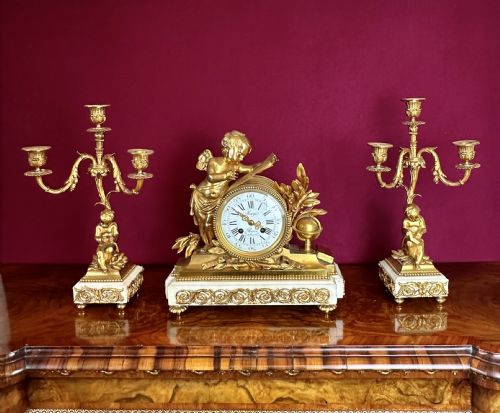


French Empire Clock Garniture
These French empire clock garniture sets bring heavy marble, gilt bronze, and striking presence to a mantelpiece.
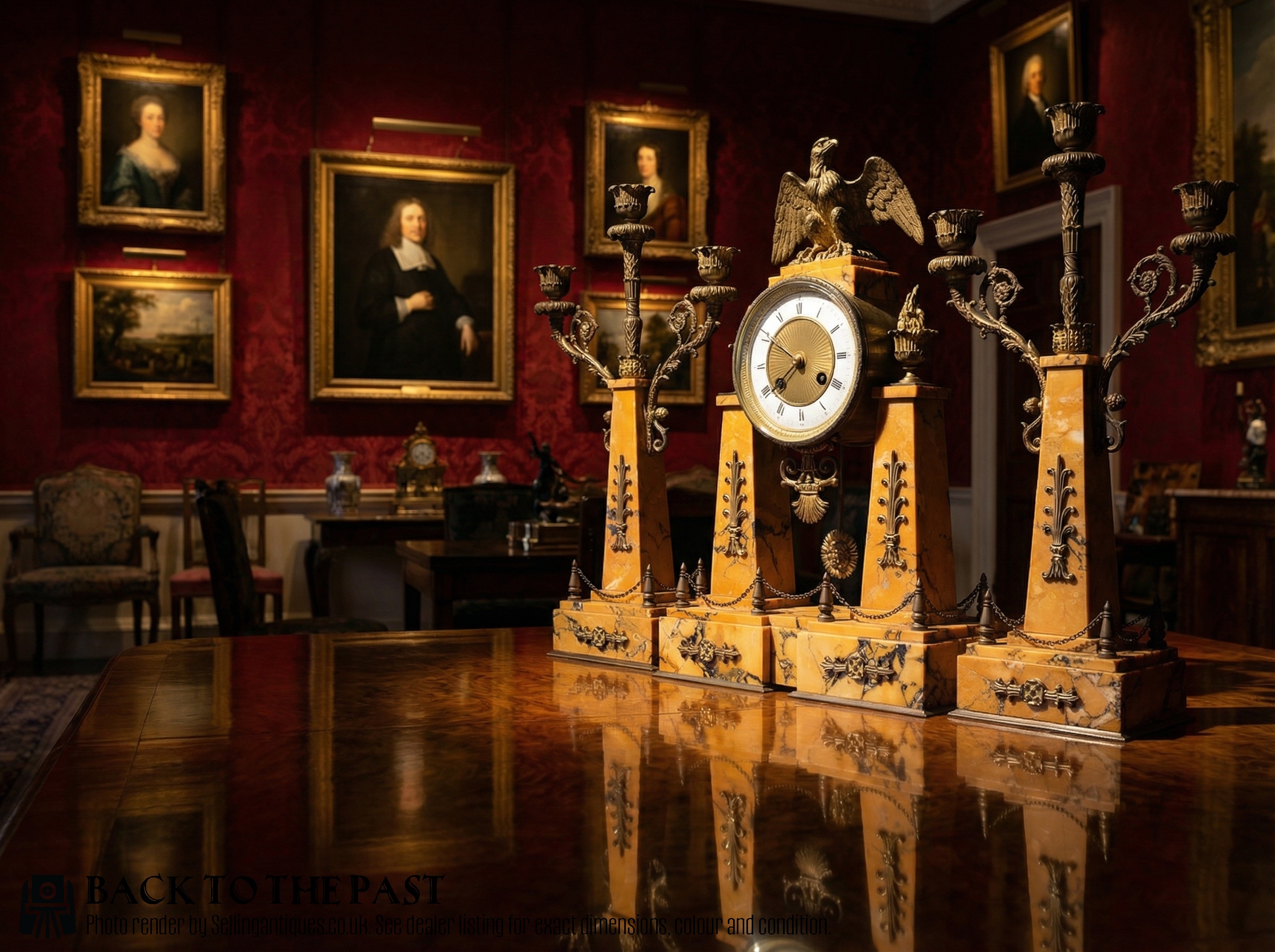
French Empire Clock Garniture
A french empire clock garniture comprises a central mantel clock accompanied by matching side pieces such as candelabras or urns, forming a unified decorative set. You will encounter sets from the nineteenth century, including Victorian, Regency, and Napoleon III periods.
The materials span marble, onyx, and siena marble paired with patinated bronze, gilded bronze, and ormolu. These complete ensembles bring classical architectural presence and matched ornamentation to a room.
Materials and Construction
The physical weight of these pieces rests on heavy stone bases of marble, onyx, or slate, carved and polished to support metal mounts. Bronze and brass components are cast, chased, and finished with fire gilding or ormolu to achieve deep contrast.
Enamel dials provide the face for eight day striking clock movements, while glass covers protect delicate mechanisms. Metal figures, cherubs, and classical motifs are secured to the stone plinths using traditional pinned fixings.
Several sets feature playful cherubs cast in gilt bronze, keeping watch over the ticking clock face.
Assessing Quality and Execution
Integration between the central clock and its matching garniture side pieces demonstrates original conception rather than assembled pairing. Movement maker marks and substantial cast bronze rather than lighter metal alloys signal superior workshop origin.
VINCENTI of PARIS·Deniere Paris
The French Empire Clock Garniture Glossary
- Garniture
- A set of matched ornamental objects designed to be displayed together on a mantelpiece, typically comprising a central clock and two flanking candelabras or urns.
- Ormolu
- Finely ground high-carat gold mercury-gilded to a bronze object, producing a warm golden finish characteristic of nineteenth-century decorative metalwork.
- Patinated Bronze
- Bronze treated with chemical solutions to create a dark or antique surface tone, providing contrast against bright gilded mounts.
- Siena Marble
- A yellow decorative limestone quarried in Italy, featuring dark grey or purple veining frequently utilised in nineteenth-century French clock sets.
- Striking Clock
- A clock mechanism that chimes the hours and sometimes the halves on a bell or gong during an eight day cycle.
French Empire Clock Garniture: Frequently Asked Questions
What pieces come in a garniture set?
A standard garniture consists of a central mantel clock accompanied by two matching side pieces, most commonly candelabras, urns, or figural vases designed to sit symmetrically.
These matched companions share the same materials, such as marble and ormolu, ensuring a unified decorative scheme across a mantelpiece.
How do these clocks operate?
Most examples use an eight day striking movement that requires manual winding with a key every week to power the timekeeping and chime.
The mechanical works drive both the hands on the enamel dial and the internal striking train that sounds the hours.
How do I date a french empire clock garniture?
Dating relies on stylistic clues, material choices, and any maker stamps found on the movement plates or bronze castings. Nineteenth-century pieces often combine neoclassical motifs with Victorian or Napoleon III manufacturing traits.
Changes in marble selection, dial construction, and casting sharpness help narrow the period of production within the eighteen hundreds.
Where should I place a heavy marble clock set?
These sets require a deep, sturdy mantelpiece or heavy furniture surface capable of supporting considerable weight from the stone and bronze components.
Keep the pieces away from direct heat sources and direct sunlight to protect the enamel dials and the patination on the bronze mounts.