




Classic Carriage Clock
A classic carriage clock brings portable nineteenth-century engineering and polished brass into a modern room.
Classic Carriage Clock
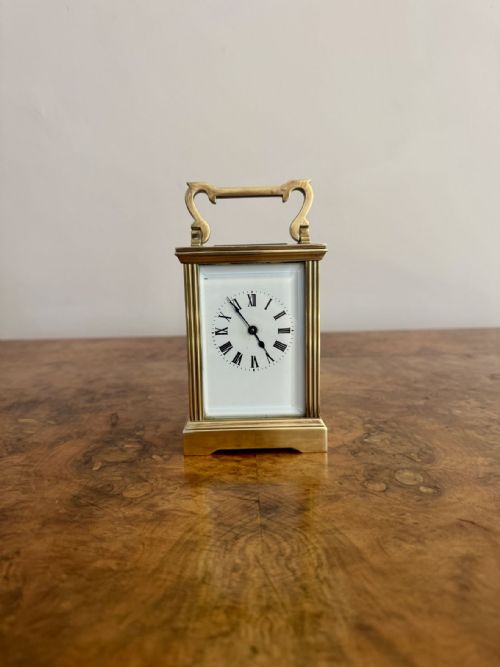
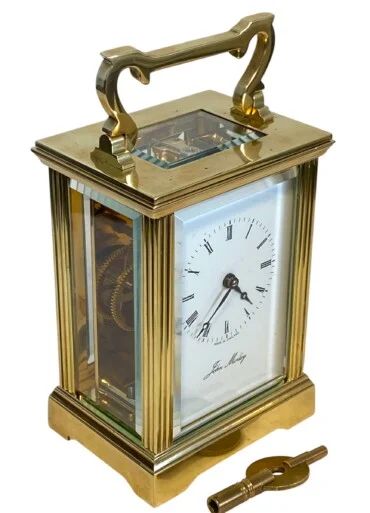
When you search for a classic carriage clock, you are looking at portable mechanical timepieces originally designed for travel by nineteenth-century travellers and officers. These pieces combine heavy metal frames with bevelled glass panels that reveal the escapement and gear trains working within. You are most likely to meet Victorian, Edwardian, and mid-twentieth-century examples rendered in brass, gilt brass, and silver.
The forms range from standard brass-cased timepieces to giant models and repeating clocks that chime the hours and quarters. Many pieces reflect revival aesthetics, drawing on Georgian and Neoclassical design motifs alongside French classical traditions. Makers such as John Morley and Charles Frodsham produced notable variants that survive today.
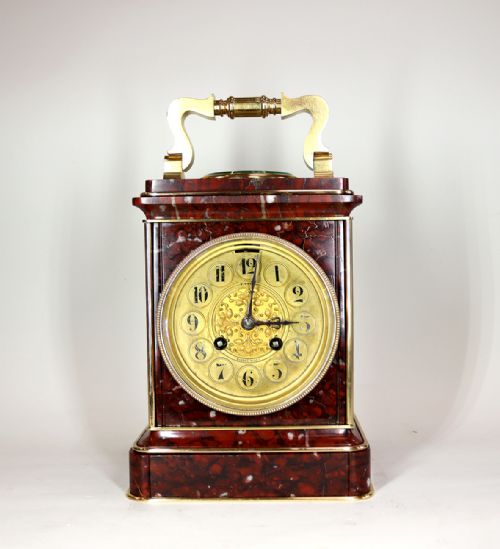
Beyond standard brass housings, listings include pieces set in rouge marble, wood, and lapis blue cases with enamel dials. These variations show how nineteenth-century and later makers adapted a utilitarian travel object into a decorative mantel ornament. Each specimen balances mechanical precision with distinct architectural styling.
How they were made
Casing construction relies heavily on cast and polished brass, gilt brass, and sterling silver, often paired with bevelled glass windows to protect the movement while displaying the internal mechanics. Wood and rouge marble provide substantial structural frames for heavier mantel variants, while lapis lazuli introduces decorative stone veneers.
Enamel provides the smooth, white background for painted numerals on the dial faces, while fine engraving decorates the exterior metal panels of repeating models. Movement construction involves intricate brass gear trains, escapements, and eight-day spring mechanisms assembled by skilled horologists.
Listings feature pieces spanning the nineteenth century, Victorian and Edwardian eras, up to mid-century modern designs in brass, silver, and marble.
What varies in quality
Quality rests in the weight of the metal casing and the clarity of the bevelled glass panels fitted into the frame. Substantial gilt brass or solid silver housings separate standard production models from heavier, more prestigious specimens.
The sophistication of the internal movement dictates the tier of the piece, with eight-day striking and repeating mechanisms demanding greater technical skill than simple timepieces. Engraved exterior detailing and high-grade enamel dials further elevate the standard of manufacture.
John Morley·Charles Frodsham·Holingue Freres·Luxor
The Classic Carriage Clock Glossary
- Carriage clock
- A portable mechanical clock fitted with a handle, originally designed for travellers in the nineteenth century. These pieces usually feature brass cases and glass panels.
- Escapement
- The mechanical linkage that controls the rotation of the gear train by releasing the wheel in regulated steps. It produces the ticking sound characteristic of mechanical clocks.
- Repeating clock
- A timepiece equipped with a mechanism that chimes the hours and quarters upon pressing a button or lever. This function allowed owners to check the time in the dark.
- Gilt brass
- Base metal treated with a thin layer of gold or gold-coloured wash to provide a bright, corrosion-resistant finish. It appears frequently on nineteenth-century clock frames.
- Bevelled glass
- Glass panes with angled, polished edges designed to fit snugly into the metal bezels of the clock case. This edge treatment adds depth and refracts light across the dial.
Classic Carriage Clock: Frequently Asked Questions
What is a classic carriage clock?
A classic carriage clock is a portable mechanical timepiece enclosed in a brass and glass case, often featuring a swing handle at the top.
Originally built for travel, these objects evolved into decorative mantel clocks during the nineteenth and twentieth centuries.
How do I wind my clock?
Most mechanical models use a dedicated key inserted into winding squares located on the backplate of the movement.
Careful rotation tensions the internal mainspring, which powers the gear train for up to eight days depending on the specific mechanism.
How do I tell periods apart?
Victorian and Edwardian pieces often feature heavy cast brass frames with classical or neoclassical revival details, while mid-century examples incorporate cleaner lines.
Materials also shift across eras, moving from traditional gilt brass to silver, marble, and lapis lazuli in various revival styles.
How should I display my clock?
Place the clock on a stable mantelpiece or flat surface away from direct sunlight and moisture to protect the internal metalwork and enamel dial.
Because these are mechanical objects, setting them on a level foundation ensures the pendulum or balance wheel beats evenly.