


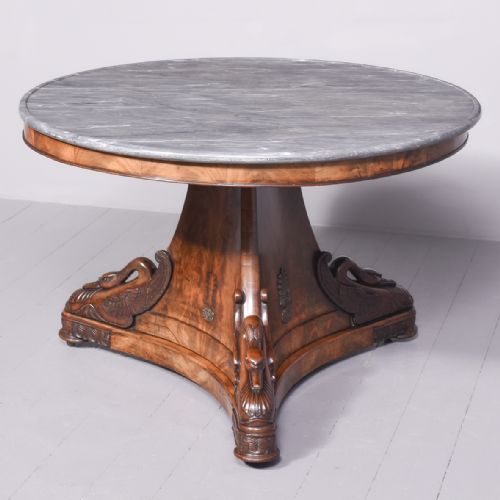
Circular Marble Hall Table
A circular marble hall table brings weight and presence to an entrance, offering a striking stone surface supported by timber bases from the nineteenth century.
Circular Marble Hall Table
A circular marble hall table sits squarely in the nineteenth century, drawing heavily on French Empire, Regency, and Italian Neoclassical traditions. These freestanding pieces function primarily as centre tables or gueridons, designed to anchor a grand hallway or reception room.
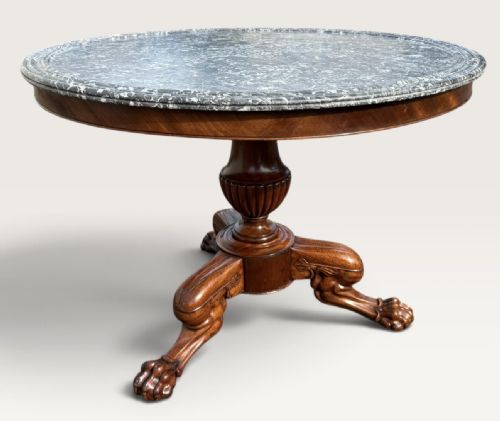
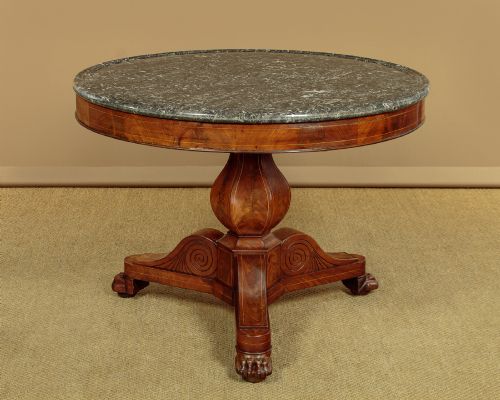
You will most frequently encounter French examples featuring inset marble tops supported by mahogany, walnut, or painted timber pedestals. The form relies on a central column or tripod base to carry the considerable weight of the stone top without crowding the floor space.
Makers of the period often incorporated brass mounts, fruitwood inlay, or parcel silvering to elevate the design beyond simple utility. Whether described as a pedestal table, console, or gueridon, the core architecture remains a solid stone surface raised on a substantial wooden frame.
How they were made
The construction of a circular marble hall table hinges on the pairing of dense stone with robust timbers like mahogany, walnut, and fruitwood. Cabinetmakers turned timber for central pedestals and applied intricate veneers or painted finishes to the surrounding apron.
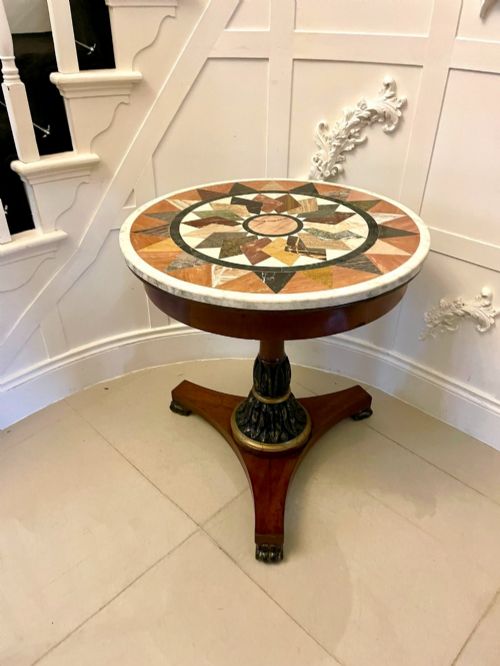
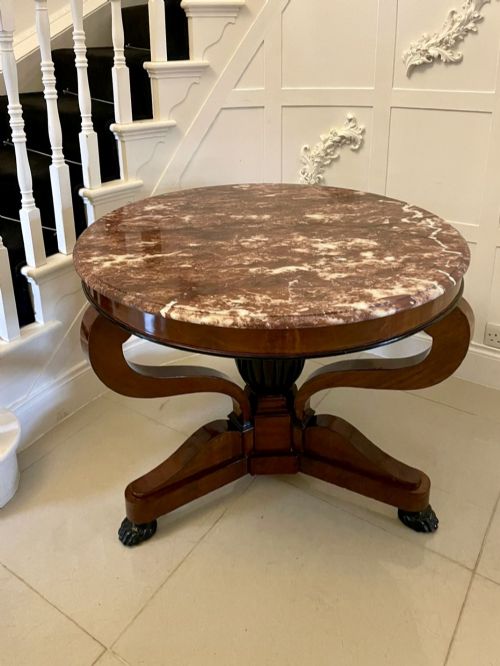
Marble slabs were hand-cut and polished to fit snugly within wooden rims, sometimes featuring specimen inlay work or contrasting purple marble varieties. Brass mounts were cast, chased, and fitted securely to reinforce joints and accent the classical lines of the base.
Several tables manage to look entirely dignified while balancing heavy stone on surprisingly slender wooden ankles.
What varies in quality
The distinction between standard and superior pieces rests on the grade and selection of the marble top. Tables featuring specimen marble or rich purple stone command attention through superior geological variety and meticulous stonemasonry.
Base construction also dictates overall quality, particularly the depth of the mahogany or walnut timber and the crispness of brass mounts. Pieces displaying refined fruitwood inlay or careful parcel silvering demonstrate a higher level of workshop execution.
The Circular Marble Hall Table Glossary
- Gueridon
- A small French table, typically round and supported by a single central column or tripod base. This form frequently carries a marble top designed for display in principal rooms.
- Centre table
- A freestanding piece finished on all sides to stand in the middle of a room rather than against a wall. These tables anchor large entrance halls and reception spaces.
- Specimen marble
- A decorative surface composed of various coloured marbles arranged in geometric patterns or pictures. This technique showcases advanced stonework from Italian and Regency workshops.
- Parcel silvered
- Partially coated with thin silver leaf to highlight carved details on a wooden frame. This decorative finish often appears on French Empire and revival styles.
- Brass mounted
- Fitted with cast brass decorative elements such as feet, collars, or mounts. These metal additions protect vulnerable timber edges and punctuate the dark wood.
Circular Marble Hall Table: Frequently Asked Questions
How do I care for the marble top?
Wipe the stone regularly with a soft, damp cloth and avoid harsh acidic cleaners that can etch the polished surface. Use coasters and mats to protect against moisture and scratches.
Apply a neutral stone wax periodically to maintain the natural sheen and guard against everyday wear. Treating the marble with care ensures the polished finish endures for generations.
Can these tables be used in small hallways?
Their circular footprint allows foot traffic to circulate smoothly around the perimeter, making them surprisingly adaptable for compact spaces. A pedestal base further reduces obstruction by eliminating corner legs.
Check the diameter carefully against your floor plan to ensure adequate clearance for doors and movement. The visual weight of the stone demands a space that can support its commanding presence.
How do I distinguish French Empire from Regency styles?
French Empire pieces typically embrace heavier mahogany construction, bold classical proportions, and extensive cast brass mounts. They often manifest as gueridons with strong architectural lines.
Regency examples from British workshops lean towards refined timber grain, delicate inlay, and restrained classical restraint. Examining the secondary woods and mount quality usually reveals the regional origin.
Are these tables sturdy enough for daily use?
Nineteenth-century cabinetmakers built these frames to support heavy stone slabs, resulting in solid, stable structures. The central pillar distributes the downward pressure evenly across the base.
Avoid dragging the table when repositioning it, as the combined weight of the marble and timber places stress on the joints. Lift the piece from the lower frame rather than the stone top when moving.