


French Mahogany Tripod Table
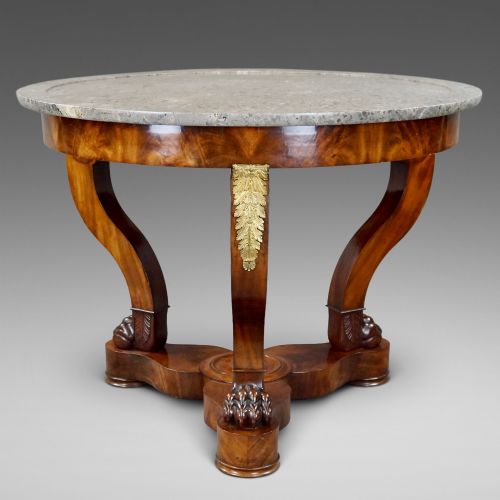
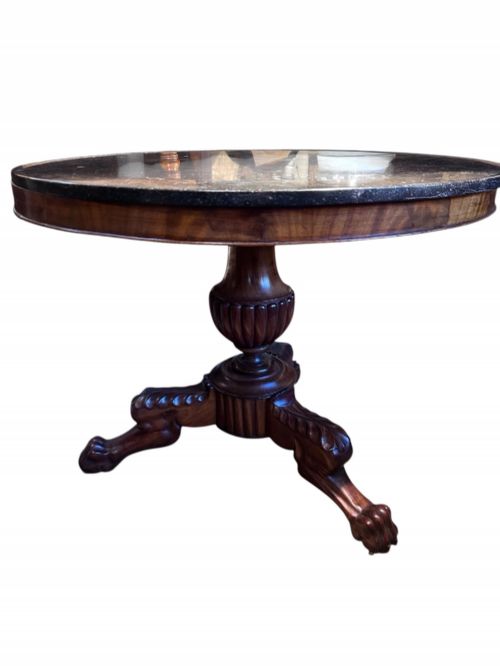
A french mahogany tripod table brings a striking architectural silhouette to a room, offering a circular top poised above a central column and three shaped feet.
French Mahogany Tripod Table
When searching for a french mahogany tripod table, buyers encounter nineteenth-century gueridons and centre tables shaped by Empire, Louis Philippe, Charles X, and Restauration styles. These occasional and side tables function as prominent focal points within a room, often featuring substantial circular timber tops.
The most frequent version met on this page is the nineteenth-century gueridon, typically constructed with rich mahogany veneers and solid timbers. Makers combined this warm wood with contrasting elements, resulting in a distinct vertical form that anchors a seating area or hallway.
Originating from French workshops across the eighteen-hundreds, these pieces reflect distinct periods of design evolution from the boldness of the early Empire style to the refined simplicity of the Louis Philippe era. Each piece demonstrates the enduring appeal of round pedestal tables in classical European interiors.
How they were made
Cabinetmakers utilised dense mahogany timber over stable secondary woods, frequently selecting figured veneers to create striking symmetrical patterns across the circular tabletops. This timber was expertly shaped and polished to highlight the natural grain and deep reddish-brown tone characteristic of the period.
Many examples incorporate heavy marble tops, particularly in white or black varieties, fitted neatly into timber rims. Metal elements such as brass mounts, gilt bronze, and ormolu add crisp decorative accents to the bases, whilst carved details like swan motifs introduce sculptural depth.
Swans make a stately appearance on several Empire bases, proving that nineteenth-century birds possessed exceptional load-bearing credentials.
What varies in quality
The distinction between tiers of quality rests upon the selection of timber veneers and the crispness of the bronze or brass mounts. Finer examples display meticulous matching of mahogany grain across the circular top, coupled with deeply chased ormolu details that retain sharp definition.
Structural harmony also dictates the standing of a piece, separating standard production from exceptional craftsmanship. Superior proportion in the central column and the stable, balanced execution of the three feet define the upper tier of these tables.
The French Mahogany Tripod Table Glossary
- Gueridon
- A small French table supported by a central column or pillar, frequently featuring a round top. These tables gained widespread popularity during the nineteenth century for domestic use.
- Ormolu
- Gilded bronze applied to furniture for decorative mounts and accents. This technique creates a rich metallic contrast against dark mahogany surfaces.
- Empire
- A stylistic period spanning the early nineteenth century characterised by classical motifs, monumental forms, and military symbolism. Furniture from this era often incorporates bold architectural lines.
- Restauration
- A French design period bridging the gap between Empire and later nineteenth-century styles. Pieces from this time typically exhibit slightly softer lines and lighter timber selections.
- Veneer
- A thin layer of choice mahogany applied over a secondary wood base to provide an ornamental surface. Skilled application ensures stability whilst displaying decorative grain patterns.
French Mahogany Tripod Table: Frequently Asked Questions
What is a gueridon table?
A gueridon is a traditional French term for a circular freestanding table supported by a central pillar. These versatile pieces were designed to stand independently in the centre of a room or beside seating.
In nineteenth-century interiors, they served practical functions as display surfaces for lighting, decorative objects, or books. Their compact footprint made them adaptable for various living spaces.
Were these tables used as centrepieces?
Many nineteenth-century examples were specifically built as centre tables intended to occupy the middle of a principal room. Their circular design allowed them to be viewed and approached from any angle.
They frequently held heavy marble slabs on top, providing a durable and cool surface that added considerable weight and stability to the freestanding frame.
What materials are typical for these tables?
Mahogany serves as the primary structural and visual timber across these listings, prized for its deep colour and smooth finish. Cabinetmakers paired this wood with contrasting elements like marble tops and cast metal mounts.
Accents of brass, gilt bronze, and walnut frequently appear alongside black marble inserts, highlighting the decorative vocabulary of French workshops during the nineteenth century.