
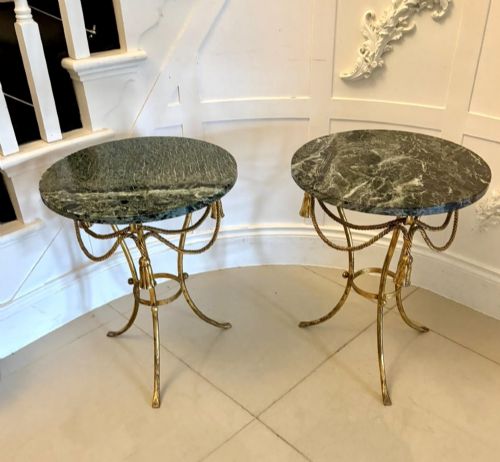
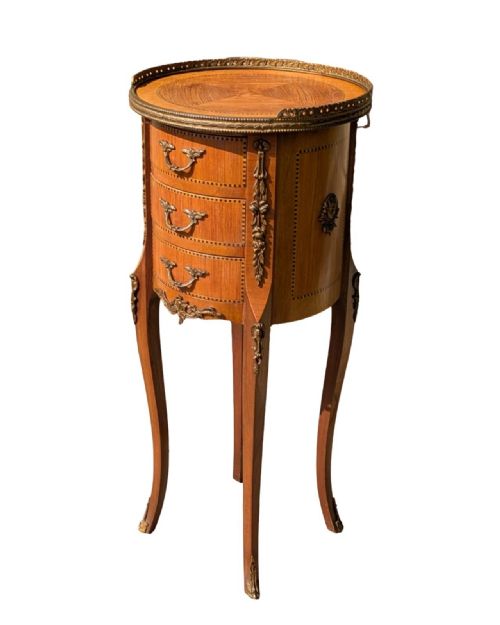
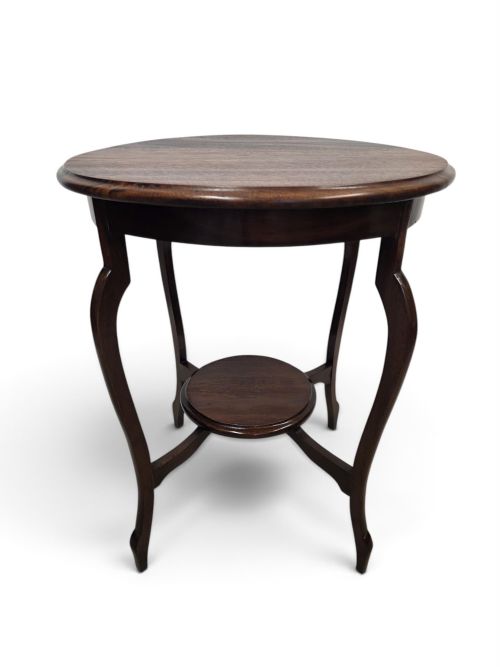


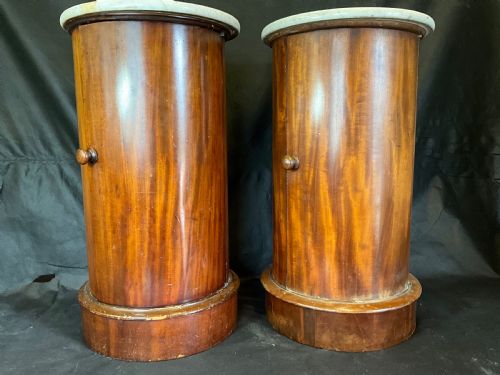


Circular Bedside Tables
These circular bedside tables bring neat geometry and practical storage to the bedroom, spanning periods from the Regency era through to Art Deco.
Circular Bedside Tables
Circular bedside tables encompass small cylindrical cupboards, drum-shaped cabinets and pedestal stands designed to sit beside a bed. When you search for circular bedside tables, you encounter pieces intended to keep night-time essentials enclosed within a compact footprint.
The selections on this page lean heavily towards nineteenth-century mahogany cylinder cabinets and nineteen-thirties walnut or maple designs. Many take the form of enclosed cupboards with doors, whilst others function as open side tables or pedestal nightstands.
Origins vary between English mahogany pieces and continental examples from France and Italy. You find both single items and matched pairs suitable for placing on either side of a bed.
How they were made
Cabinetmakers constructed the main bodies of these tables using solid timber frames overlaid with veneers such as flame mahogany, walnut, kingwood and birds-eye maple. Cylindrical forms required specialist steaming or segmented stave construction to achieve the curved profile.
Many nineteenth-century and twentieth-century examples integrate inset marble tops in white or verde marble, providing a durable surface for water jugs and lamps. Details such as gilt metal mounts, brass galleries and inlaid woodwork complete the construction.
Materials span mahogany, walnut, flame mahogany, birds-eye maple, brass, marble and verde marble across periods from Regency to Art Deco.
What varies in quality
Quality rests upon the selection of timber veneers and the precision of the curved joinery. Superior pieces display continuous grain patterns across cylindrical doors and robust internal shelving.
The integration of heavy materials like marble tops and the crispness of brass or gilt metal mounts separate standard utility items from finer decorative pieces.
The Circular Bedside Tables Glossary
- Cylinder cupboard
- A cylindrical bedside cabinet featuring a curved door that encloses the interior storage space. This form hides the contents entirely while maintaining a smooth circular footprint.
- Verde marble
- A dark green decorative stone frequently utilised for table and cabinet tops. It offers a contrasting texture to polished wood surfaces.
- Vide-poche
- A French term translating as empty-pocket, used to describe small tables or stands for holding small personal items. They appear in nineteenth-century continental furniture forms.
- Kingwood
- A dense exotic hardwood used for fine furniture inlay and veneering. It brings dark contrasting tones to decorative surfaces.
Circular Bedside Tables: Frequently Asked Questions
What fits inside a cylindrical bedside cabinet?
These compact cupboards typically house a single internal shelf suited for books, nighttime water jugs and small personal items. The enclosed door keeps the surface tidy and hides the contents from view.
Larger pedestal models offer deeper vertical space, whilst open side tables rely on drawers or simple lower surfaces for storage.
How do I spot a French Empire piece?
French Empire pieces from the early nineteenth century often utilise dark mahogany timbers combined with architectural proportions and minimal ornamentation. They favour clean cylindrical lines that emphasise the natural grain of the wood.
Matching French styles from later periods may introduce contrasting veneers or gilt metal mounts while retaining the characteristic pedestal form.
Are marble tops original to these tables?
Many nineteenth-century bedside cabinets and tables were manufactured with inset marble slabs to provide a durable, liquid-resistant surface. Verde marble and white variants appear frequently on both English and continental examples.
These heavy stone tops sit flush within the wooden rim of the cabinet structure.
Do these tables come in pairs?
The selection includes both individual tables and matched pairs originating from periods such as the nineteen-twenties and nineteen-thirties. Pairs often feature identical walnut, mahogany or painted finishes suitable for twin bed setups.
Single tables work effectively as standalone occasional pieces or nightstands where space is limited.