


Matching Walnut Nightstands
Matching walnut nightstands bring symmetry to a bedroom while offering useful surface space and concealed storage beside the bed.
Matching Walnut Nightstands
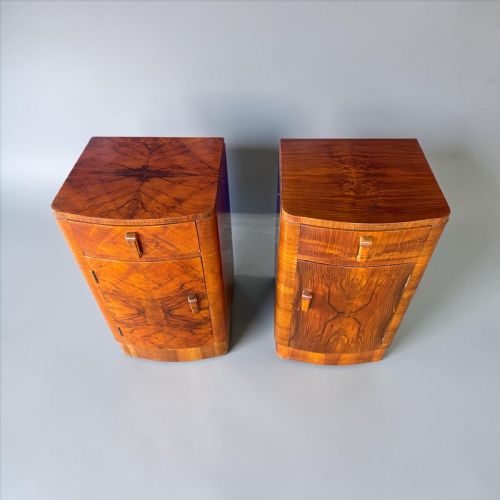
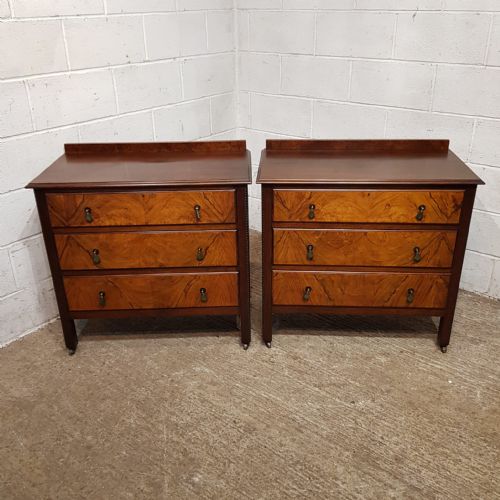
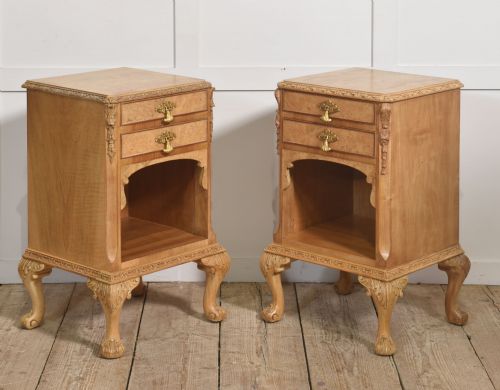
When you search for matching walnut nightstands, you are looking at pairs of bedside pieces designed to sit alongside a bed. These range from dedicated bedside cabinets and drum-shaped tables to small chests of drawers intended for the same purpose.
The versions you are most likely to meet on this page date predominantly from the Art Deco period of the 1930s, alongside earlier Victorian and Edwardian examples. They frequently appear as part of larger bedroom suites that include matching beds and larger chests.
Originating from British, French, and Italian makers, these pieces reflect distinct regional design sensibilities, spanning from streamlined modernism to heavily carved revival styles. Buyers choose them to achieve a balanced, cohesive look on either side of a bed.
How they were made
Makers utilised solid walnut and decorative walnut veneers, often selecting burr walnut to create striking, highly figured grain patterns across drawer fronts and cabinet doors. This timber was frequently combined with brass for handles, hinges, and decorative mounts.
Certain pieces incorporate marble tops, particularly on French designs, providing a durable and decorative surface for bedside use. Construction techniques involve traditional joinery adapted to support curved drum shapes, rectilinear cabinet bodies, and fitted drawers.
Several sets doubling as lamp stands prove that bedside storage has been illuminating the room since 1860.
What varies in quality
The standard of timber selection largely dictates the visual impact of a piece, with mirrored burr walnut veneers demonstrating superior craftsmanship compared to plain timber surfaces. Finishes that preserve the natural warmth and depth of the wood grain without appearing overly glossy elevate the overall appearance.
Design complexity and structural integrity also separate pieces within this range, visible in the precision of curved drum forms, the weight of brass hardware, and the integration of matching sets. Coherence between paired pieces determines their success in a unified interior scheme.
The Matching Walnut Nightstands Glossary
- Burr walnut
- A specialised wood veneer taken from the warted growths on walnut trees, prized for its swirling, intricate grain patterns. It forms a decorative surface across cabinet doors and drawer fronts.
- Bedside cabinet
- A closed piece of furniture featuring a door or drawers, designed to keep personal items out of sight next to the bed. These differ from open bedside tables by offering concealed storage.
- Art Deco
- A design style popular in the 1930s characterised by clean lines, geometric forms, and streamlined shapes. It heavily influences the majority of the twentieth-century pieces found in this category.
- Drum-shaped
- A circular furniture form where the body of the cabinet curves continuously around a central axis. This specific silhouette is frequently encountered in Italian interpretations from the 1930s.
Matching Walnut Nightstands: Frequently Asked Questions
Are these pieces sold in pairs?
Yes, the listings focus primarily on matched pairs designed to sit symmetrically on either side of a bed.
Buyers often select these setups to ensure a balanced aesthetic within a bedroom suite.
What periods do these nightstands come from?
The available pieces span from the mid-nineteenth century through to the Art Deco period of the 1930s.
Twentieth-century designs dominate the selection, alongside earlier Victorian and Edwardian examples.
Do they include marble tops?
Certain French and continental pieces incorporate fitted marble tops as part of their original design.
This surface material provides a practical, hard-wearing finish alongside the walnut woodwork.
How do drum-shaped nightstands differ from standard cabinets?
Drum-shaped nightstands feature a rounded, circular cabinet body rather than traditional rectangular corners.
This distinct geometric form was particularly favoured by Italian makers during the Art Deco era.