





Circular Aneroid Barometer
These circular aneroid barometers combine precision brass movements and carved wooden cases to measure atmospheric pressure with reliable domestic charm.
Circular Aneroid Barometer
A circular aneroid barometer relies on a sealed metal capsule that expands or contracts with shifting air pressure, moving a needle across a marked dial. These pieces span the Victorian, Edwardian, and early twentieth-century periods, capturing an era when domestic forecasting became both scientific and decorative.
The most common examples on this page are housed in solid oak, walnut, or carved beech frames designed to hang on a wall or sit upon a desk. Makers ranged from prominent London scientific instrument firms to provincial watchmakers and opticians.
Dial sizes vary from intimate pocket versions to large twelve-inch instruments intended for ships or grand hallways. Many incorporate companion instruments such as thermometers or altitude adjustment scales directly into the face.
How they were made
The exterior cases utilise turned and carved timbers including oak, walnut, beech, and ebonised wood, alongside cast iron and brass for structural rigidity. Glass covers protect the delicate silvered metal dials and steel indicator hands from dust and accidental damage.
Inside the case, the mechanism depends on precision gearing linked to the vacuum capsule, often requiring specialised calibration by skilled instrument makers. Patent altitude adjustments and thermometer tubes were fitted alongside the main barometer movement during assembly.
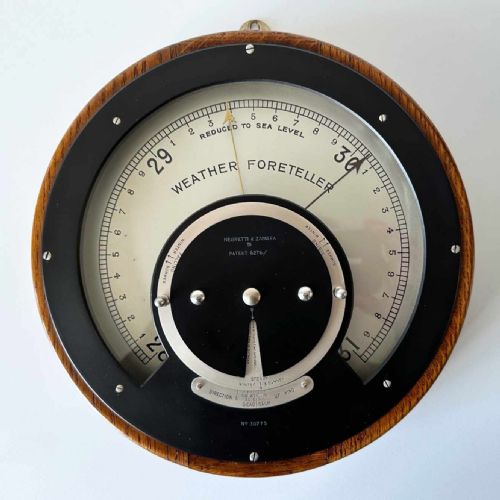
Weather foretellers with built-in barometers once helped Victorian households prepare for sudden downpours before heading out.
What varies in quality
Quality rests in the crispness of the timber carving and the reputation of the maker inscribed upon the silvered dial. Instruments signed by established opticians show superior mechanical refinement and more legible, finely engraved lettering.
The integrity of the case construction, the clarity of the protective glass, and the presence of original mechanical components like thermometer tubes distinguish fine examples from standard production pieces.
Short & Mason London·Negretti & Zambra·Bramwell & Harbron·Blake & Son·Dollond of London·M Pillischer
The Circular Aneroid Barometer Glossary
- Aneroid barometer
- An instrument that measures atmospheric pressure using a flexible metal capsule rather than liquid mercury. It responds promptly to weather changes.
- Silvered metal dial
- A metal face treated to achieve a bright, reflective finish upon which pressure scales and maker details are engraved. This surface catches room light effectively.
- Hypsometer
- An instrument used for measuring altitude by determining the boiling point of a liquid or through barometric pressure. These specialised pieces are uncommon.
- Skeletonised
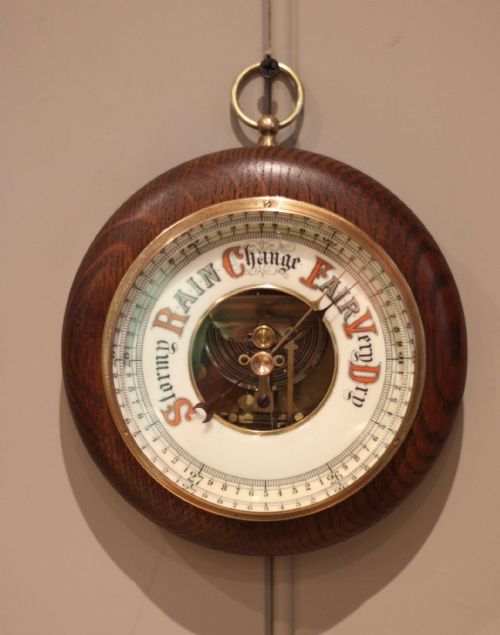
- A design where the internal mechanism of the barometer is partially exposed to view through the dial. This allows the observer to see the mechanical levers and gears.
Circular Aneroid Barometer: Frequently Asked Questions
How do I read a barometer?
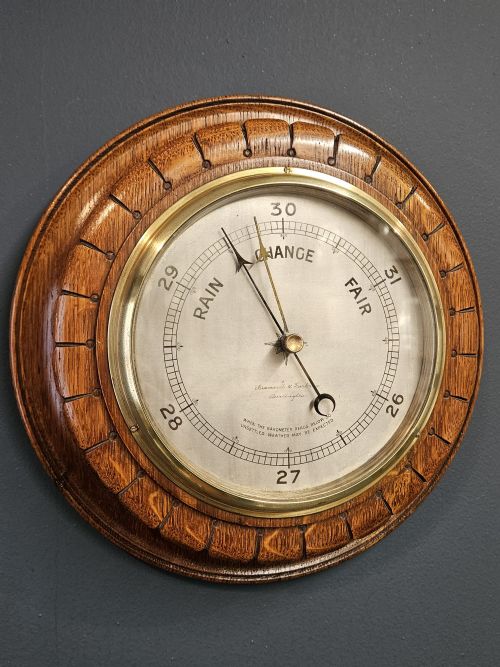
Observe the position of the pointer relative to weather descriptions like rain, change, and fair inscribed on the dial. Tapping the glass gently helps settle the needle to show the current reading.
Rising pressures generally indicate improving weather, while falling readings suggest approaching rain or wind. Comparing changes over several hours provides a reliable local forecast.
Where should I hang my barometer?
Select an interior wall away from direct sunlight, radiators, and heavy draughts to ensure accurate pressure responses. Stable room temperatures prevent artificial expansion of internal metal components.
Ensure the mounting screw secures firmly into timber or masonry because these instruments carry significant weight from brass movements and hardwood cases.
Can antique barometers be recalibrated?
Most aneroid barometers feature a small adjustment screw accessible from the back or through the dial face. This screw alters the tension on the internal spring mechanism.
Calibration requires comparing your reading against a reliable local meteorological source for the exact altitude. Turn the screw incrementally until the pointer matches the verified pressure.
What is a holosteric barometer?
A holosteric barometer is simply an early alternative term for an aneroid barometer, meaning whole-solid without liquid. Victorians adopted this label to emphasise the modern enclosed vacuum capsule design.
These instruments were marketed as safer and more portable than traditional mercury column barometers. They quickly became standard fixtures in homes and maritime vessels alike.