
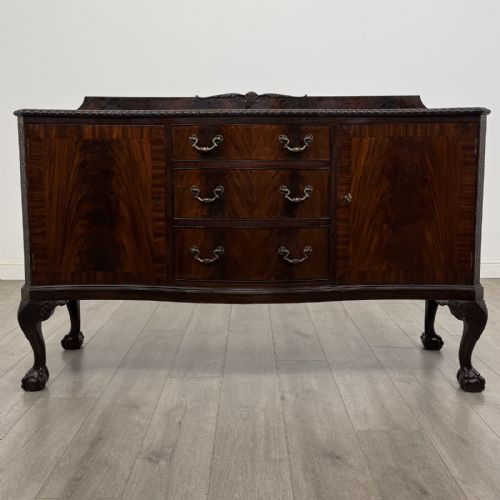

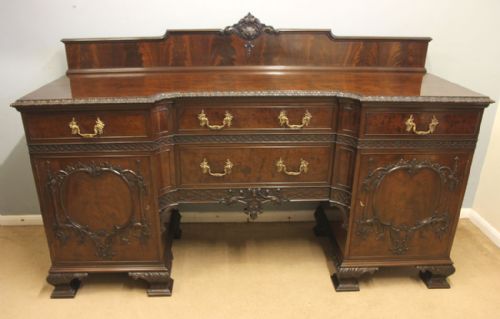


Chippendale Style Buffet
These chippendale style buffet pieces bring substantial presence to a room, offering deep timber tones and classic carved detailing for storage and display.
Chippendale Style Buffet
Forms range from serpentine fronted servers to inverted breakfront sideboards and side tables. These substantial furniture items provide generous surface space and concealed storage beneath.
Origins span English cabinet making traditions, with occasional influences from Chinese Chippendale design vocabulary. The selection bridges formal eighteenth century proportions and later nineteenth century revival craftsmanship.
Materials and construction
Construction relies heavily on solid mahogany and flame mahogany veneer, chosen for rich grain patterns and deep natural colour. Satinwood highlights appear as contrasting stringing or inlay details on select surfaces.
Brass hardware such as handles and escutcheons provides functional and decorative accents against the dark timber. Cabinet makers employed hand carved ornamentation, including scrollwork and bracket feet, to define the revival aesthetic.
Assessing craftsmanship and execution
Quality reveals itself in the choice of timber veneer, where book matched flame mahogany creates striking movement across the front drawers and doors. Finer examples display crisp, deep hand carving rather than shallow or cast decorative relief.
Structural integrity and the precise alignment of serpentine or breakfront profiles separate standard production from superior cabinet work. The handling of secondary woods and the quality of interior construction further distinguish high tier items.
The Chippendale Style Buffet Glossary
- Serpentine front
- A curved furniture front featuring a convex centre flanked by concave curves. This contour requires precise carpentry to execute properly on a sideboard.
- Flame mahogany
- A veneer cut from the branch junction of the mahogany tree, displaying a distinctive flamy or mottled pattern. Cabinet makers used this to create dramatic visual effects on primary surfaces.
- Breakfront
- A cabinet or sideboard whose central section projects forward from the flanking outer sections. This architectural form adds depth and shadow to large dining room furniture.
- Stringing
- Thin inlay lines of a contrasting wood used to outline drawers or top surfaces. It highlights the geometric layout of the piece.
Chippendale Style Buffet: Frequently Asked Questions
How do I date a sideboard?
Dating involves examining the construction methods, secondary timbers, and hardware fixed to the frame. Eighteenth century examples show hand cut joinery and period specific brass pulls.
Revival pieces from the nineteenth and twentieth centuries often feature machine sawn elements or standardised drawer construction while mimicking earlier aesthetic styles.
Where should I place a serving table?
These large serving tables suit dining rooms, grand hallways, or spacious living areas where they provide both surface space and storage. Their substantial proportions require adequate clearance to appreciate the carved details.
Positioning them against a main wall allows the serpentine or breakfront silhouette to catch the light.
What distinguishes Chinese Chippendale influence?
Chinese Chippendale influence appears through pierced fretwork, lattice patterns, and pagoda inspired motifs integrated into the carved woodwork. This specific subset of the style merges English cabinet forms with Asian decorative arts.
Pieces bearing these characteristics offer an lighter, more intricate visual profile compared to heavier classical revival models.