
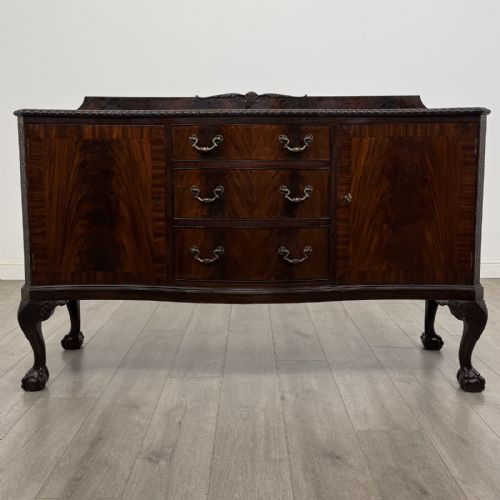

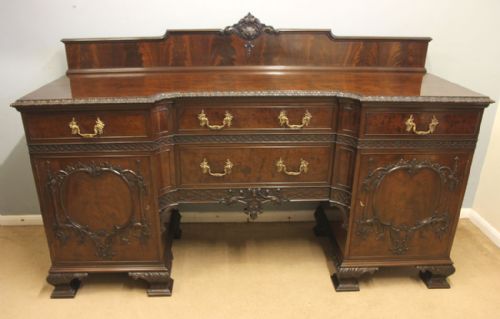


Mahogany Chippendale Sideboard
These mahogany chippendale sideboard examples bring substantial timber and carved detail to a room, offering formal serving storage.
Mahogany Chippendale Sideboard
A mahogany chippendale sideboard combines formal Georgian proportions with decorative carving rooted in eighteenth-century cabinet making traditions. When you search for this phrase, you encounter large timber serving surfaces, low cupboards, and console forms designed for dining rooms.
The pieces on this page span the original eighteenth-century Georgian period through to later revival movements in the Victorian, Edwardian, and early twentieth-century eras. Revival interpretations from nineteen hundred and nineteen ten appear frequently alongside genuine eighteenth-century server tables and low press cupboards.
Makers and cabinet makers applied these styles across varied forms including serpentine fronted servers, display cabinets, and side tables. The overarching form remains centred on heavy mahogany timber, often elevated on carved legs with ball and claw feet.
How they were made
Makers built these pieces primarily using solid mahogany and flame mahogany veneer over secondary timbers, selecting grain patterns to create visual depth on large drawer fronts and cabinet doors. Brass handles, escutcheons, and occasional mirror glass or fabric linings complete the construction.
Carving defines the style, with artisans working directly into the solid mahogany to produce intricate details on legs, friezes, and edge mouldings. Sideboards and serving tables incorporate sturdy frame construction to support heavy serving vessels and timber tops.
Listings feature mahogany, flame mahogany veneer, brass, glass, and fabric across eighteenth-century, Victorian, Edwardian, and early twentieth-century periods.
What varies in quality
Quality rests in the crispness of the hand carving and the selection of timber veneers, where highly figured flame mahogany commands greater visual presence than plain boards. The depth and precision of the carved motifs on the legs and drawer rails distinguish standard revival workshop output from finer cabinet work.
Construction methods also dictate standard, visible in the thickness of the mahogany drawer linings, the neatness of dovetail joints, and the retention of original brass hardware. Pieces originating in the eighteenth century carry structural integrity shaped by age, while later revival examples rely on the competence of Edwardian and Victorian workshops.
Waring and Gillow·Elkington and Co
The Mahogany Chippendale Sideboard Glossary
- Chippendale Revival
- A late nineteenth and early twentieth century movement reproducing or reinterpreting eighteenth-century styles. Cabinet makers drew inspiration from Thomas Chippendale pattern books.
- Flame mahogany
- A veneer cut from timber where the branch meets the trunk, producing a rippling flame effect. This figure was prized for principal surfaces on grand sideboards.
- Serpentine front
- A front contour curving outward at the centre and inward toward the ends. This shape requires skilled timber bending or precise cutting.
- Low boy
- A small leg table with drawers, often functioning as a dressing table or side table in eighteenth-century interiors.
- Press cupboard
- A large enclosed storage piece featuring upper and lower cupboard sections used for linens or clothing.
Mahogany Chippendale Sideboard: Frequently Asked Questions
How do I date a mahogany chippendale sideboard?
Examine the construction methods inside the drawers, looking at dovetailing and timber thickness alongside the type of mahogany and hardware used. Eighteenth-century pieces display hand-cut joinery and aged timber patina, whereas revival pieces from nineteen hundred often show later manufacturing techniques.
Check for style indicators such as the sharpness of the carved ball and claw feet or the presence of flame mahogany veneer. Comparing these details against known Georgian and Edwardian production traits helps clarify the period of origin.
Where were these sideboards used?
These pieces served primarily in dining rooms and formal reception spaces to hold silver, linen, and serving dishes during meals. Their generous top surfaces also acted as serving tables for food and drink.
In modern interiors, they function effectively as living room console units, hallway storage, or dining room servers. Their substantial timber presence anchors a room while providing practical enclosed storage.
What is the difference between an original and a revival piece?
Original pieces date from the eighteenth century during the Georgian period and reflect the working practices of contemporary cabinet makers. Revival pieces emerged later, during Victorian and Edwardian periods, reproducing those classic forms for modern homes.
While both utilise solid mahogany and detailed carving, the older examples carry centuries of handling and distinct structural wear. Revival pieces offer similar aesthetic weight but were constructed during the nineteenth and twentieth centuries.
How do I care for a mahogany surface?
Maintain the mahogany by dusting regularly with a soft cloth and avoiding placement near direct heat sources or strong sunlight. Excessive warmth dries out the timber and can cause flame mahogany veneers to lift or split.
Apply quality beeswax periodically to nourish the wood and protect the polished finish. Avoid silicone-based sprays, which build up on the antique timber surface over time.