





Chippendale Serpentine Dresser
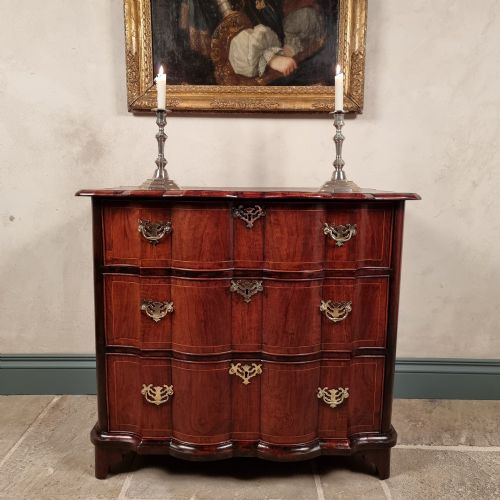
A chippendale serpentine dresser brings rhythmic mahogany curves and period Georgian proportion into a room.
Chippendale Serpentine Dresser
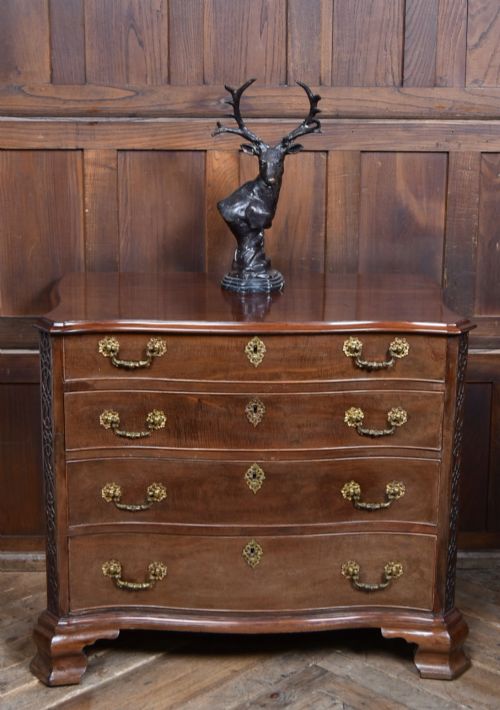
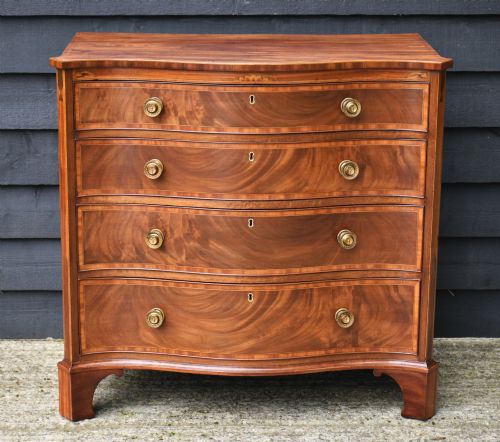
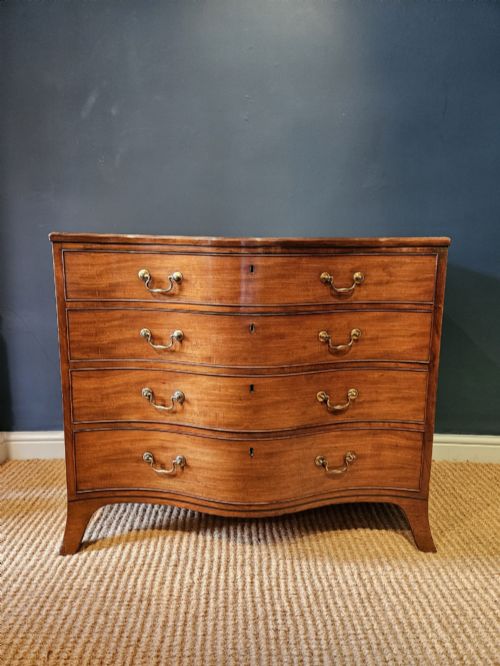
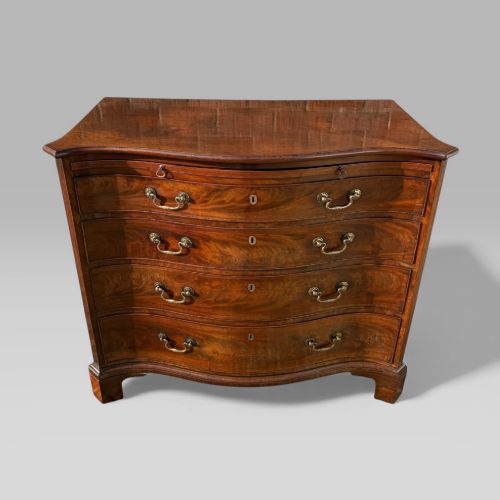
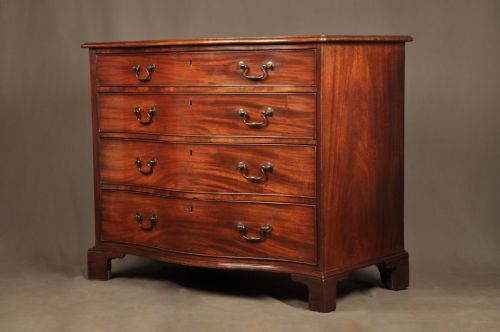
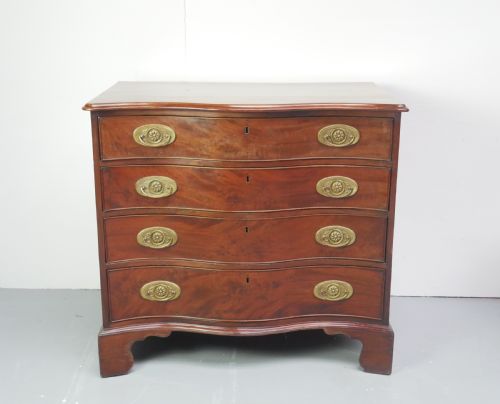
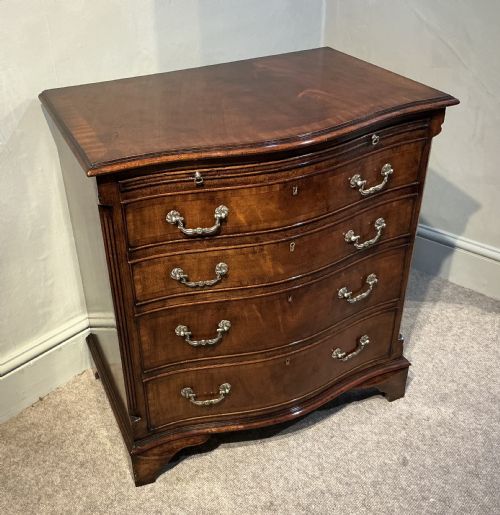
A chippendale serpentine dresser presents a distinct undulating front that curves outward at the centre and recedes at the sides, forming a silhouette developed during the eighteenth century. Most examples found here belong to the Georgian and George III eras, though revival pieces from the Edwardian period and the early twentieth century also appear.
These chests of drawers typically stand on bracket feet or ogee feet, holding four graduating drawers within a sturdy timber carcase. Certain pieces incorporate functional variants such as a fitted writing brush and slide or compartments suited to a gentleman's use.
The form relies entirely on the sculptural sweep of the mahogany drawer fronts, which demands careful joinery to maintain the continuous horizontal grain across the curved facade.
Materials and construction
Makers built these pieces primarily using solid and veneered mahogany, often pairing the dense tropical timber with oak linings for the drawer carcasses. Brass hardware, including swing handles and escutcheons, secures the drawer fronts while boxwood inlay occasionally defines the structural borders.
Shaping the serpentine curve required substantial timber thickness to allow cabinetmakers to plane the undulating profile directly into the solid wood or apply thick mahogany veneers to shaped softwood foundations. Dovetail joints hold the drawer boxes together firmly, reflecting standard eighteenth century joinery methods.
Secret compartments occasionally hide behind the brush slides of early drawers, waiting for a lost key.
Assessing quality and craftsmanship
The crispness of the serpentine sweep defines the visual success of the piece, separating skilled cabinet work from softer, heavier revival interpretations. Sharp, clean lines along the moulded edges and well-defined bracket feet indicate superior execution.
Timber selection and grain matching across the drawer fronts determine the refinement of the surface. Pieces that maintain a cohesive, rich grain pattern through the undulating curves display a higher level of material choice than those with disjointed timber sections.
The Chippendale Serpentine Dresser Glossary
- Serpentine
- A front contour that curves convexly in the centre and concavely at the flanks. This flowing line creates movement across the furniture facade.
- Chippendale Style
- A design classification drawing upon the mid eighteenth century aesthetic of Thomas Chippendale. It encompasses rhythmic curves, bracket feet and robust mahogany construction.
- George III
- The period spanning from 1760 to 1820. Furniture from this era displays refined proportions and accomplished timber craftsmanship.
- Brush and Slide
- A pull-out shelf integrated above the top drawer. Historically used for brushing clothes or preparing writing materials.
- Bracket Foot
- A simple corner foot formed by two mitred pieces of wood. It supports the heavy carcase while maintaining a low profile.
Chippendale Serpentine Dresser: Frequently Asked Questions
How do I spot an eighteenth century piece?
Examine the timber construction inside the drawers, looking for hand-cut dovetails and oak linings rather than modern fixings. Eighteenth century examples show subtle irregularities in the hand-planed surfaces.
Check the backboards and drawer bottoms for uniform ageing, tool marks, and appropriate wood species consistent with the period.
What is a gentleman's chest?
A gentleman's chest refers to a specialised form that often includes internal fitted compartments or a pull-out slide for writing. These additions served personal grooming and correspondence needs.
The exterior maintains the characteristic serpentine silhouette while housing specialised storage configurations behind the primary drawers.
How do I care for mahogany furniture?
Keep the timber away from direct heat sources and strong sunlight to prevent the mahogany from drying out or fading. Regular dusting with a dry, soft cloth protects the polished surface.
Apply traditional wax sparingly when the wood appears dry, buffing it gently to maintain the natural sheen of the polish.
Are Edwardian revival pieces well made?
Edwardian and early twentieth century revival pieces often utilise solid mahogany and traditional joinery techniques learned from earlier traditions. Cabinetmakers during this era respected Georgian proportions.
These pieces provide an accessible alternative to eighteenth century originals while retaining the decorative curve and structural integrity.