
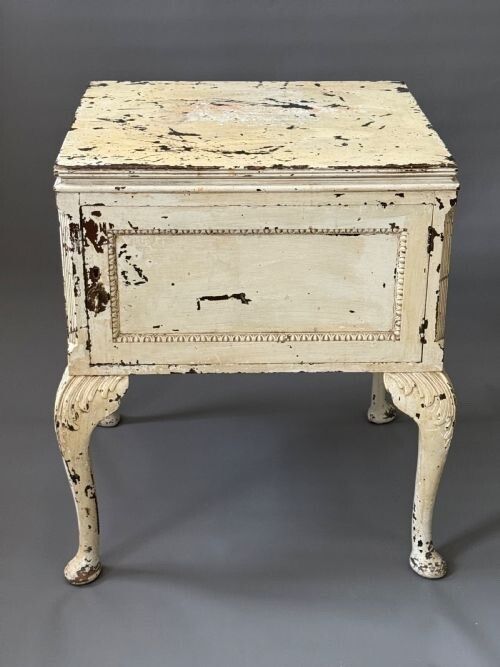
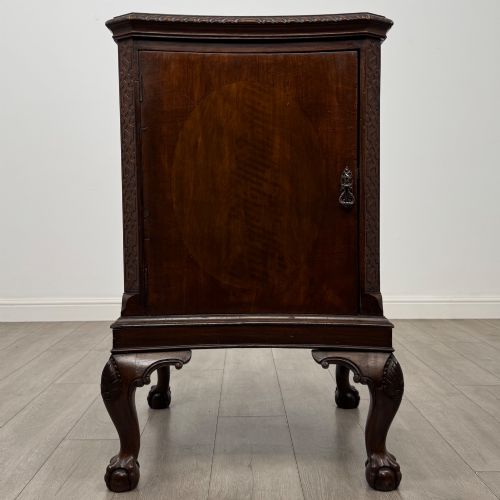

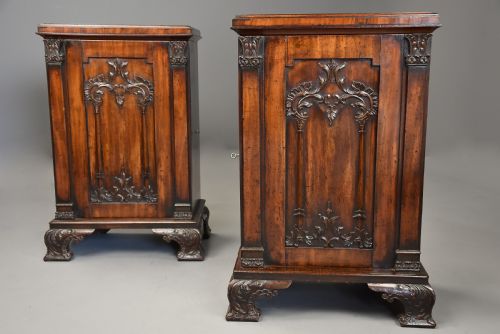
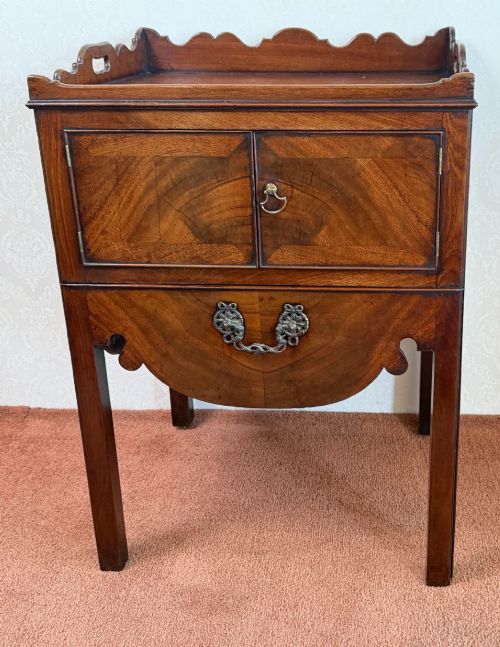
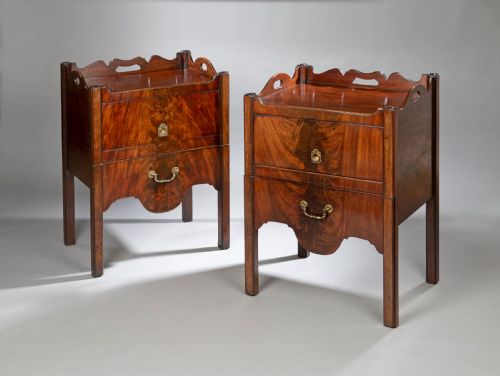


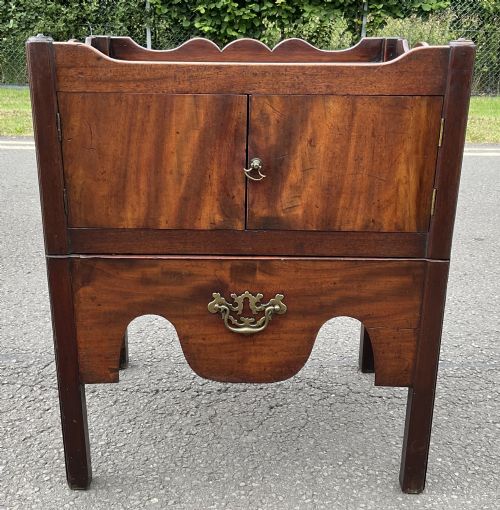


Chippendale Bedside Cupboard
These Chippendale bedside cupboard pieces offer classic Georgian design and timber craftsmanship, bringing practical elegance to any room.
Chippendale Bedside Cupboard
A Chippendale bedside cupboard represents eighteenth-century cabinet making at its most functional, often taking the form of a bedside cabinet, commode, or pedestal cabinet. These items are designed to store chamber necessities or personal items discreetly while maintaining an elegant silhouette beside a bed.
The historical scope spans from mid-eighteenth-century Georgian originals up to Edwardian revivals and twentieth-century interpretations. Each piece reflects the enduring popularity of Thomas Chippendale's aesthetic vocabulary in domestic furnishings.
How they were made
Makers relied primarily on solid and veneered mahogany, shaping the timber to create serpentine fronts and tray tops designed to keep items secure. Joinery was executed by hand, utilising traditional mortise and tenon methods to ensure structural longevity.
Hardware such as brass handles and hinges were cast and fitted individually, while secondary woods were chosen for internal drawer construction. Some examples incorporate painted finishes or fine inlay work to accentuate the primary mahogany grain.
Listings span the eighteenth century, Georgian period, nineteenth century, Edwardian era, and nineteen twenty, predominantly utilising mahogany, brass, paint, inlay, and wire mesh.
What varies in quality
Quality in a Chippendale bedside cupboard rests on the crispness of carved details, the figure of the mahogany timber, and the integrity of the original construction. Superior examples display balanced proportions, refined serpentine shaping, and well-chosen grain patterns across the primary surfaces.
The distinction between period originals and later revivals involves subtle aspects of timber ageing, dovetail precision, and the weight of the brass fittings. Pieces retaining their original tray tops and untampered internal compartments command greater attention from discerning collectors.
The Chippendale Bedside Cupboard Glossary
- Tray top
- A tabletop finished with a raised moulded edge or gallery designed to prevent objects from rolling off. This feature appears frequently on eighteenth-century commodes and bedside tables.
- Serpentine
- A curved shape featuring a convex centre flanked by concave ends, creating a gentle undulating line. This contour demands advanced woodworking skill and appears on finer eighteenth-century cabinets.
- Commode
- A low cabinet or chest with doors or drawers, originally serving domestic sanitary functions before evolving into a decorative bedside or lamp table. In eighteenth-century terminology, this often describes a bedside cupboard.
- Pedestal cabinet
- A tall, narrow freestanding cupboard designed to stand beside a bed or in the corner of a room. These pieces provide enclosed storage within a compact footprint.
- Mahogany
- A durable, reddish-brown tropical hardwood favoured by Georgian cabinet makers for its stability, rich colour, and ability to take fine carved detail.
Chippendale Bedside Cupboard: Frequently Asked Questions
How do I identify a Georgian piece?
Georgian pieces display the proportions, timber choices, and construction methods characteristic of the eighteenth century. Look for hand-cut dovetails and solid mahogany.
Revival pieces from later periods often imitate these design traits but use different internal construction techniques.
Where were these cupboards used?
These items were placed beside beds in domestic chambers to hold personal belongings or chamber equipment. Their enclosed storage kept necessities out of sight.
Today, they function well as lamp stands or bedside tables in traditional and contemporary interiors.
What is serpentine shaping?
Serpentine describes a front profile that curves outward in the middle and inward toward the edges. This flowing contour requires precise woodworking.
Cabinets featuring this shape are typically associated with higher levels of craftsmanship.