
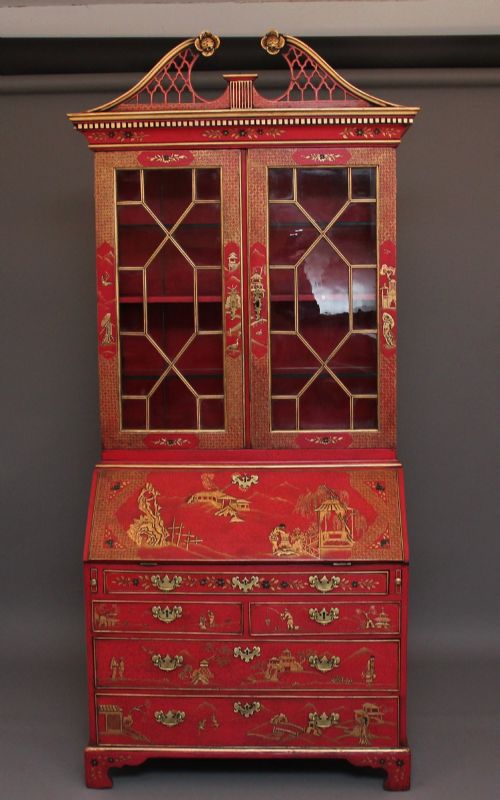


Chinoiserie Writing Cabinet
A chinoiserie writing cabinet brings painted lacquer, gilt motifs and hidden compartments into a room.
Chinoiserie Writing Cabinet
A chinoiserie writing cabinet combines a fall-front desk or bureau with shelving or a cabinet top, finished in decorative lacquer. These pieces range from substantial bureau bookcases to compact escritoires and desk cabinets.
Most examples encountered here date from the Georgian period through to the early twentieth century, incorporating revival styles such as Queen Anne and William and Mary. The form serves for both correspondence and display.
The surface decoration typically depicts figures, landscapes and flora in gold leaf or polychrome on a dark or red lacquer ground. Such pieces offer practical storage alongside a distinct decorative presence.
How they were made
Construction relies on timber carcasses, predominantly wood and pine, prepared to receive layers of lacquer. Artisans applied successive coats of varnish and pigment to achieve a smooth foundation for subsequent decoration.
Gilt and gold leaf details were hand-painted onto the lacquered surfaces, often enhanced with raised paste work to create texture. Brass hardware such as hinges, escutcheons and handles completed the construction.
Materials recorded across the pieces include lacquer, brass, glass, gold leaf, gilt, pine and bamboo.
What varies in quality
Quality rests upon the depth and finesse of the lacquer work and the clarity of the gilt painting. Finer examples display intricate figures and landscapes executed with control, whereas simpler pieces show coarser brushwork.
The architectural proportion of the cabinet top and the quality of the timber beneath the lacquer determine the integrity of the piece. Well-executed brass mounts and smoothly functioning internal drawers distinguish superior craftsmanship.
The Chinoiserie Writing Cabinet Glossary
- Bureau bookcase
- A writing bureau with a glazed or panelled cabinet top for storing books or display items. This form provides dual functionality for work and storage.
- Japanning
- A European imitation of East Asian lacquerwork using heat-dried varnishes and gold dust. It became popular in furniture decoration during the seventeenth and eighteenth centuries.
- Escritoire
- A small writing cabinet with a fall-front flap enclosing pigeonholes and small drawers. The term derives from the French word for writing.
- Fall-front
- A hinged writing flap that pulls down to create a horizontal surface for writing. It conceals internal compartments when closed.
Chinoiserie Writing Cabinet: Frequently Asked Questions
How do I care for lacquer furniture?
Lacquer surfaces require protection from direct sunlight and excessive humidity to prevent cracking or fading. Dusting should be done gently with a dry, soft cloth.
Avoid using chemical polishes or water on antique lacquer finishes.
Are these cabinets purely decorative?
While visually striking, they remain functional items of furniture intended for writing and storage. The enclosed compartments and desktop surfaces serve practical daily use.
Many pieces also function as display furniture for books or porcelain.
How do I identify the period of a cabinet?
Dating relies on carcass construction, the style of the brass hardware, and the character of the lacquer decoration. Georgian and William and Mary examples exhibit different proportions compared to Edwardian or later revivals.
Examining secondary timbers inside the drawers provides further chronological clues.