
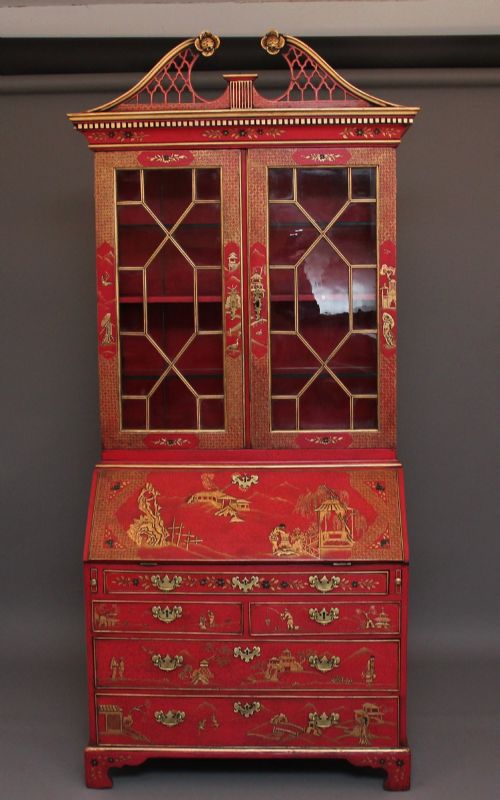


Lacquered Slant Front Bureau
A lacquered slant front bureau brings together rich decorative finishes and practical writing storage from several centuries.
Lacquered Slant Front Bureau
A lacquered slant front bureau is a fitted writing desk with an angled fall-front lid that conceals internal compartments and pigeonholes. When buyers search for this phrase, they find writing furniture finished in decorative surface coatings, ranging from tall bookcase combinations to compact tabletop examples.
The pieces on this page span several distinct periods, including pieces from the eighteenth century, Georgian eras, and early twentieth century revivals. Forms vary from full-height bureau bookcases to smaller toilet mirrors with miniature bureau bases and travelling writing desks.
Chinoiserie and Queen Anne styles dominate the design vocabulary, alongside Venetian Rococo and William and Mary influences. Buyers encounter black japanned finishes, red lacquered surfaces, and gilt detailing across these distinct historical periods.
How they were made
Construction relies upon wooden carcases finished with specialist lacquer, gold leaf, and gilt details applied over prepared surfaces. Artisans built these pieces using timber frames designed to hold decorative paintwork and polished glass panels.
Metal hardware such as brass handles and hinges provide structural and decorative accents on the drawers and fall-front lids. Pine and other foundational woods form the internal structures beneath the exterior lacquer and gilt ornament.
Listings feature pieces spanning from 1700 through the Georgian era to the Edwardian period and the 1920s.
What varies in quality
The refinement of the hand-painted Chinoiserie scenes and the depth of the gilt work dictate the visual success of the piece. Earlier eighteenth-century examples display intricate surface detailing that contrasts with the simpler execution found in later revivals.
The integrity of the lacquer finish and the preservation of the original gilt layer determine how well the decorative scheme survives. Comprehensive bureau bookcase forms require balanced proportions between the upper glazed shelving and the lower writing compartment.
The Lacquered Slant Front Bureau Glossary
- Slant front bureau
- A desk featuring a hinged, sloping lid that opens to reveal a writing surface and small drawers. This form provides enclosed storage for correspondence and writing materials.
- Bureau bookcase
- A combination furniture piece featuring a writing bureau base beneath an upper shelving or cabinet section. These tall pieces often incorporate glass-fronted doors.
- Japanning
- A European technique of finishing wood with hard, resinous varnishes that imitated Japanese lacquerwork. This process involved layered coatings and metallic dust decorations.
- Toilet mirror with miniature bureau base
- A small tabletop looking glass mounted above a compact set of drawers shaped like a desk. These diminutive pieces served personal grooming and storage needs.
Lacquered Slant Front Bureau: Frequently Asked Questions
What is a lacquered slant front bureau?
A lacquered slant front bureau is a writing desk featuring an angled hinged lid and a decorative surface finish. These pieces combine enclosed storage compartments with distinctive painted or japanned exterior decoration.
They appear in various forms, from compact tabletop mirrors to large bureau bookcases designed for formal reception rooms.
How do I date a lacquered bureau?
Dating relies upon construction methods, timber selection, and the specific style of the lacquer and gilt decoration. Eighteenth-century examples display different handling of Chinoiserie motifs compared to Edwardian or 1920s revivals.
Examining the internal drawer construction and hardware fixings helps establish the period of manufacture.
Where were these bureaux used?
These desks served as private writing spaces in principal rooms, bedchambers, and libraries of historical homes. The bureau bookcase variations offered display space for books alongside practical writing surfaces.
Compact travelling versions and miniature desk bases were designed for portability or intimate dressing room use.
How do I care for antique lacquer?
Antique lacquer requires stable environmental conditions away from direct sunlight and excessive humidity. Regular dusting with a soft, dry cloth preserves the delicate gilt and painted surfaces without abrasion.
Avoid using modern chemical cleaning products or liquid polishes on these historic decorative finishes.