
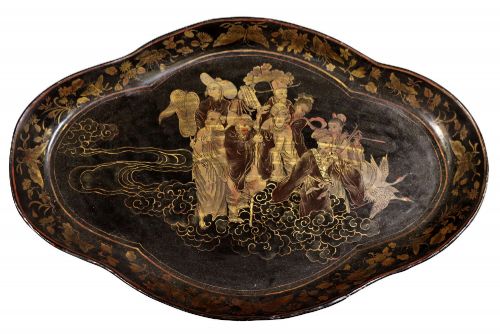


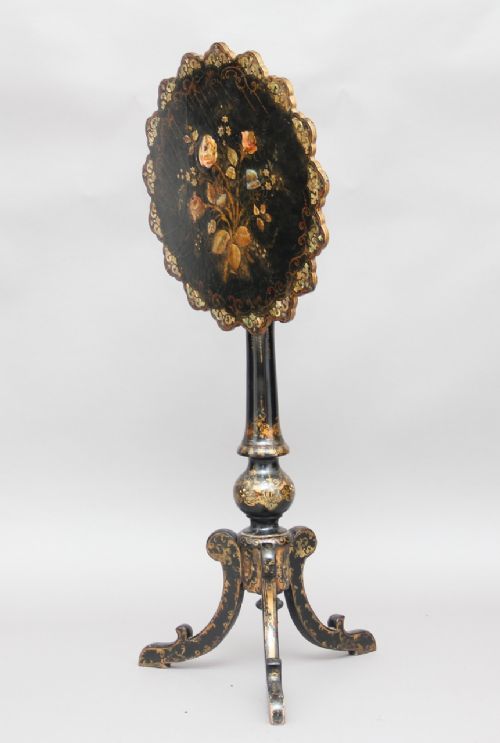


Chinoiserie Papier Mache Table
These chinoiserie papier mache table examples bring together hand-painted Orientalist scenes and sturdy wooden stands, offering practical surfaces with distinct historical character.
Chinoiserie Papier Mache Table
A chinoiserie papier mache table typically combines a portable serving tray with a folding or fixed wooden stand, creating a versatile occasional piece. Buyers searching this phrase encounter nineteenth-century pieces alongside later twentieth-century interpretations, including tray tables, coffee tables, and occasional stands.
The dominant form on this page pairs a moulded papier-mâché tray featuring gilt and painted oriental motifs with a sturdy timber base. These items span periods from the Regency era through to the Victorian epoch, with occasional twentieth-century adaptations appearing in the listings.
Materials and Construction
Craftsmen built the primary surfaces using compressed paper pulp mixed with binding agents, which dried into a remarkably tough, lightweight board. Artisans then applied layers of dark lacquer and detailed hand-painted designs enriched with gold leaf and gilt highlights.
Listings on this site demonstrate that these items frequently utilise papier-mâché combined with lacquer, wood, and gold leaf across nineteenth-century and Victorian periods.
Assessing Craftsmanship
Quality in a chinoiserie papier mache table rests principally on the crispness and complexity of the hand-painted decoration. Superior examples display intricate figures, pavilions, and landscapes rendered in rich gold leaf rather than simpler stencilled patterns.
The structural integrity of both the papier-mâché tray and its supporting stand dictates the overall standard. Finer pieces maintain smooth, stable surfaces without extensive cracking to the lacquer, paired with robust timber bases that properly support the tray.
Gillows
The Chinoiserie Papier Mache Table Glossary
- Papier-mâché
- A composite material made from paper pulp or layers of paper reinforced with glue, moulded and dried to form a rigid surface. This substance forms the foundational tray of the table.
- Chinoiserie
- A European artistic style reflecting Chinese and East Asian motifs, popular in furniture decoration. Artisans applied these imaginative landscapes and figures using paint and gold leaf.
- Lacquer
- A clear or coloured varnish applied in multiple coats to produce a hard, durable, and glossy finish. It protects the painted scenes on the tray surface.
- Tray table
- An item comprising a removable serving tray set upon a dedicated supporting stand. This dual-purpose form allows the surface to be lifted off independently.
- Gilt
- A thin layer of gold or gold-like material applied to decorate surfaces. It highlights the intricate details within the painted chinoiserie scenes.
Chinoiserie Papier Mache Table: Frequently Asked Questions
How were these tables originally used?
These pieces served primarily as portable serving trays that could be placed upon dedicated folding or fixed stands when required for entertaining.
Owners utilised the removable top to serve drinks or food in formal reception rooms before mounting it on the frame to create an occasional surface.
What periods do these tables represent?
The examples listed span from the Regency era and the nineteenth century through to Victorian times and twentieth-century revivals.
Earlier pieces typically feature hand-painted Regency details, while Victorian and later twentieth-century items incorporate ebonised finishes and alternative decorative interpretations.
How do I care for papier-mâché surfaces?
Keep these tables away from direct sunlight and excessive moisture to protect the delicate lacquer and gold leaf decoration from deterioration.
Dust the surface gently with a soft, dry cloth and avoid using liquid polishes or harsh chemical cleaners that might damage the painted finish.
Are the trays removable from the stands?
Most pieces on this page consist of a distinct serving tray resting freely upon a separate wooden or bamboo-style stand.
This traditional construction allowed the flat top to be lifted off easily, though some later or adapted variations secure the tray more permanently to the base.