


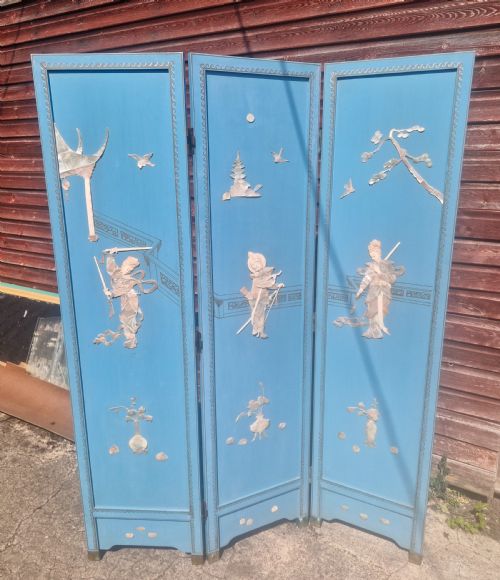


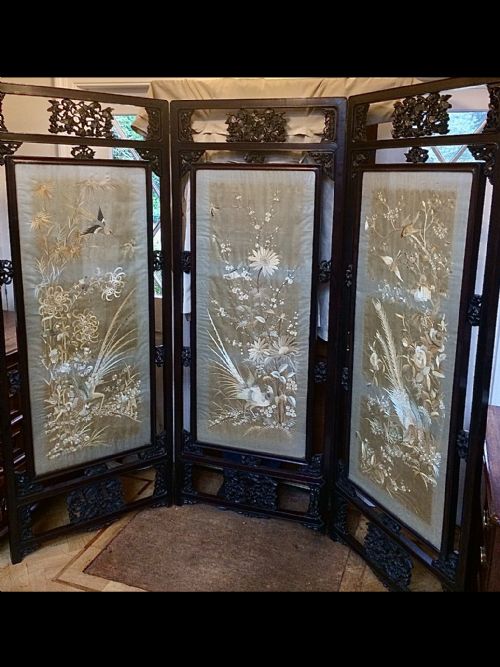


Chinoiserie Floor Screen
These chinoiserie floor screen pieces bring hand-finished lacquer and painted panels into a room, offering both decorative division and striking visual depth.
Chinoiserie Floor Screen
When you search for a chinoiserie floor screen, you encounter folding panels designed to divide interior spaces while displaying ornate Asian-inspired ornamentation. These pieces range from eighteenth-century coromandel lacquer examples to mid-century folding screens.
You are most likely to meet multi-fold panels featuring lacquer finishes, painted room dividers, and traditional motifs. The selection includes items spanning the nineteenth and twentieth centuries, alongside earlier works.
How they were made
Wood serves as the primary structural foundation for these folding screens, providing the necessary rigidity for multi-panel construction. Artisans apply layers of lacquer to build the distinct glossy surface characteristic of these pieces.
Decoration involves polychrome pigment, gold leaf, and intricate mother-of-pearl or hardstone inlays mounted directly onto the surface. Carving techniques appear on elements such as dragon-carved wooden frames, combining relief work with flat painted scenes.
Chinoiserie Floor Screen Retail Price Guide 2026
Typical asking prices for chinoiserie floor screen among the pieces listed under this phrase on Sellingantiques today, from the lower quarter to the upper quarter. They describe what is for sale here now, not the wider market.
Materials recorded across these items include wood, lacquer, brass, hardstone, mother-of-pearl, and gold leaf.
What varies in quality
The sophistication of the surface decoration defines the upper tiers of quality, seen in the depth of carved coromandel lacquer and the precision of applied hardstone or mother-of-pearl. Simpler painted room dividers present less intricate detailing compared to heavily inlaid or multi-fold antique examples.
Age and material complexity also distinguish the pieces, with eighteenth-century works and deep lacquer panels showing greater craft investment than mid-century iterations.
The Chinoiserie Floor Screen Glossary
- Coromandel lacquer
- A Chinese incised lacquer technique where the design is carved into a built-up ground, filled with colour, and sealed. This method creates recessed details across large folding panels.
- Hardstone
- Minerals such as soapstone used for three-dimensional decorative inlays mounted onto lacquer screens. These elements provide tactile relief against flat painted backgrounds.
- Polychrome
- The application of multiple distinct colours in the painted surface decoration of a screen. This technique brings pictorial scenes to life across various panels.
- Fold
- An individual vertical panel that connects to adjacent sections with hinges to form the complete screen. Screens in this category typically range from three panels up to eight folds.
Chinoiserie Floor Screen: Frequently Asked Questions
How do I place a floor screen?
These folding panels work best positioned against a plain wall to highlight their painted details, or angled to partition a large room.
Ensure the panels rest on stable flooring so the hinges bear weight evenly across every fold.
What periods do these screens cover?
The available pieces span from the eighteenth century through the nineteenth century and into the mid-twentieth century.
Earlier items often feature coromandel lacquer, while later examples include twentieth-century dressing screens.
How many panels do they have?
The listings include screens with three, four, six, and eight folding panels.
Larger eight-fold screens create substantial visual barriers, whereas smaller three-fold versions suit compact spaces.
What materials are used?
Construction relies primarily on wood and lacquer, frequently enhanced with gold leaf, brass, and polychrome pigment.
Certain pieces incorporate raised details through mother-of-pearl, hardstone, and soapstone mounts.