
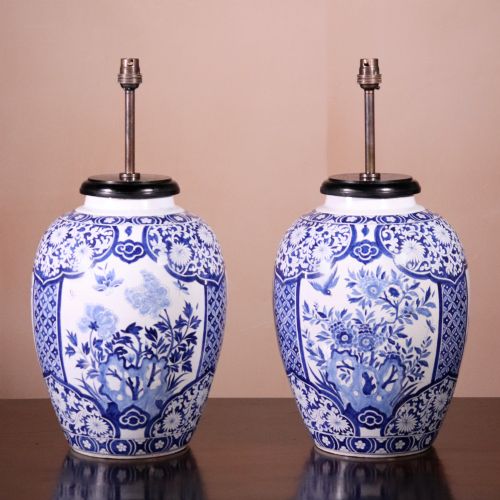


Chinese Porcelain Jar Lamp
A Chinese porcelain jar lamp brings hand-painted colour and historical depth into a room, sitting best upon a side table or sideboard.
Chinese Porcelain Jar Lamp
When you search for a Chinese porcelain jar lamp, you are looking at ceramic vessels that have been converted into table lamps. These pieces originate primarily from the nineteenth century, utilising blue and white, powder blue, celadon, and famille rose glazes.
The forms you meet most often on this page are ginger jars and baluster vases mounted for electricity. Many survive in pairs, while others appear as single monumental pieces.
Styles range from traditional Qing Dynasty export ware to nineteenth-century French Chinoiserie interpretations. Each object combines Far Eastern ceramic traditions with European lighting mounts.
How they were made
The foundation of every piece is hard-paste porcelain, thrown and shaped before receiving hand-painted enamel or cobalt decoration under the glaze. Artisans applied complex palettes including famille verte, famille noire, and rose medallion before high-temperature firing.
Once imported to Europe, these jars were often fitted with brass, ormolu, and gold leaf mounts by skilled metalworkers. Wooden bases and silk or fabric shades completed the transformation from vessel to lamp.
What varies in quality
The distinction between standard and superior pieces rests upon the precision of the hand-painted brushwork and the depth of the porcelain glaze. Finely detailed prunus blossom motifs and crisp blue and white cobalt tones elevate a jar above simpler production.
Quality also depends upon the integration and metalwork of the ormolu and brass mounts. Heavy, crisply chased bronze mounts demonstrate greater workshop skill than plain wooden or basic brass fittings.
Samson Porcelain
The Chinese Porcelain Jar Lamp Glossary
- Famille Rose
- A palette of opaque enamels dominated by pink or rose colours, introduced during the Qing Dynasty. It allows for subtle shading of floral and figurative scenes.
- Celadon
- A pale green jade-like glaze achieved through iron oxide in the reduction kiln. The subtle tone highlights the carved or moulded details beneath.
- Ormolu
- Gilded bronze used widely for decorative mounts on nineteenth-century European lighting. It frames the ceramic body with polished metallic contrast.
- Ginger Jar
- A broad-shouldered storage jar with a domed lid, frequently adapted for domestic interiors. Their generous proportions provide an ideal canvas for intricate hand-painted decoration.
- Crackleware
- A porcelain glaze intentionally patterned with a network of fine microscopic cracks. This finish mimics ancient ceramic styles prized by collectors.
Chinese Porcelain Jar Lamp: Frequently Asked Questions
How do I clean a porcelain lamp?
Dust the porcelain body gently with a dry, soft cloth to prevent accumulation. Avoid harsh chemical cleaners that might damage the antique glaze or enamel decoration.
Keep fabric or silk shades separate and brush them lightly with a soft-bristled attachment. Ensure the lamp is unplugged before undertaking any routine maintenance.
Are these lamps originally electrified?
Nineteenth-century Chinese jars were originally created as storage vessels or decorative vases, not as electrical light fittings. European workshops subsequently drilled or fitted them with metal mounts to accommodate wiring.
This conversion process happened at various points in history. Buyers should examine the wiring and consult an electrician to ensure modern safety standards.
How do I style a pair of lamps?
Symmetrical placement upon matching sideboards or heavy timber side tables creates visual balance in a traditional or eclectic interior. Their height and painted surfaces draw the eye upward as focal points.
Single lamps work effectively on narrower hallway consoles or reading desks. Choose fabric shades that complement the dominant blue, green, or pink tones of the glaze.
What is Chinese export porcelain?
Chinese export porcelain refers to wares manufactured in China specifically for overseas markets in Europe and the Americas. These pieces often blend traditional Eastern motifs with Western decorative demands.
Such items arrived via maritime trade routes during the Qing Dynasty. They formed the basis for much of the Chinoiserie taste in nineteenth-century interiors.