
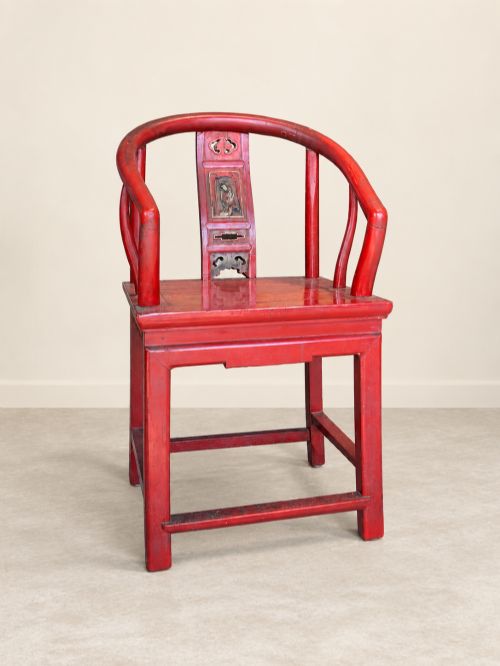
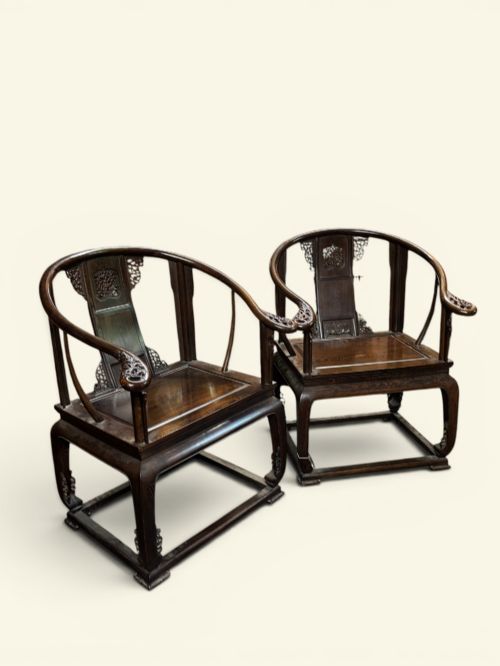


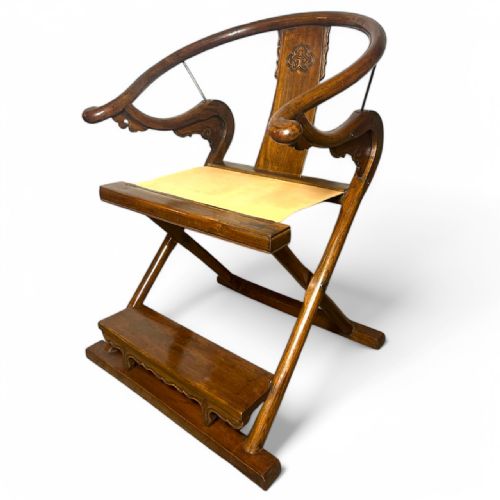


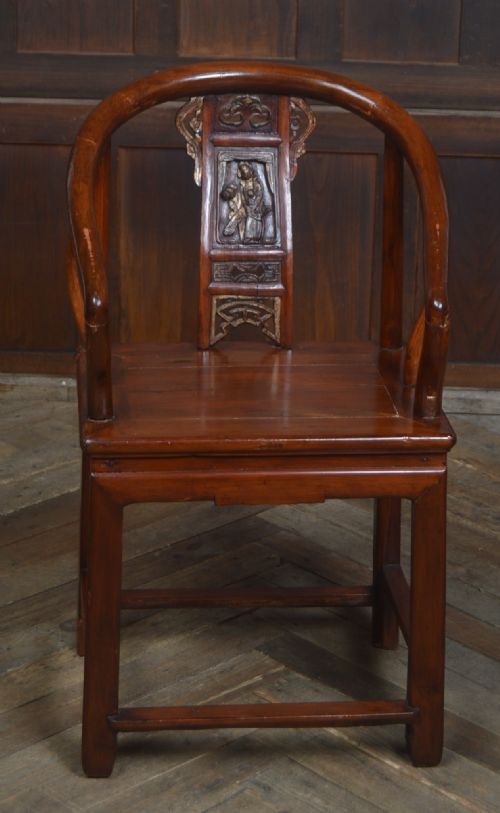
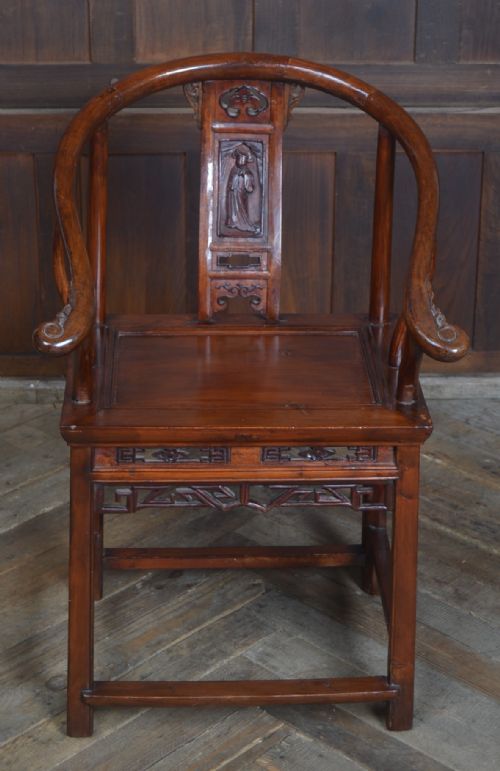

Chinese Horseshoe Armchair
A Chinese horseshoe armchair brings a continuous, sweeping curved rail and balanced proportions into a room.
Chinese Horseshoe Armchair
A Chinese horseshoe armchair is a distinctive seating form defined by its circular backrail that flows down into armrests. The pieces on this page span several centuries, including examples from the eighteenth, nineteenth, and early twentieth centuries.
You will encounter various interpretations of the Chinese horseshoe armchair here, ranging from traditional elm and hardwood frames to lacquered surfaces and brass-inlaid details. Some examples are rigid armchairs, while others feature folding frames or bench adaptations.
Makers drew on Qing dynasty aesthetics, Ming style traditions, and Edwardian tastes to produce these chairs. The selection includes individual seats as well as matched pairs and broader seating sets.
How they were made
Wood selection is central to the construction, with elm, hardwood, and dark polished timber forming the primary structural frames. Artisans also incorporated bamboo and cane-work elements into specific regional variations.
Surface treatments range from clear polishing that reveals the grain to painted finishes, lacquer, and brass inlays. Joinery traditions allowed these sweeping backrails and folding mechanisms to retain their structural integrity over centuries.
Some horseshoes double as settling benches, proving that ancient scholars enjoyed a wider seat.
What varies in quality
Quality separates through the integrity of the joinery along the sweeping backrail and the crispness of any applied brass inlay or carved detail. Dense hardwoods and well-preserved lacquer command greater interest than simpler painted pine or softwoods.
The survival of original surface finishes, whether polished timber or traditional lacquer, dictates the visual authority of the piece. Matching pairs demonstrate a higher level of original intent than assembled single chairs.
The Chinese Horseshoe Armchair Glossary
- Horseshoe-back
- A continuous curved top rail that forms the back and sweeps forward to serve as armrests. This ergonomic shape originates from classical Chinese seating design.
- Qing Dynasty
- The final imperial dynasty of China, lasting from the mid-seventeenth to the early twentieth century. Many decorative arts and furniture styles derive from this prolonged era.
- Ming Style
- A furniture aesthetic focused on clean lines, restrained ornamentation, and advanced joinery. Pieces in this tradition rely on the natural grain of hardwoods.
- Lacquered
- Coated with multiple layers of resin to produce a smooth, protective, and decorative surface. This technique requires considerable time and skill to execute properly.
- Elm
- A durable, fibrous timber frequently utilised in traditional Chinese regional furniture. It accepts carving well and displays a pronounced, attractive grain.
Chinese Horseshoe Armchair: Frequently Asked Questions
How do I style a horseshoe armchair?
A horseshoe armchair works well as an accent piece in a contemporary or traditional room. Its curved silhouette contrasts sharply with linear modern upholstery.
Position the chair where the sweeping backrail can be appreciated from multiple angles, such as a corner or opposite a low sofa.
Are these chairs comfortable?
The curved rail wraps around the sitter to provide natural arm support. Many examples are designed for upright posture rather than deep lounging.
Adding a small silk or linen squab cushion can alter the seat height and soften the timber base for extended sitting.
How do I date an antique Chinese chair?
Dating relies on timber species, joinery construction methods, and the wear patterns on the feet and armrests. Earlier pieces often display simpler, heavier hardwood frames.
Surface finishes like early lacquer or patinated elm also offer clues to the period of manufacture.
Can I use a folding armchair daily?
Folding horseshoe armchairs were originally designed for portability among the elite. The hinged mechanisms require careful handling.
While functional, antique folding examples benefit from gentle use to preserve the historical pivots and braces.