
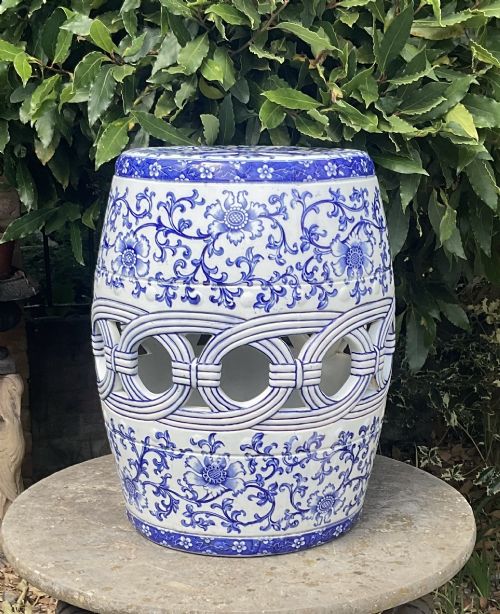


Chinese Garden Seat
A Chinese garden seat brings structural weight and botanical pattern to a room, functioning equally well as a low table or a stool.
Chinese Garden Seat
A Chinese garden seat is a barrel-shaped or drum-formed vessel originally designed for outdoor use but now widely deployed indoors as a side table or accent stool. The form is rooted in traditional ceramic and hardwood traditions, appearing frequently in nineteenth-century designs influenced by Qing Dynasty aesthetics.
The versions most commonly met on this page span the nineteenth century, including blue and white pottery, famille rose porcelain, and carved hongmu or hardwood. English makers also interpreted the form, resulting in nineteenth-century clobbered ironstone and Staffordshire pottery examples alongside imported Chinese originals.
Materials and construction methods
Ceramic pieces rely on porcelain, glazed earthenware, and pottery bodies shaped into hollow barrels and finished with enamel, glaze, or underglaze blue and white painting. Staffordshire and Minton examples demonstrate European mastery of these Asian-inspired ceramic techniques during the Victorian era.
Wooden equivalents utilise dense hardwoods such as hongmu and teak, often heavily carved and inlaid with materials like mother-of-pearl. These pieces combine traditional joinery with barrel-form silhouettes, mirroring the structural profile of their ceramic counterparts.
Elephants occasionally support the seat, turning a simple garden barrel into a sculptural beast.
Distinguishing quality in the range
Quality rests in the crispness of the hand-painted enamels, the depth of the famille rose or blue and white pigments, and the intricacy of the porcelain body. Heavily potted ceramics with clean glaze application represent a higher standard of production.
In wooden examples, the quality is measured by the precision of the carving in the hongmu and the refinement of mother-of-pearl inlay. Solid construction and balanced proportions distinguish the finer accent stools and tables from simpler regional variants.
The Chinese Garden Seat Glossary
- Famille rose
- A major palette of Chinese ceramic glazes introduced in the eighteenth century, dominated by opaque pink enamel. This style persists into nineteenth-century porcelain production.
- Hongmu
- A traditional Chinese term for dense, dark hardwoods used in fine furniture. It translates literally to red wood.
- Clobbered
- A ceramic term for older underglaze blue pottery or porcelain that has been decorated overseas with overglaze enamels and refired. This practice created colourful hybrid pieces.
- Chinoiserie
- The European interpretation of Chinese and East Asian artistic traditions. It shaped decorative arts and furnishings throughout the eighteenth and nineteenth centuries.
- Ironstone
- A heavy, durable type of earthenware patented in the nineteenth century. It serves as a sturdy substitute for porcelain.
Chinese Garden Seat: Frequently Asked Questions
Were these seats actually used in gardens?
Ceramic and glazed terracotta versions were traditionally designed for use in courtyards and gardens, resistant to weather and damp conditions. Hardwood varieties were intended primarily for interior domestic spaces.
Over time, collectors and decorators have moved both ceramic and wooden forms indoors, where they serve as occasional tables, plant stands, and extra seating.
How do I tell Chinese originals from English copies?
Examination of the paste, glaze characteristics, and potting style helps separate imported Chinese porcelain and hongmu from European interpretations. British makers such as Minton and Copeland Spode produced distinct earthenware and pottery variants.
Markings, weight, and the specific application of blue and white or enamelled decoration provide further clues to regional origin and period.
Can I use a ceramic garden seat outside?
Many nineteenth-century ceramic and glazed earthenware pieces withstand mild outdoor conditions, but historical examples are often sensitive to frost. Freezing water can crack antique ceramic bodies.
Most owners choose to keep antique and nineteenth-century pieces indoors to protect the glaze and enamel from weathering.
What is the difference between a garden seat and a side table?
The structural barrel or drum form allows these objects to function interchangeably as low tables or stools. Flat tops and stable bases support drinks, lamps, or weight as a seat.
Hardwood and ceramic versions share this versatile silhouette, whether described as a stool, barrel, or occasional table in the listing.