
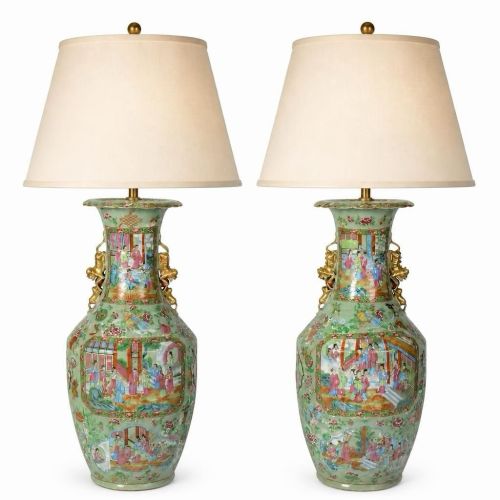


Chinese Famille Rose Lamps
Chinese famille rose lamps combine hand-painted porcelain with electrical fittings to create decorative table lights.
Chinese Famille Rose Lamps
When searching for chinese famille rose lamps, buyers encounter converted antique vessels carrying hand-painted enamel decoration from the nineteenth and early twentieth centuries. These pieces originate as porcelain vases, ginger jars or lidded vessels before receiving subsequent adaptations for domestic illumination.
The inventory on this page consists predominantly of nineteenth-century pieces, including pairs of table lamps and individual specimens. Many examples display traditional forms mounted with brass, ormolu or gilt bronze alongside fabric or silk shades.
How they were made
Potters shaped the ceramic bodies from porcelain and applied opaque enamel colours, characteristic of the famille rose palette, before firing the vessels. Subsequent metalworkers added brass or ormolu mounts to secure the electrical components and elevate the display.
Textiles such as silk and fabric formed the accompanying shades, completing the conversion from traditional Chinese export vases into functional table lamps.
Several ginger jars abandoned their original kitchen duties to become illuminated companions beside Victorian reading chairs.
What varies in quality
The refinement of the hand-painted enamel work dictates the visual distinction between individual examples, with finer brushwork displaying greater detail in figures, flora and fauna. The integration of metal mounts, whether ormolu, gilt bronze or brass, also influences the overall execution.
Proportion and symmetry between paired vases determine the balance of the composition, particularly in matching sets adapted from nineteenth-century porcelain.
Samson Porcelain
The Chinese Famille Rose Lamps Glossary
- Famille Rose
- A ceramic palette defined by opaque pink or rose enamel colours introduced during the Qing Dynasty. This technique allowed artists to achieve delicate tonal gradations on porcelain surfaces.
- Ormolu
- Gilt bronze applied as decorative mounts to furniture and ceramics. Makers utilised this French technique to embellish nineteenth-century porcelain lamps.
- Ginger Jar
- A high-shouldered storage vessel with a domed lid, frequently adapted into a table lamp. These jars often feature elaborate enamel panels showing domestic scenes.
- Rose Medallion
- A specific style of Cantonese porcelain decoration featuring distinct panels filled with figures, birds and flowers. The design utilises vibrant enamel colours arranged in symmetrical patterns.
Chinese Famille Rose Lamps: Frequently Asked Questions
Are these lamps converted from original vases?
Most pieces began life as nineteenth-century Chinese export vases or ginger jars before being adapted into table lamps. Artisans added electrical wiring and metal mounts during this conversion process.
Original ceramic bodies retain their hand-painted enamel decoration from the Qing period, while the fittings represent later modifications for modern use.
How do I identify a nineteenth-century piece?
Nineteenth-century examples display hand-mixed enamel colours typical of the period, often showing subtle variations in the porcelain body and hand-painted details. Look for traditional Cantonese motifs and Qing Dynasty stylistic conventions.
Metal components such as brass or ormolu mounts frequently exhibit the wear and patination associated with Victorian or nineteenth-century manufacture.
What is the difference between famille rose and famille verte?
Famille rose relies on an opaque pink or carmine enamel introduced in the eighteenth century, allowing for softer blended shades. Famille verte depends primarily on green enamel tones within a contrasting palette.
Both styles appear on nineteenth-century porcelain vessels adapted into decorative table lamps.
Do these lamps come with shades?
Many listings include fabric or silk shades that complement the proportions of the ceramic bases. These shades are frequently later additions chosen to match the colour palette of the porcelain.
Buyers should review individual descriptions to confirm whether a shade is included with the lamp.