


Chinese Export Jewellery
Chinese export jewellery brings together fine silver, lacquer and jade made for Western markets during the nineteenth and early twentieth centuries.
Chinese Export Jewellery
Chinese export jewellery and small decorative accessories encompass items produced in styles tailored for international trade during the nineteenth and early twentieth centuries. These pieces reflect a distinct blend of traditional craftsmanship and foreign taste that defined the treaty ports and global markets of the era.
Pieces from this category draw on aesthetic traditions associated with the Qing Dynasty and Straits Chinese Peranakan culture. Collectors encounter items marked by distinct regional aesthetics ranging from mid nineteenth century craftsmanship up to the 1930s.
How they were made
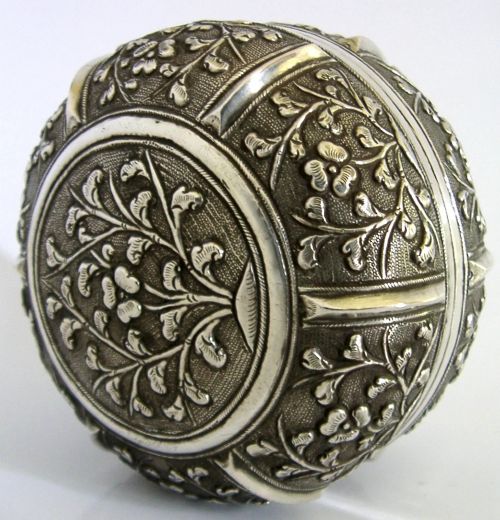
Makers utilised solid silver and gilt silver for structural components, often employing fine filigree wirework to create intricate openwork patterns on brooches and belt buckles. Enamel work frequently adds colour to these metallic surfaces, contrasting with the polished silver and gold elements.
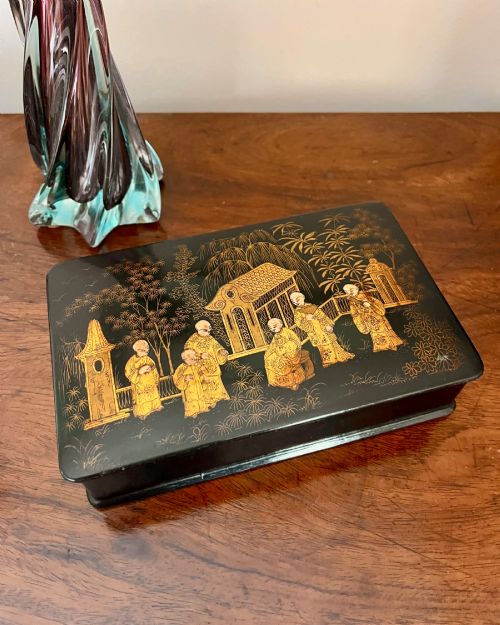
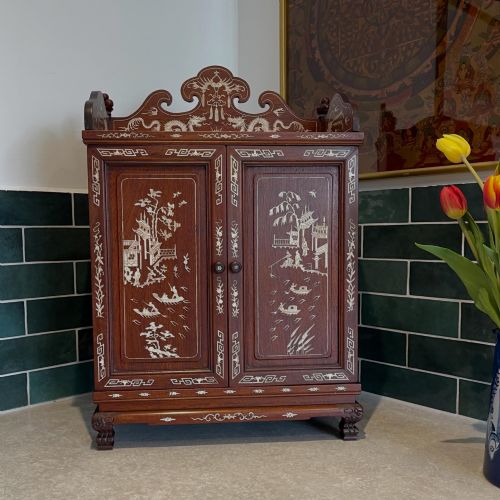
Lacquered wood forms the basis for table cabinets and keepsake boxes, decorated with gold leaf and detailed painting typical of chinoiserie and Qing Dynasty traditions. Mother of pearl also appears as an inlay material, adding tonal variety to wooden surfaces.
A silver dragon box by Wang Hing & Company proves that mythological beasts make surprisingly orderly keepers for small trinkets.
What varies in quality
The distinction between standard commercial output and exceptional work lies in the precision of the metalwork and the depth of the carved or painted surface decoration. Fine filigree requires delicate soldering and symmetry, while superior lacquer work displays multiple applied layers with crisp, enduring gilded motifs.
Maker marks and regional silver hallmarks provide an indication of workshop origin, with established names adding historical interest to the physical construction of the piece.
Wang Hing & Company
The Chinese Export Jewellery Glossary
- Chinese Export
- Goods manufactured in China specifically for Western markets, adapting traditional techniques to foreign tastes. This category covers both personal adornments and decorative household containers.
- Filigree
- Ornamental work consisting of fine wire, usually of silver or gold, soldered together to form open lace-like patterns. It is frequently seen on export brooches and decorative metal accessories.
- Straits Chinese
- Cultural artefacts and personal items associated with the Peranakan Chinese communities of the Malay Peninsula. These pieces often feature distinctive gilt silver work and vibrant ornamentation.
- Chinoiserie
- European artistic styles reflecting Chinese motifs, though pieces produced within China for export often combine indigenous craftsmanship with Western functional forms.
- Qing Dynasty
- The final imperial dynasty of China, spanning from the seventeenth to the early twentieth century. Many export pieces draw directly upon the decorative arts developed during this period.
Chinese Export Jewellery: Frequently Asked Questions
What is chinese export jewellery?
These pieces comprise wearable items and small accessories made in China for international buyers during the nineteenth and early twentieth centuries.
They combine local craftsmanship with the forms and styles demanded by Western markets of the period.
How do I date a piece?
Dating relies on stylistic clues, material choices and any visible maker marks or silver hallmarks stamped into the metal.
Nineteenth-century items often show heavier Qing Dynasty influences, whereas 1930s examples reflect changing twentieth-century tastes.
How were silver items decorated?
Silversmiths employed detailed filigree wirework, dimensional dragon motifs and applied enamel to create textured metallic surfaces.
Straits Chinese pieces additionally utilised heavy gilding on solid silver belt buckles and decorative mountings.
How do I care for lacquer boxes?
Lacquered table cabinets and keepsake boxes require stable environmental conditions away from direct sunlight and extreme humidity.
Gentle dusting with a soft, dry cloth preserves the fragile gilded decoration and the underlying wooden structure.