







Chinese Enamel Lamps
These Chinese enamel lamps bring rich colour and texture to a room, pairing antique vases with practical illumination.
Chinese Enamel Lamps
Chinese enamel lamps unite antique Far Eastern vessel forms with the wiring and fittings required for modern interiors. You will frequently find pairs of converted vases, many dating from the nineteenth century or the early twentieth century.
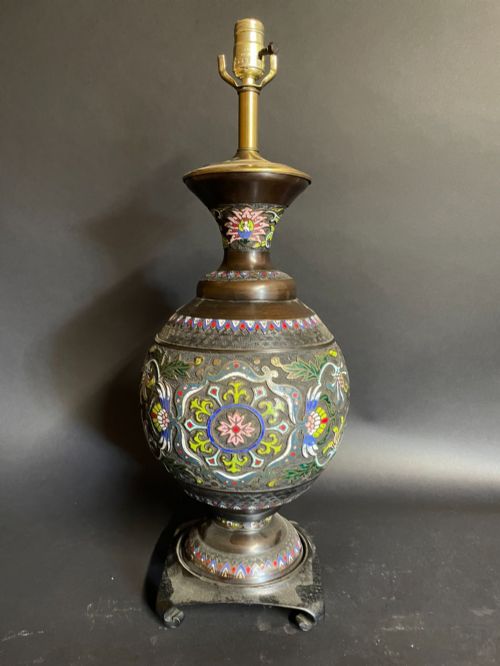
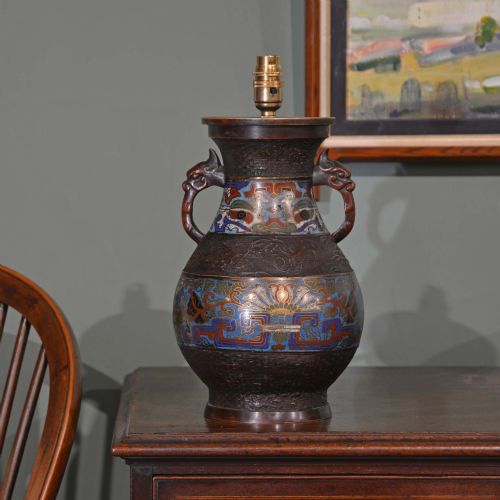
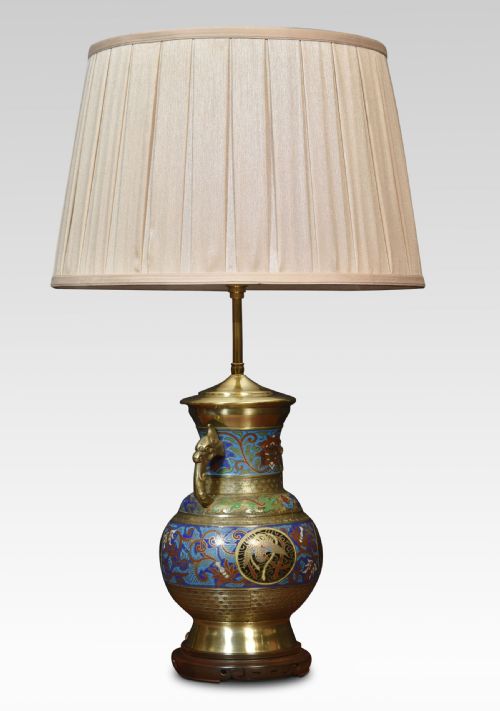
The body of each piece typically originates as a decorative vase, such as a cloisonne enamel vessel or a painted porcelain piece in the famille rose or rose medallion style. Dealers and former owners have mounted these onto bases and fitted them to serve as table lamps.
Origins span Qing Dynasty workshops, nineteenth century oriental production, and Chinese export or Republic periods. Many retain their original brass or gilt bronze mounts, often configured with fabric shades.
Materials and Construction
Makers formed the core structures using copper, brass, or bronze, often applying intricate wirework cells for cloisonne enamel surfaces. Artisans also utilised porcelain for painted bodies, decorating them with vibrant enamels in famille rose and famille verte palettes.
Metalworkers added ormolu and gilt bronze mounts to secure the vessels and provide stable bases for electrical components. Wood frequently supports the internal or base structure of these converted lamps.
Some nineteenth century vases spent decades holding dried flowers before finally getting wired for electricity.
Assessing Quality and Finish
Quality rests on the crispness of the enamel work and the artistry of the painted or cloisonne surface. Pieces featuring dense, multi-coloured wirework or finely detailed floral and figural painting sit firmly at the higher end.
The integration of the metal mounts also defines the piece, with heavier ormolu and gilt bronze fittings showing superior craftsmanship. Matching pairs consistently demonstrate a higher level of original workshop output than single mismatched conversions.
The Chinese Enamel Lamps Glossary
- Cloisonne Enamel
- A metalwork technique where thin flat wires are soldered to a metal base to form compartments, which are then filled with coloured glass paste and fired. This creates intricate geometric and floral patterns across the surface.
- Famille Rose
- A palette of opaque rose-pink enamel introduced in Chinese porcelain decoration during the eighteenth century. It allowed artists to achieve delicate shading and botanical detail.
- Ormolu
- Finely ground high-carat gold cast and chased onto a bronze or brass object. It provides a rich, warm metallic lustre on the mounts of many antique lamps.
- Rose Medallion
- A distinct style of Chinese export porcelain decoration divided into alternating panels of figures and birds or flowers, filled with vibrant pink enamel. These patterns dominate nineteenth century export wares.
Chinese Enamel Lamps: Frequently Asked Questions
Are these lamps converted antiques?
Most of these pieces started life as decorative vases or vessel bases before being fitted for electricity. Artisans mounted them to function as practical table lamps while preserving the antique body.
This conversion process typically respects the original vessel, allowing the decorative cloisonne or porcelain work to remain the focal point of the lighting fixture.
What periods do these lamps come from?
The selection primarily spans the nineteenth century, including Qing Dynasty and Chinese export periods, alongside early twentieth century pieces. You will also encounter specific decade markers such as the 1870s, 1880s, 1890s, and 1920s.
These dates refer to the manufacturing era of the core vase or vessel rather than the date of the electrical conversion.
Do these lamps come in pairs?
A significant portion of the available pieces are offered as matched pairs, particularly among the cloisonne enamel and rose medallion vase conversions. These pairs provide symmetrical options for sideboards or mantelpieces.
Single lamp bases also appear in the listings for more focused placement in smaller spaces.
What materials are used in these lamps?
The primary bodies consist of enamel, cloisonne enamel, and porcelain featuring famille rose and famille verte palettes. Supporting elements incorporate brass, copper, bronze, gilt bronze, ormolu, and wood.
Fabric is commonly used for the accompanying lamp shades that complete the assembled fixtures.